
died c. 678·Feast July 21
St. Arbogast
Missionary Bishop of Strasbourg in the Frankish Empire
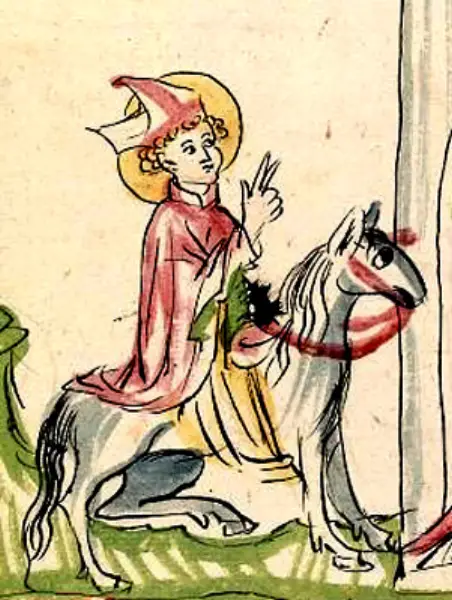
Overview
Arbogast carried the Christian faith to the Franks in the seventh century and governed the see of Strasbourg as one of its earliest bishops; ever afterwards he has been honoured as the saint who brought Christianity to Alsace. His origins remain uncertain, ancient testimony variously naming Scotland or Ireland, Aquitania, or Francia itself, but his life's work unfolded in the Merovingian kingdom, where he came to enjoy the warm friendship of King Dagobert. Upon Dagobert's accession, Arbogast was appointed Bishop of Strasbourg, and he became famed for sanctity and miracles. The most celebrated story of his life tells how he raised to life the king's son Siegebert, who had died after being thrown and trampled by his startled horse during a boar hunt near Ebersheim; when the grateful king offered him money, the bishop refused, asking instead that land be given for the building of a cathedral at Strasbourg. He raised for himself a modest retreat beyond the walls, where the waters of the Ill flowed, and thither he would often retire to pray. He died about 678 and was buried outside the city, on ground later deemed fit for a church. His name became especially popular in Alsace, and he is commemorated on 21 July.
The Complete Life
From Unknown Origins to the Frankish Court
Little of Arbogast's life can be stated with historical certainty. Even his homeland is a matter of conflicting testimony: ancient accounts variously make him a native of Scotland or Ireland, of Aquitania, or of Francia itself. Whatever the truth of his birth, his destiny lay in the Frankish kingdom, to which he came as a missionary of the Christian faith in the course of the seventh century. There providence opened for him the door of the royal court. He found a warm friend in the Merovingian king Dagobert, and the friendship between the holy bishop and the worldly monarch became the axis of his later career. Such favour at court was not without peril for a man of God, but Arbogast used it not for personal advancement; the sources portray him as a wonderworker whose sanctity, rather than his connections, drew the admiration of the Franks. By the time Dagobert ascended the throne, the missionary was ready for the office that would define his life: the episcopal governance of the young church of Strasbourg, a city whose conversion would be inseparably linked with his name.
§ Biography
Bishop of Strasbourg and the Raising of Siegebert
Upon Dagobert's accession to the throne, Arbogast was appointed Bishop of Strasbourg, and his episcopate was marked by a reputation for holiness and miracles. The most famous of these deeds concerns the king's own son. The young prince Siegebert had gone boar hunting with his father's huntsmen in the forests along the River Ill near Ebersheim, where he became separated from the company; startled by a boar, his horse reared, threw him, and trampled him while his foot hung caught in the stirrup. His companions carried him home, and there he died. Dagobert summoned the bishop, and Arbogast prayed to the Mother of God with a bold simplicity: she who had carried the life of the whole world would surely intercede for the life of one boy. At his prayer life returned to the prince, who rose from his bier still wrapped in the shroud of burial. Dagobert then offered gold to his son's restorer; Arbogast refused it, asking instead that land be donated for the building of a cathedral at Strasbourg — a request whose fruit was the foundation of the great church that would crown the city for centuries.
§ Biography
The Hermitage by the Ill and a Holy Death
Amid the duties of his see, Arbogast preserved the habits of a monk and missionary. He built a small hermitage outside the walls of Strasbourg on the banks of the River Ill, a retreat to which he had frequent recourse for prayer and solitude. There the bishop, shepherd of a growing Christian community, renewed in quiet the strength he spent in public labours. He died about the year 678 in Austrasia, the eastern heartland of the Frankish kingdom. In accordance with his wishes, or the custom of the age, he was buried outside the city. The accounts name two possible sites: the old Roman necropolis, or the slope of Hangman's Hill, a place of ill repute where a gallows stood and only malefactors were laid to rest. That such a place should receive the body of a saint was itself fitting testimony to the faith he preached; in time the site was judged suitable for a church, and a chapel was erected there in honour of St Michael. The gallows gave way to the altar, and the place of the condemned became a place of prayer.
§ Biography
The Apostle of Alsace
From the early medieval period onward Arbogast was venerated as the saint who brought Christianity to Alsace, and this enduring devotion shaped the culture of the region profoundly. So deeply was he honoured that his given name became especially popular among the people of the province, a rare monument of gratitude carried not in stone but in the names of generations of the faithful. His memory entered the art and heraldry of the German lands as well: Batzendorf bears his figure upon its heraldic arms, and the Alsatian Golden Legend of 1419 preserves a vivid picture of his solemn entry into Strasbourg. The medieval imagination preserved the miracle of Siegebert among the German legends gathered by the Brothers Grimm, ensuring that the story of the praying bishop and the risen prince passed into the folklore of the people. In the Catholic and Eastern Orthodox churches alike his feast is kept on 21 July. The cathedral he asked from the king remains the emblem of Strasbourg, and in it he is remembered as the apostolic founder of its faith.
§ Biography
The Record
- Major works
- Founding of the cathedral site at Strasbourg·Hermitage on the banks of the River Ill
- Patron of
- Christianity in Alsace·the city of Strasbourg
- Symbols
- bishop's crosier·cathedral model·resurrected youth
- Canonization
- Pre-congregation canonization; venerated from the early medieval period in the Catholic and Eastern Orthodox churches
Prayer
Bibliography
Show 5 sources
- Dechant, Lyle. "The Case of Arbogast: Image and Identity in a Swiss Gothic Parish Church", The Courtauld.
- Grattan-Flood, William. "St. Arbogast." The Catholic Encyclopedia Vol. 1. New York: Robert Appleton Company, 1907.
- Ward, Donald (1981). The German Legends of the Brothers Grimm, Vol. II. Philadelphia: Institute for the Study of Human Issues. p. 61. ISBN 0-915980-71-1.
- O'Hanlon, John. Lives of the Irish saints, Vol. 6, 1873, p. 285.
- Webb, Alfred (1878). "Arbogast". A Compendium of Irish Biography. Dublin: M. H. Gill & son.
Profile text adapted from the Wikipedia article, licensed CC BY-SA 4.0.
Pray with this saint every day
Save St. Arbogast to your favorites, read the full profile, and get feast-day reminders in the Saints app.
Get the Saints AppFree on the App Store for iPhone and iPad