
died c. 302·Feast January 12
St. Arcadius of Mauretania
Martyr of Caesarea
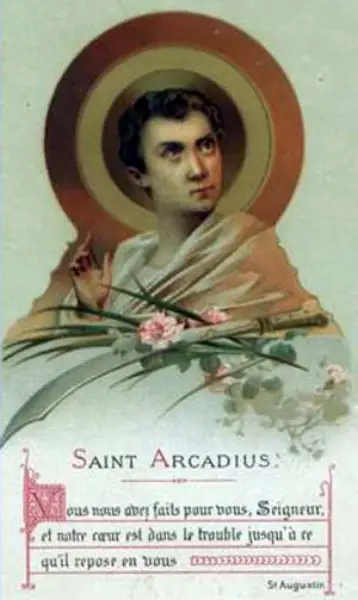
Overview
Arcadius of Mauretania is a martyr of the last great Roman persecution, put to death around 302 at Caesarea in Mauretania — modern Cherchell on the Algerian coast. The tradition makes him a prominent citizen of the city who, when the public sacrifices were enforced, withdrew to the countryside to avoid being compelled to worship the Roman gods. His absence was noticed; soldiers came to his house and, finding him gone, seized a relative in his place. When Arcadius heard of the arrest he returned and gave himself up to the governor. His death, as the legend tells it, ranks among the cruelest on record: executioners severed his limbs joint by joint until nothing remained but trunk and head, and looking — the story says — at the pieces of himself lying on the ground, he could still speak, addressing the scattered members with a blessing: happy now, they belonged at last entirely to God, all of them offered to him. His cult is ancient and secure: Zeno of Verona, himself a Mauretanian by origin, preached a sermon on Arcadius, which is the earliest evidence that the church had taken this martyr to itself. He is commemorated on 12 January.
The Complete Life
A Citizen of Caesarea
Arcadius lived at Caesarea in Mauretania Caesariensis, the provincial capital on the North African coast west of Algiers, a city of Roman theaters, temples, and a Christian community old enough to have produced confessors before him. The tradition calls him a prominent citizen — a man whose absence from public life would be noticed, which is precisely what the story turns on. In the years around 300, when Diocletian's edicts enforced sacrifice to the gods, the men of standing had the hardest position: they could not disappear into the crowd, and their compliance was the point of the exercise. Arcadius chose the countryside, and the story of his martyrdom begins with that choice.
The Return
The narrative gives the moral structure plainly. Soldiers dispatched to Arcadius's house, having missed him, seized a relative, who insisted he had no idea where Arcadius might be; when word of the arrest reached the man in hiding, he came back. Whatever modern readers make of the legends of voluntary martyrdom, the ancient church read this act as the essence of the confessor: the Christian who could have stayed safe but would not let another suffer in his place. He presented himself to the governor as the man the soldiers had wanted, and the machinery of interrogation took over.
The Dismemberment
The passion of Arcadius is remembered above all for its brutality and for the sentence he spoke through it. His limbs, the legend says, were cut off joint by joint — the Latin anthologies render the process in a word, articulatim — until nothing remained of him but trunk and head. Still able to speak, he looked at the pieces of his own body on the ground and addressed them as if they were separate persons now perfected: happy members, truly God's at last, sacrificed entire. The sentence was quoted for centuries — in martyrologies, in Zeno of Verona's homiletic tradition, and in the manuals of the saints — because it reversed the terror of the spectacle: the broken body became the completed offering. In art he is shown with a club, a taper, a rack, or his own severed limbs.
Cult
The earliest and strongest evidence for Arcadius is homiletic: Zeno of Verona, the fourth-century bishop whose own origins lay in Mauretania, preached a sermon on him — the act by which a local martyr enters the church's wider memory. From Zeno the cult spread into the martyrologies; Holweck's Biographical Dictionary of the Saints carries him under 12 January with the full iconographic apparatus. He belongs to the great company of North African martyrs, the church that gave the early centuries more confessors than any other province, and his feast is still kept on 12 January.
Legacy
Arcadius's legacy is a single sentence carried across seventeen centuries. The church that preserved his passion did so not for the gore but for the theology of the body it contains: the claim that the Christian's flesh, offered in martyrdom, is not destroyed but completed — that what is sacrificed to God is thereby made God's entirely. The martyrologists of every generation have found him useful precisely because his words interpret his suffering, turning spectacle into sacrifice. For the church of North Africa, now almost vanished from the land that gave it birth, he remains a native witness: a Mauretanian of the old Roman city on the sea, whose voice Zeno of Verona thought worth carrying to Italy.
In Their Own Words
You are happy, my members. Now you really belong to God. You have all been sacrificed to Him.
The Record
- Patron of
- Those undergoing torture·North African Christians
- Symbols
- Club in hand·Lighted taper·Rack·Severed limbs
- Canonization
- Pre-congregation; cult attested by a sermon of Zeno of Verona
Prayer
Profile text adapted from the Wikipedia article, licensed CC BY-SA 4.0.
Pray with this saint every day
Save St. Arcadius of Mauretania to your favorites, read the full profile, and get feast-day reminders in the Saints app.
Get the Saints AppFree on the App Store for iPhone and iPad