
8th century – 786·Feast June 21 (July 4 N.S.)
St. Archil the Martyr
Prince of Kakheti, Royal Martyr
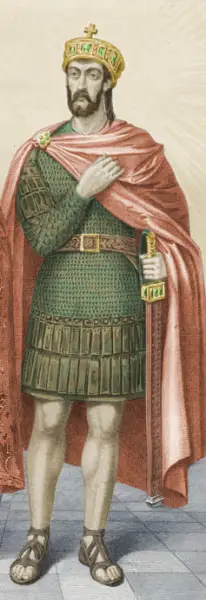
Overview
Archil the Martyr was an eighth-century Georgian prince of the Chosroid dynasty, son of Prince Stephen of Kakheti, who ruled Kakheti in the eastern Georgian highlands from 736 to 786 — an era bracketed by the Arab conquests. His biography survives in the medieval Georgian chronicles, The Life of Kartli: Pseudo-Juansher's history of about 800 ends with a brief account of his tenure, and a separate Martyrdom of Archil, of uncertain date between the early ninth and late eleventh centuries, tells of his end. When the Arab expedition of Marwan ibn Muhammad swept the Caucasus in 735–737, Archil and his brother Mirian fled west through Egrisi into Abasgia and joined Leon I in the defence of Anacopia against the invaders. Returning to Kakheti, he launched a program of reconstruction and of the Christianization of his mountain pagan subjects, and his reign saw the rise of the Georgian Bagratids. Around 786 eastern Georgia suffered another Arab invasion under Khuzayma ibn Khazim, reconfirmed viceroy by the caliph al-Hadi. His position untenable, Archil sued for peace; Khuzayma dangled gifts before him if he would accept Islam, but the prince would not, and was thrown into prison. Asked next about a treasure the Chosroid kings were said to know — the gold Heraclius was believed to have hidden on evacuating the Caucasus in the 620s — he was put to death in 786. He was survived by two sons, Juansher and Ioane, and four daughters.
The Complete Life
A Chrosroid of Kakheti
Archil was a scion of the Chosroid dynasty — the house that had ruled the kingdom of Iberia (Kartli) since the fourth century and had given Georgia her first Christian kings — and the son of Prince Stephen of Kakheti (r. 685–736), who had established the family in the eastern highlands after the collapse of the royal line. Archil succeeded his father in 736 and ruled Kakheti, as prince rather than king, for fifty years. His reign coincided with the greatest external threat Georgia had faced: the Arab conquests, which had taken Tbilisi and reduced the lowland principalities to tribute. The eastern Georgian lands in his day were a frontier between the caliphate's northern frontier zone and the surviving Christian principalities of the mountains — Kakheti itself, Hereti, and the westward kingdoms of Egrisi and Abasgia — and their rulers survived by fighting, negotiating, and occasionally fleeing. Archil did all three, and outlasted nearly everyone who had attacked him.
§ Life
Defence and Reconstruction
The 735–737 expedition of Marwan ibn Muhammad — the future caliph Marwan II — swept the Caucasus with unusual thoroughness. Archil and his brother Mirian made their way west through Egrisi into Abasgia, where they took sides with the local dynast Leon I in the defence of Anacopia, the great fortress on the Black Sea coast that the Arabs besieged and failed to take. The survival of Anacopia was decisive for the future of Christian Georgia: the Abasgian dynasty that defended it would become, in time, the royal house of united Georgia. Returning to Kakheti when the storm passed, Archil launched a program of reconstruction and of the Christianization of his mountain pagan subjects — the highland tribes of the eastern Caucasus who were still outside the Church. The Georgian texts of his era also relate the rise of the Georgian Bagratids, the future royal dynasty, during his time. His long reign was thus a period of quiet rebuilding between the two great Arab invasions of his lifetime.
§ Life
Martyrdom, 786
Around 786 eastern Georgia endured another invasion, this one led by Khuzayma ibn Khazim, whom the caliph al-Hadi had reconfirmed as viceroy of Arab-controlled Caucasia (Arminiya). Archil, old and in an untenable position, pleaded for peace. Khuzayma held out gifts if he would accept Islam; the prince said no, and was thrown into prison. Word then reached the viceroy that Archil was descended from the Chosroid kings, keepers, so it was said, of a treasure the Byzantine emperor Heraclius had hidden while evacuating the Caucasus in the 620s — the crusader-era legend of Heraclius' gold, already at home in the Caucasus. The questioning of the prisoner about the treasure and his refusal of Islam belong together in the Martyrdom, which presents a double motive for his death: apostasy he would not perform and gold he could not produce. He was killed in 786. He was survived by two sons, Juansher and Ioane, and four daughters, Gurandukht, Mariam, Mirandukht and Susan; on his death Ioane withdrew to Egrisi while Juansher remained in Kakheti and married into the Bagratid house of Tao-Klarjeti.
§ Life
The Royal Martyr
The Georgian Orthodox Church canonized Archil and commemorates him on 21 June (4 July N.S.) together with St Luarsab, the sixteenth-century king martyred by the Persians, as the holy royal martyrs of the Georgian Church — a pairing across eight centuries that makes a single category of the Georgian rulers who died for the faith. The Martyrdom of Archil, the brief text that carries his end, is of uncertain date — between the early ninth and late eleventh centuries — and its title calls him king of Kartli though the text does not, the honorific settling onto the memory of a prince. The Life of Kartli that preserves Pseudo-Juansher's account ends with him, which is fitting: the old royal history closes with the last Chrosroid, the dynasty of the first Christian kings ending in a martyrdom that joined their beginning. He is one of the small company of sovereign saints who died refusing conversion, and the Georgian Church has honoured him without interruption since.
§ Life
Timeline
- 736
Succeeds his father Stephen as Prince of Kakheti and Erismtavari of Kartli
§ Life
- 737
Driven west by Marwan ibn Muhammad's invasion, he joins Leon I of Abasgia in defending Anacopia
§ Life
- 786
Facing Khuzayma ibn Khazim's invasion, he sues for peace, refuses Islam, and is imprisoned
§ Life
- 786
Put to death as a martyr after refusing conversion and the demand for Heraclius' hidden treasure
§ Life
- 800
Pseudo-Juansher's history, written around this time, closes with an account of his rule
§ Life
The Record
- Patron of
- Georgian royal martyrs (with Luarsab)
- Canonization
- Canonized by the Georgian Orthodox Church
Prayer
Bibliography
Show 4 sources
- ↑ In surviving manuscripts the title is given as The Passion of the Holy and Glorious Martyr Archil, King of Kartli (წამებაჲ წმიდისა და დიდებულისა მოწამისა არჩილისი, რომელი ესე იყო მეფე ქართლისაჲ, ts'amebay ts'midisa da didebulisa mots'amis
- ↑ Rapp, p. 474.
- ↑ Machitadze, Archpriest Zakaria (2007) Holy Royal Martyrs Archil and Luarsab Archived 2008-05-17 at the Wayback Machine . The Lives of the Georgian Saints . Retrieved from Pravoslavie.Ru on November 11, 2007.
- ↑ Rapp, pp. 474-5.
Profile text adapted from the Wikipedia article, licensed CC BY-SA 4.0.
Pray with this saint every day
Save St. Archil the Martyr to your favorites, read the full profile, and get feast-day reminders in the Saints app.
Get the Saints AppFree on the App Store for iPhone and iPad