
died c. 523·Feast October 24
St. Arethas of Najran
Martyr and Leader of the Christians of Najran
Overview
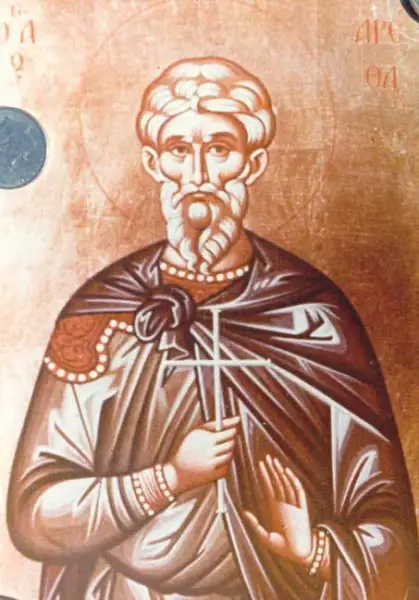
Arethas, in Arabic al-Harith ibn Kab, was the leader of the Christian community of Najran in the early sixth century, killed there around 523 during the persecution of the Jewish Himyarite king Dhu Nuwas, who had embraced Judaism and warred on the Christian kingdoms of Arabia. The massacre did not stay hidden: word of what had happened at Najran spread through the surrounding lands until it reached Emperor Justin I and the Christian kingdom of Aksum. His passion is known through the Martyrdom of Arethas, a text that survives in two recensions: an earlier and more authentic version that cannot postdate the seventh century, and a tenth-century reworking made under the name of Simeon Metaphrastes. Byzantine emotion over the massacre fed the invasion by the Christian kingdom of Aksum that ended Himyarite rule. Arethas is commemorated with his companions on 24 October.
The Complete Life
Najran before the Storm
Najran, an oasis city of south-western Arabia, was in the early sixth century a prosperous Christian centre in the Jewish-ruled kingdom of Himyar. Its church was miaphysite, connected through Ethiopia and Syria to the wider Christian world, and its community included Arab tribes settled and nomad, merchants and farmers, with a leadership of notables among whom Arethas — al-Harith ibn Kab in the Arabic sources — stood first. The kingdom around it had recently turned: Yusuf Asar Yathar, known to the tradition as Dhu Nuwas, had embraced Judaism and taken the throne with a programme of war against the Christian powers that hemmed Himyar in, Byzantium's ally Aksum across the Red Sea first of all. Najran, wealthy, Christian and strategically placed on the road north, was the obvious target; the choice its leading men were to face — the law of Moses or death — was a political as much as a religious ultimatum.
The Massacre of 523
Dhu Nuwas besieged the city, promising the Christians their lives and property if they submitted to his faith. Arethas, by the chronicles ninety-eight years old, was brought before the king with the other notables and invited first; his refusal set the pattern, and he was beheaded. What followed entered Christian memory as one of the great massacres of the era: the city burned — the traditions say by trenches of fire prepared for those who would not yield — and thousands killed, among them women and children whose names the martyrologies kept beside the men's. Ruhm, the mother who held her child, and the girl who refused the king's daughter's conversion became types retold for centuries. The documentary record is exceptional: Simeon of Beth Arsham's contemporary letter on the martyrs, the Syriac Book of the Himyarites, the letters of the Aksumite court, and the later histories combine to fix the events of 523 with unusual certainty for a martyrdom of its time.
Cult
The martyrs of Najran were received at once as saints by every church that heard of them. Their acts and letters circulated in Syriac, Greek and Ethiopic; the Roman Martyrology, the Greek synaxaria and the oriental calendars came to keep their feast on 24 October, with Arethas named as their leader and the collective remembered as the martyrs of Najran. Byzantine feeling ran high: the emperor and patriarch organized relief and prayer, and the invective of the age called the king who killed them the new Nero. The political consequence followed — the Aksumite king Kaleb, urged by his Byzantine ally and his own church's ties to Najran, invaded Himyar and overthrew Dhu Nuwas around 525, an act of religious war recorded on both sides. An icon of Arethas by Manuel Panselinos stands among the masters' work at Mount Athos, the old man in white among the martyrs.
Legacy
Arethas and the martyrs of Najran are the great witnesses of the Arabian church before Islam, and their story is among the best-evidenced persecutions of late antiquity. For the historian they document the geopolitics of the Red Sea world — Jewish Himyar, Christian Aksum, the Byzantine-Persian duel — at the moment before the prophet Muhammad's world emerged from it; some Islamic tradition itself preserves the memory of the trench of Najran. For the Church they are the ancestors of the Christian communities of the Middle East, invoked today for the persecuted of Iraq and Syria no less than of Arabia. Arethas himself, the old leader who spoke first and died first, carries the whole city's confession in his name: the refusal to trade the faith for safety, made at the end of a long life when refusal cost everything and obedience looked like waste.
Timeline
- 523
Killed at Najran during the persecution of Christians by the Yemeni king Dhu Nuwas
§ Introduction
- 523
Aksumite troops land to depose Dhu Nuwas after news of the massacre spreads, beginning the siege of Najran
§ Introduction
The Record
- Patron of
- Arabian Christians·Persecuted churches
- Symbols
- White beard of the old man·Martyr's palm·Crown
- Canonization
- Pre-congregation; venerated in the Catholic, Eastern Orthodox and Oriental Orthodox churches
Prayer
Profile text adapted from the Wikipedia article, licensed CC BY-SA 4.0.
Pray with this saint every day
Save St. Arethas of Najran to your favorites, read the full profile, and get feast-day reminders in the Saints app.
Get the Saints AppFree on the App Store for iPhone and iPad