
5th or 6th century (probably)·Feast July 20
St. Arilda
Virgin Martyr of Oldbury-on-Severn
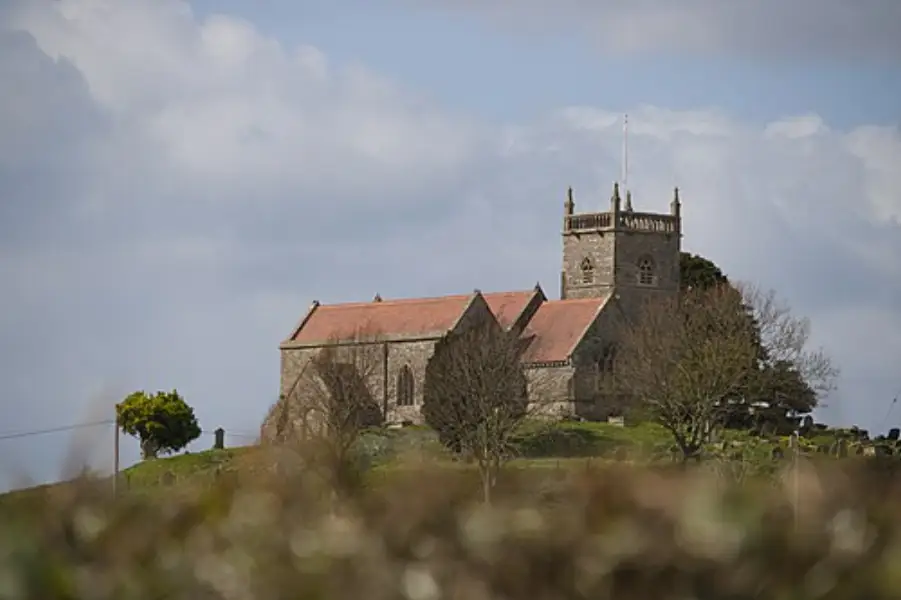
Overview
Arilda, also Arild, was a female saint of Oldbury-on-Severn in Gloucestershire, probably of the fifth or sixth century, of Anglo-Saxon or possibly Welsh origin. She is a virgin martyr: on the testimony of the antiquary John Leland, writing in the sixteenth century, a youth called Municus put her to death after she refused to sleep with him — martyrdom by refusal, in the pattern of the early virgin saints. Two Gloucestershire churches are dedicated to her: one at Oldbury-on-Severn by her traditional home, and a second one, St Arild's Church, up at Oldbury-on-the-Hill; Domesday (1086) records both places as 'Aldberie', which suggests the places may take their names from her. Leland relates that her home was Kington, a hamlet of Oldbury-on-Severn parish, where a well that bears her name passes for holy; its waters, people say, run red with her blood, though the sober explanation is a red alga of the genus Hildenbrandia. A shrine to Arilda stood at St Peter's Abbey, Gloucester — now the cathedral — until it was destroyed at the Dissolution of the Monasteries. Her feast is 20 July.
The Complete Life
A Saint of the Severn Shore
Arilda — the name also appears as Arild — belongs to the oldest stratum of English hagiography, the layer of local saints remembered by the villages of the West Country before the Normans reorganized the calendar. Her lifetime probably fell in the fifth or sixth century, and her origin may be either Anglo-Saxon or Welsh: the lower Severn then formed a borderland between the two peoples, and a saint whose cult lies on both sides of that line can be claimed by either. The substance of her story is a single tradition, recorded by John Leland, the great antiquary of Henry VIII's reign who toured the English monasteries in the years before their destruction and wrote down what the monks told him. On Leland's telling she was a virgin put to death by a youth called Municus after refusing to sleep with him. The story is the standard plot of the virgin-martyr passions of late antiquity — the woman who will not yield, and the man who kills her — applied to a local figure whose name alone might otherwise have survived.
§ Introduction
Two Churches and a Well
Arilda's cult has a remarkably complete local geography. Two churches in Gloucestershire are dedicated to her: one at Oldbury-on-Severn, beside her traditional home along the wide marshy banks of the great river estuary, and a second church, St Arild's, up at Oldbury-on-the-Hill in the Cotswolds, further east. Both places were recorded as 'Aldberie' at the time of Domesday Book in 1086, which suggests that the names of the villages themselves may derive from the saint — the eponym working backwards, the holy woman giving her name to the places that remembered her. Leland further maintains that her home was Kington, a hamlet of Oldbury-on-Severn parish, where a well that bears her name passes for holy; its waters, tradition says, run red with her blood. The modern explanation is gentler and more interesting: the colour is produced by a red alga of the genus Hildenbrandia, which grows in the stone of the well. Legend and biology offer the same sign in the same water.
§ Introduction
The Shrine at Gloucester
Arilda's cult had a monastic centre as well as a parochial one: a shrine to her stood at St Peter's Abbey, Gloucester — the great Benedictine house that is now Gloucester Cathedral — and was a destination of local pilgrimage through the Middle Ages. The abbey's interest in her is easy to understand: a local virgin-martyr with wells and churches in the neighbourhood was exactly the kind of saint a regional monastery collected, and her shrine gave the abbey a piece of the Severn valley's sanctity. The shrine did not outlast the Dissolution of the Monasteries of the 1530s and 1540s — the same dissolution that sent Leland touring the houses to record what was about to be lost, which is why we have her story at all. Her feast is 20 July, and the two Oldbury churches keep her memory; she is venerated in the Roman Catholic Church and commemorated in the Anglican Communion, a saint of the English soil whose biography fits on a headstone and whose cult has outlasted her shrine.
§ Introduction
The Record
- Patron of
- Oldbury-on-Severn and Oldbury-on-the-Hill, Gloucestershire
- Canonization
- Pre-congregation (medieval local cult)
Prayer
Bibliography
Profile text adapted from the Wikipedia article, licensed CC BY-SA 4.0.
Pray with this saint every day
Save St. Arilda to your favorites, read the full profile, and get feast-day reminders in the Saints app.
Get the Saints AppFree on the App Store for iPhone and iPad