
1st century·Feast April 14
St. Aristarchus of Thessalonica
Fellow Prisoner of Paul, Martyr
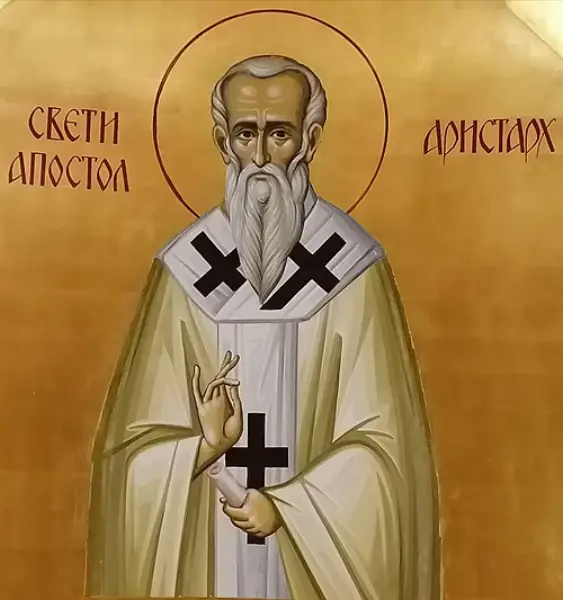
Overview
Aristarchus, 'a Macedonian of Thessalonica' in Luke's words, was an early Christian known from a few passages of the New Testament as one of Paul's most constant companions. At Ephesus the rioting silversmiths seized him together with Gaius and dragged him into the theater; he returned with Paul from Greece to Asia on the last journey; and at Caesarea he embarked with Paul on the ship of Adramyttium bound for Myra, accompanying him toward Rome. Paul calls him his 'fellow prisoner' in Colossians and his 'fellow laborer' in Philemon. Eastern tradition identifies him with one of the Seventy Apostles and makes him bishop of Apamea on the Orontes; the calendars keep his feast as saint and martyr on January 4, on April 14, and on September 27, while the Roman Martyrology records him on August 4. His life after the narrative of Acts belongs entirely to that tradition, which honors the man who stayed when others fled.
The Complete Life
A Macedonian of Thessalonica
Aristarchus was, in the words of Acts 27:2, a Macedonian of Thessalonica — a citizen of the great port city where Paul had preached in the early 50s, and where a church was founded amid riot and accusation within weeks of his arrival. The name Aristarchus, 'best ruler,' was a common Greek name of the Hellenized cities, and a Thessalonian bearing it would have grown up amid the mixture of Roman administration, Greek culture, and Jewish synagogue life that the Acts narratives show. He was very likely a convert of that first Thessalonian mission, one of the Macedonian believers — with Gaius, another Macedonian, and Secundus, explicitly called a Thessalonian — who attached themselves to Paul's travels and formed the constant core of his company. A Macedonian port with a synagogue, a Roman magistracy, and a busy harbor was fertile ground for the mission, and its converts traveled; the city's inscriptions preserve the politarchs whose office Luke's account reflects.
§ Introduction
Companion of Paul
Aristarchus's vocation, as the New Testament presents it, was companionship under threat. Like Gaius, he fell into the hands of the Ephesian mob and was carried into the theater amid the silversmiths' riot over Diana's image — the scene in Acts 19 where two of Paul's companions are pushed into the amphitheater while the crowd shouts for two hours. Later he returned with Paul from Greece to Asia on the final journey; at Caesarea he went aboard with Paul on an Adramyttium ship bound for Myra in Lycia, and whether he stayed with him for the voyage to Rome is not recorded in Acts, though the later letters of Paul supply the answer. In Colossians he is 'my fellow prisoner,' in Philemon 'my fellow laborer' — the two titles that sum up the man: he worked, and he suffered. He worked, he suffered, and he stayed: the record's own prepositions — with Paul — are the testimony.
§ Introduction
Tradition of Apamea
The tradition fills the silence after Acts with an episcopate and a martyrdom. Eastern Orthodox and Eastern Catholic tradition gives Aristarchus a place among the Seventy Apostles, those disciples sent out in pairs by Jesus, and assigns him the see of Apamea on the Orontes in Syria, among the great cities of the Greek East. As bishop of Apamea he is held to have been martyred, and the calendars honor him as a martyr on January 4 with the Synaxis of the Seventy, on April 14, and on September 27. The Roman Martyrology mentions him on August 4. Some scholars have also linked him to a certain Aristarchus, son of another Aristarchus, who served as politarch of Thessalonica and is attested by an inscription — the city's magistracy is unusually well documented — though the identification remains conjectural. Apamea's episcopate and a martyr's palm are the tradition's answer to the silence that follows Acts; the politarch inscription that some scholars lay beside his name shows how completely the saint and the city's record are entangled.
§ Background
Veneration
Aristarchus belongs to the saints of the apostolic age, venerated in East and West from antiquity without process. The Byzantine synaxaria carry his notices on the several feasts of the Seventy, and the Orthodox service texts pair him with the other Macedonian co-workers of Paul. Western martyrologies from Bede's martyrology onward kept his name, and the Roman Martyrology's August notice preserves the Latin tradition. In the Greek church of Thessalonica his memory is that of the city's own apostolic son, the Thessalonian who went with Paul to the capital of the world. Acts drops him after the voyage toward Rome; the calendars pick him up and do not let go. Four dates — three Byzantine, one Latin — carry a companion the narrative leaves at Myra, and Thessalonica numbers him with the Seventy whose Synaxis opens the Eastern year. No process was ever needed; the fellow prisoner's chains were credential enough.
§ Background
Legacy
Aristarchus's legacy is the theology of companionship. Paul's mission was not a one-man operation, and the letters' greetings name the men and women who carried it: fellow laborers, fellow prisoners, fellow soldiers. Aristarchus appears in the record only in company — seized with Gaius, sailing with Paul, imprisoned alongside him — and the Church's memory canonized exactly that. For everyone who serves in support, unnamed in the headlines but present in the dangers, the Macedonian of Thessalonica is the patron: the companion whose fidelity is recorded in a verse and honored with a feast. Paul's teams shifted as men came and went; Aristarchus stands in the record at Ephesus, in Greece, and on the prison ship, one of the few present at every stage of the risk. Where the acts say 'with Paul,' there he is: the preposition is the vocation, and the companion's feast is its monument.
§ Introduction
The Record
- Patron of
- Travelers and companions of missionaries·Prisoners for the faith
- Symbols
- Fellow prisoner's chains·Ship (of the voyage to Rome)
- Canonization
- Pre-congregation; New Testament figure honored from antiquity
Prayer
Bibliography
Show 4 sources
- ↑ "Roman Martyrology August, in English" .
- ↑ Greek inscription- IG X,2 1 30
- ↑ Church and Community Conflicts: The Relationships of the Thessalonian, Corinthian, and Philippian Churches with their Wider Civic Communities Page 148 By Craig Steven De Vos ISBN 1-58983-007-5
- ↑ An annotated bibliography of 1 and 2 Thessalonians By Jeffrey A. D. Weima , Stanley E. Porter Page 26 ISBN 90-04-10740-1
Profile text adapted from the Wikipedia article, licensed CC BY-SA 4.0.
Pray with this saint every day
Save St. Aristarchus of Thessalonica to your favorites, read the full profile, and get feast-day reminders in the Saints app.
Get the Saints AppFree on the App Store for iPhone and iPad