
died c. 133-134·Feast August 31 (Catholic); September 13 (Eastern Orthodox)
St. Aristides of Athens
Philosopher and Apologist
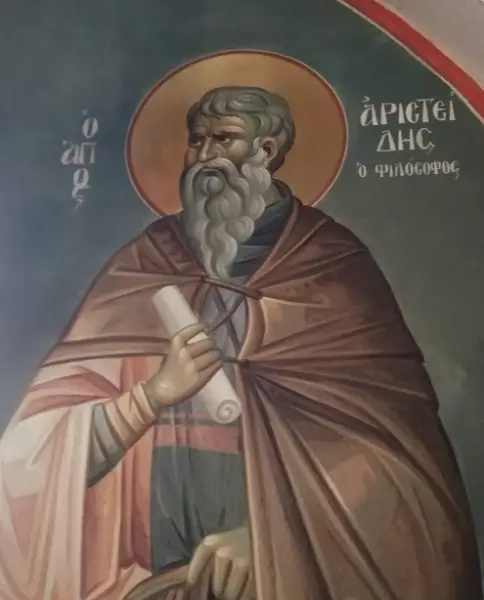
Overview
Aristides the Athenian, also known as Marcianus Aristides, was a Greek Christian philosopher of the second century, the author of the Apology of Aristides, the oldest Christian apologetic work that survives entire. Almost all that is known of him comes from Eusebius and Jerome: he practiced philosophy at Athens before and after his conversion, and he delivered his apology, dedicated to the emperor Hadrian, at about the same time as Quadratus delivered his own, which suggests a date around 124 or 125, and a death perhaps in 133 or 134. The Apology argues from the existence of the world to a God who is eternal, impassible and perfect, and surveys the four races of humanity, Barbarians, Greeks, Jews and Christians, and their worship, finding in the Christians' doctrine of creation and their way of life the truth the others missed. Lost for centuries, the work was rediscovered in an Armenian fragment in 1878 and in a complete Syriac version by Rendel Harris at Mount Sinai in 1889, which showed it had survived embedded in the Life of Barlaam and Josaphat since the seventh century. Greek papyrus fragments followed in 1922.
The Complete Life
Early Life
Aristides was an Athenian, and the ancient world's description of him is a title: the philosopher. Eusebius, writing in the fourth century, calls him a faithful disciple of our religion who composed an apology of the faith and dedicated it to Hadrian; Jerome adds that he practiced philosophy at Athens before and after his conversion. The sequence matters: he came to Christianity as a formed man of the schools, trained in the traditions of a city that had heard Paul on the Areopagus three centuries before and had never stopped arguing. What school claimed him the sources do not say; his apology's manner, calm, systematic, comparative, suggests the lecturing philosopher more than the rhetorician. He belongs to the first small generation of Christian intellectuals who took the faith into the arena of Greek thought and found that it could stand there: Justin at Rome, Quadratus at Athens, and Aristides, whose work, alone of theirs, has survived whole, making him the earliest complete voice of Christian reasoned speech to the empire.
§ External links
The Apology
The Apology of Aristides is addressed to an emperor, Hadrian by the reading of Eusebius and Jerome, and its argument is deceptively simple. It opens with the proof of God from the order of the world: the world's existence and harmony show a maker, and that maker must be eternal, impassible and perfect. It then surveys the four races of humanity, the Barbarians, with their worship of dead men and the elements; the Greeks, under whose heading the Egyptians and Chaldeans are included, with their mutually contradictory myths about gods who behave like vicious men; the Jews, acknowledged as near the truth in their worship of one God; and the Christians, whose doctrine of creation and whose way of life, their truthfulness, purity and care for the poor, the apologist sets forth as the demonstration of their knowledge of God. The method, a comparative history of religions in miniature, was a genuinely philosophical instrument, and the tone is urbane throughout; Aristides does not curse the empire but instructs it, asking the emperor to read and judge.
§ The Apology of Aristides
Loss and Recovery
The Apology vanished from the Greek tradition, and for six centuries it survived by accident. In the seventh century an anonymous author, composing the Life of Barlaam and Josaphat, the Christian romance that carried the story of the Buddha into European literature, put a version of Aristides' argument into the mouth of his pagan sage, and the apology thus lived on, disguised, in one of the most widely read books of the middle ages. Modern recovery came in stages: in 1878 the Mechitarists of San Lazzaro in Venice published an Armenian fragment with the title naming Hadrian and the Athenian philosopher; in 1889 Rendel Harris found at the monastery of St. Catherine on Sinai a complete Syriac translation, whose superscription names Antoninus Pius; and in 1922 the British Museum published Greek papyrus fragments of two chapters. The Syriac and Armenian together, with the Greek, allow the work to be read nearly as Aristides wrote it.
§ The Apology of Aristides
Veneration
Aristides is honored as a saint in both the Catholic and the Eastern Orthodox churches, the West keeping his feast on 31 August and the East on 13 September. His cult is that of the early confessors, acknowledged by the ancient church's memory rather than by any process; the martyrologies carried his name through the centuries in which his one book was lost, a small irony the recovery of the text has repaired. The questions that exercised the scholars of the recovery, whether the emperor addressed was Hadrian or Antoninus Pius, and whether Aristides died in 133 or delivered his work in 140, remain open in the literature; the Armenian version's language supports the Hadrianic dating favored by Eusebius and Jerome. The church, in venerating him, has claimed exactly what he claimed for himself: that the Christian faith can be spoken before the powerful in the language of reason.
§ Biography
Legacy
Aristides' legacy is the apology itself, the oldest complete work of Christian apologetics, and the example of its author. For historians it is a primary witness to the self-understanding of the second-century church: its view of paganism, of Judaism, of its own moral life, and of the relation of faith to philosophy, all documented in a text of the first Christian generation of writers. For apologists of every later age it established a genre, the reasoned address to power, and a method, the comparison of religions before the bar of reason. The romance of its loss and recovery, an Armenian monastery, a Sinai manuscript, a text hidden in a Buddhist-derived novel, has made it a favorite of the historians of the transmission of texts. And for the ordinary reader the Apology remains astonishingly readable: a calm voice from the Athens of Hadrian, explaining to the ruler of the world why the Christians worship the God who made it.
§ The Apology of Aristides
Timeline
- 124
Delivers his Apology of the faith to Emperor Hadrian, probably around 124-125
§ Biography
- 133
Dies at Athens, a death usually dated between 133 and 134
§ Biography
- 140
A Syriac superscription instead records the Apology as presented to Antoninus Pius
§ Biography
- 700
The Apology is woven into the Life of Barlaam and Josaphat, keeping it extant
§ The Apology of Aristides
- 1878
An Armenian fragment of the Apology is published at San Lazzaro, Venice
§ The Apology of Aristides
- 1889
Rendel Harris discovers a complete Syriac translation at Mount Sinai
§ The Apology of Aristides
- 1922
The British Museum publishes Greek papyrus fragments of the Apology
§ The Apology of Aristides
In Their Own Words
eternal, impassible and perfect
The Record
- Major works
- Apology of Aristides (To Emperor Hadrian Caesar from the Athenian Philosopher Aristides)
- Patron of
- Philosophers·Apologetics and apologists
- Symbols
- Philosopher's cloak·Scroll of the apology
- Canonization
- Pre-congregation; ancient cult
Prayer
Bibliography
Show 12 sources
- ↑ Theodropolous, Aristides. "Dr" . Mystagogy Resource Center .
- 1 2 Cayré 1936 , p. 111 .
- 1 2 Jurgens 1970 , p. 48 .
- ↑ Vinzent, Markus (March 14, 2019). Writing the History of Early Christianity: From Reception to Retrospection . Cambridge University Press. p. 205. ISBN 9781108480109 . OCLC 1056203241 .
- ↑ W A Jurgens (1970). The faith of the early fathers : a source-book of theological and historical passages . Liturgical Press. p. 48. ISBN 9780814610213 . OCLC 5256138 .
- ↑ Martin, Francis (October 14, 2011). The Feminist Question: Feminist Theology in the Light of Christian Tradition . Wipf and Stock Publishers. p. 21. ISBN 9781610977623 . OCLC 760990581 .
- ↑ Eusebius of Cesarea ; Cushman McGiffert, Arthur (December 18, 2019). The Ecclesiastical History: Complete 10 Book Edition: The Early Christianity: From A.D. 1-324 . p. 300.
- ↑ Kurian, George Thomas ; Lamport, Mark A. (May 7, 2015). Encyclopedia of Christian Education . Vol. 3. Rowman & Littlefield. p. 578. ISBN 9780810884939 . OCLC 1073758657 .
- ↑ Quasten 1950 , pp. 191–195 .
- ↑ Milne 1923 , p. 73 .
- 1 2 3 Cayré 1936 , p. 112 .
- ↑ Harris 1891 , p. 40 .
Profile text adapted from the Wikipedia article, licensed CC BY-SA 4.0.
Pray with this saint every day
Save St. Aristides of Athens to your favorites, read the full profile, and get feast-day reminders in the Saints app.
Get the Saints AppFree on the App Store for iPhone and iPad