
1st century BC - c. AD 56 (traditional)·Feast March 15 (Catholic and Greek Orthodox); March 16 (Anglican and Russian Orthodox); 19 Paremhat (Coptic)
St. Aristobulus of Britannia
First Bishop of Britain, One of the Seventy Disciples
Overview
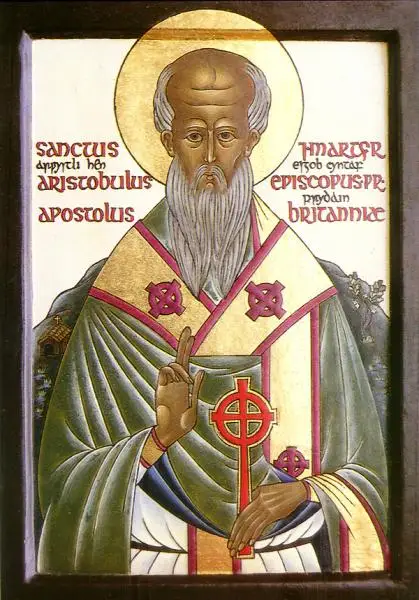
Aristobulus of Britannia is a Christian saint whom Hippolytus of Rome (170-235) and Dorotheus of Gaza (505-565) name among the Seventy Disciples of Luke 10:1-24 and honor as the first bishop in Roman Britain. Greek, Latin, and Alexandrian tradition makes him the brother of the Apostle Barnabas, of Jewish Cypriot origin, who like Barnabas accompanied Saint Paul on his journeys; he ranked among the assistants of Saint Andrew alongside Urban of Macedonia, Stachys, Ampliatus, Apelles of Heraklion, and Narcissus of Athens — the group of names Paul greets together in Romans 16:8-11. He may be mentioned in Romans 16:10 ('Salute them which are of Aristobulus' household'), though the reference may instead mean the household of the late Aristobulus IV of the Herodian family, into which some traditions fit him. On his missionary journey to Britain he is said to have halted to preach among the Celtiberians of northern Hispania. In Roman Britain he preached and died: some traditions say he died in peace, others — Catholic and others besides — that he was martyred in Wales. Dates proposed for his death range from 56 (Michael Alford, in the second year of Nero) to 99 at Glastonbury (Serenus de Cressy). From these traditions it appears that Aristobulus, rather than the legendary Joseph of Arimathea — whose Glastonbury legend is of 12th-13th-century origin — stands at the root of the earliest British Christian memory.
The Complete Life
The Traditions
Everything known of Aristobulus comes from tradition rather than record. Pseudo-Hippolytus lists 'Aristobulus, bishop of Britain' among the seventy disciples, and Dorotheus, bishop of Tyre, is cited as asserting that the Aristobulus saluted by Paul in Romans 16:10 was bishop of Britain. The Greek, Latin, and Alexandrian traditions agree in making him the brother of Barnabas, a Cypriot Jew of Levi's tribe, and thus a man of the first generation of the church. The possible New Testament mention — the household of Aristobulus in Romans 16:10 — may instead refer to the household of the Herodian prince Aristobulus IV, which has encouraged a further tradition connecting him with the Herodian family.
§ Traditions
First Bishop of Britain
The traditions send Aristobulus west with Saint Andrew and the companions of Romans 16 — Urban, Stachys, Ampliatus, Apelles, Narcissus — and specifically to Britain, preaching on the way to the Celtiberians of northern Hispania. In Britain he is remembered as the first bishop: 'Aristibule the Old, Apostle, Martyr, and First Bishop of Britain' in his full liturgical title. Latin Catholic tradition additionally identifies him with Zebedee, the father of James and John, an identification few modern scholars would defend but one that testifies to the early church's desire to bind Britain to the apostolic family as tightly as possible.
§ Greek, Latin, and Alexandrian traditions
Commemoration
Aristobulus is commemorated on 15 March in the Catholic and Greek Orthodox calendars, 16 March in the Anglican Communion and the Russian Orthodox Church, and 19 Paremhat in the Coptic Church. His cult belongs to the whole undivided tradition: the man the East calls the brother of Barnabas and the West called the first bishop of Britain is kept on both sides of every later division, in Rome, Constantinople, Moscow, Canterbury, and Cairo.
§ Introduction
Legacy
Aristobulus's legacy is the claim itself: that Christianity reached Britain in the apostolic age. Modern scholarship treats the historical claims cautiously — George Smith argued that no preaching of the Gospel happened in Britain before Claudius's reign, and the Glastonbury legend of Joseph of Arimathea is a medieval invention — but the early writings, as the sources note, center on Aristobulus, not Joseph. John Williams identified him with Arwystli Hen, 'a man of Italy,' one of four missionaries credited with bringing Christianity to the British Isles, and the one who gave the Welsh district of Arwystli its name. In the Orthodox and Catholic imagination he remains the founding shepherd of the church of these islands, whatever the historians make of the documents.
§ British tradition
Timeline
- 56
Michael Alford dates his death to the second year of Nero, holding that he reached Britain before Paul came to Rome
§ Greek, Latin, and Alexandrian traditions
- 99
Serenus de Cressy holds that St. Paul consecrated him and that his death came at Glastonbury in this year
§ Greek, Latin, and Alexandrian traditions
The Record
- Patron of
- British Christianity
- Symbols
- Bishop's vestments·Apostolic scroll
- Canonization
- Pre-congregation; named among the Seventy Disciples by Hippolytus of Rome and Dorotheus
Prayer
Bibliography
Show 1 sources
- ↑ Note: It is an example of the great difficulty in establishing the relationships of various holders of the same name in the same area or family – especially in the Herodian dynasty.
Profile text adapted from the Wikipedia article, licensed CC BY-SA 4.0.
Pray with this saint every day
Save St. Aristobulus of Britannia to your favorites, read the full profile, and get feast-day reminders in the Saints app.
Get the Saints AppFree on the App Store for iPhone and iPad