
died c. 570·Feast August 16
St. Armel
Welsh-Breton Abbot and Dragon-Taming Founder
Overview
Armel, whose Welsh name Arthfael means literally "Wolf-Prince" and whose Latin name was Armagilus, was an early sixth-century holy man in Brittany, remembered as an abbot, a wonderworker at the Merovingian court, and the victor over a dragon. The tradition of his cult gives him princely Breton blood: his mother was the consort of King Hoel, and at the royal residence in Glamorgan, Wales, in the late fifth century, the future saint was born. Crossing to Brittany, he founded the abbey of Plouarzel, and from there his renown brought him a summons to the court of King Childebert I of Paris. On the journey he established churches that still bear his name at Ergué-Armel, Plouharnel, and Saint-Armel. His stay with Childebert lasted seven years, and during it the blind received their sight and the lame their step at his prayer; in the end the king bestowed on him an estate at Saint-Armel-des-Bochaux in Ille-et-Vilaine, and there he raised a second monastery. In his last years he withdrew to the Forest of Teil, where he is said to have defeated a dragon that terrorized the countryside. He died in his monastery around 570, and his feast is kept on 16 August. Some have even proposed him as a historical prototype of King Arthur.
The Complete Life
A Prince Born in Wales
Armel's story begins among the royalty of the Brittonic peoples in the generations after the Roman withdrawal from Britain. He is accounted a Breton prince by birth, his mother the queen consort of Hoel, in whose household — then dwelling at Glamorgan in Wales — the child was born in the late fifth century. His very names carry the memory of that noble birth: in Welsh he was Arthfael, literally "Wolf-Prince", while the Latinate tradition of the church knew him as Armagilus. Born to a throne, he chose instead the cloister, consecrating himself to God in an age when the faith was being carried from the British Isles across the Channel to the Armorican peninsula. His passage from Wales to Brittany placed him within that great migration of saints — Samson, Paul Aurelian, Tudwal, and their companions — who in the sixth century carried monastic learning and evangelistic zeal from the Celtic lands to Brittany, planting churches whose dedications still mark the Breton landscape. Of his formation and early years of religious life the record is silent, but the foundations he left behind speak of a man of energy, holiness, and gifts of healing that drew the attention of kings.
§ Saint Armel
Founder of Monasteries and Court Wonderworker
In Brittany Armel founded the abbey of Plouarzel, the first of the religious houses associated with his name. From there his reputation travelled beyond the peninsula, and he was called to attend the court of King Childebert I of Paris, son of Clovis and ruler of the Frankish kingdom. The journey southward itself became a mission: on the road thither he raised churches at Ergué-Armel, at Plouharnel, and at the place afterwards called Saint-Armel, dedications that kept his memory green in the Breton countryside. At the royal court he remained seven years, exercising a ministry of healing; the lame and the blind were brought to him and were cured, and the saint won a standing at the seat of Frankish power that few churchmen of his generation enjoyed. His presence among the powerful, however, did not dim his monastic vocation. When Childebert bestowed on him an estate at Saint-Armel-des-Bochaux in Ille-et-Vilaine, a second monastery rose upon it, and the centre of his life shifted from the palace to the cloister. In his foundation at Plouarzel and his later house at Bochaux, the prince of Hoel's line proved himself a builder of the Breton church.
§ Saint Armel
The Dragon of the Forest of Teil
In his last years Armel withdrew from human society into the Forest of Teil, seeking the solitude in which the Celtic saints found God most plainly. There tradition sets his most famous exploit: the forest was terrorized by a dragon, a monster whose ravages no one dared confront, and the holy man is said to have defeated it. The tale belongs to a family of dragon legends that gathered around the saints of the sixth century, in which the taming or slaying of the beast signified the triumph of the Gospel and of holiness over the ancient powers of wilderness and darkness. Whether read as history or as allegory, the story fixed Armel's place in the imagination of Brittany as the serpent-taming saint, and he is so represented in the art and statuary of the region. He died in his monastery around the year 570, at Saint-Armel-des-Bochaux, the house he had founded on the king's land, and there his memory was cherished by the community he left behind.
§ Saint Armel
Memory in Brittany and Beyond
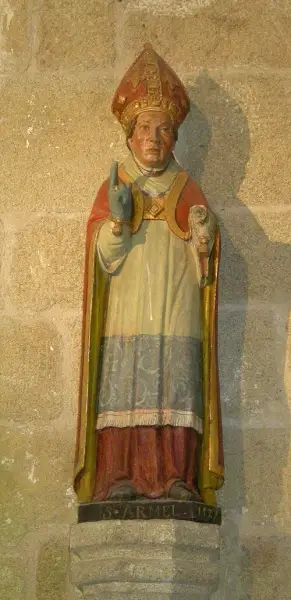
The dedications Armel left on his journey to Paris — Ergué-Armel, Plouharnel, and Saint-Armel — endure among the place names of Brittany, together with the communes that grew around his monasteries, and his cult spread with pilgrims as far as England, where badges commemorating the saint have been identified among medieval finds in London. His feast is kept on 16 August in the Roman Catholic Church, the Anglican Communion, and the Eastern Orthodox Church, a rare convergence of the three traditions in honouring a Celtic-Breton abbot. Medieval pilgrims wore his badge and sought his intercession, and his memory was sustained in the chapels of the Breton countryside; a statue of Saint Armel may still be seen at the Chapelle Notre-Dame-des-Fleurs in Plouharnel. A more curious strand of his afterlife links him with the greatest name of Brittonic legend: because his Welsh name Arthfael echoes that of Arthur, some have suggested that the historical Armel served as a prototype or identity for the legendary king. Whatever the merits of that speculation, it testifies to the stature his cult attained in the Celtic world.
§ Saint Armel
The Record
- Major works
- Abbey of Plouarzel·Monastery of Saint-Armel-des-Bochaux·Churches at Ergué-Armel, Plouharnel, and Saint-Armel
- Patron of
- against scalds and burns·Brittany
- Symbols
- dragon at his feet·abbot's crosier·bishop's vestments
- Canonization
- Pre-congregation canonization; venerated in the Roman Catholic, Anglican Communion, and Eastern Orthodox churches
Prayer
Bibliography
Show 1 sources
- Asperen, Hanneke (2005-01-01). "Saint Armel of Brittany: The identification of four badges from London". Peregrinations: Journal of Medieval Art and Architecture. 2 (1). ISSN 1554-8678.
Profile text adapted from the Wikipedia article, licensed CC BY-SA 4.0.
Pray with this saint every day
Save St. Armel to your favorites, read the full profile, and get feast-day reminders in the Saints app.
Get the Saints AppFree on the App Store for iPhone and iPad