
c. 540/560-611·Feast October 18
St. Arnoald
Bishop of Metz
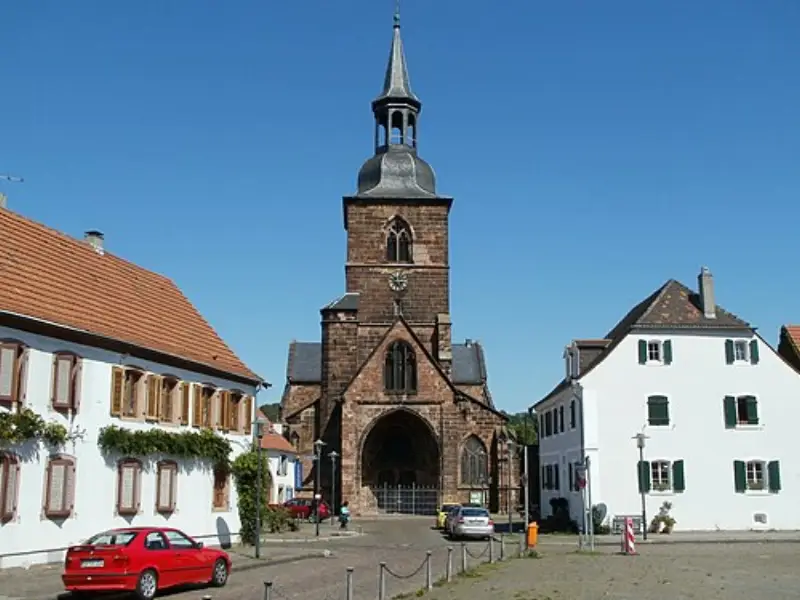
Overview
Arnoald, also Arnoldus or Arnual, was bishop of Metz between about 601 and 609 or 611, succeeding his uncle Agilulf in the see. The son of the senator Ansbertus and of Blithilde — whose parents were the Frankish king Charibert I and Ingoberga — he stood at the junction of Roman senatorial and Merovingian royal blood, an ancestry that made him a grandfather-figure of the Carolingian line through his son Arnulf's family traditions. Virtually no information survives of his acts before or during his episcopate. Paul the Deacon records that he was a Roman of senatorial stock, one of the southern Gallic families that had held senatorial rank; later genealogies make him a Ferreolus. His see of Metz was the capital of Austrasia, and his uncle's tenure before him shows the family's hold on the bishopric. Late in life he is said to have resigned the see and retired to the hermitage of Scarponne, where he died. He is venerated as a saint at Saint-Arnual, the church that grew over his resting place across the Saar from Saarbrücken.
The Complete Life
Ancestry
Arnoald's importance to history begins before his episcopate, in his blood. His father was Ansbertus, a senator; his mother Blithilde was, by the genealogies, a daughter of Charibert I, the Merovingian king of Paris, and his queen Ingoberga — a marriage joining Roman senatorial rank to royal Frankish blood. Paul the Deacon, the earliest witness, calls him merely a Roman of the senatorial class, a pointer toward the great families of southern Gaul; the Commemoratio Genealogiae of the Carolingian age connects him to the Ferreoli of the Midi, a family that had transferred its allegiance from the Visigoths to the Frankish realm of Austrasia after Vouillé in 507. Modern scholars have suspected that the pedigree was constructed to give the Carolingians a Roman and royal ancestry; yet the choice of the merely notable Ferreoli argues for its authenticity, since inventors would have claimed a greater name. Through his family the see of Metz passed in practice as an inheritance: his uncle Agilulf held it before him, and his son Arnulf — the future saint — entered the church of the same city.
Bishop of Metz
Arnoald succeeded his uncle Agilulf as bishop of Metz between 601 and 609 or 611, governing the metropolitan church of the Austrasian capital in the reigns of Theudebert II and Theuderic II and the mayoral wars that surrounded them. Virtually no information survives concerning his acts as bishop: no charters under his name, no councils he attended are recorded, no letters remain — an almost perfect silence, broken only by his presence in the episcopal lists. The silence is itself evidence of a kind: Metz in his day was a political see, its bishop the chaplain and treasurer of a court in motion, and Arnoald's episcopate spanned the years in which Brunhild's fall was prepared. His kinsmen and successors, above all his son Arnulf and Arnulf's friend Romaric, would people the church of Austrasia with saints; Arnoald himself remains the ancestor at the edge of the story, the senator's son who held the throne of Metz quietly in turbulent years.
Retirement and Death
The tradition of his last years, preserved in the later Lives of the Saar, is that Arnoald resigned the see and withdrew to a hermitage at Scarponne — identified with the site of Saint-Arnual on the Saar, opposite modern Saarbrücken — where he died in prayer, around 611. A bishop's resignation was rare enough to be remembered; retirement to a solitary life rarer still, and the story aligns him with the penitent aristocrats of the seventh century who ended as hermits. His grave at the hermitage became the nucleus of a church and a settlement, Stiftskirche St Arnual, the collegiate church of Saint Arnual, which kept his cult through the Middle Ages and gave the surrounding town its name. The translation of his relics and the growth of the pilgrimage belong to the later history of the Saar church. His feast is kept on 18 October.
Legacy
Arnoald's legacy is genealogical before it is devotional: as the husband of Blithilde and father of Arnulf of Metz by the traditional stemmata, he stands among the grandfathers of the Carolingian house — the line that produced Charles Martel, Pippin and Charlemagne — and genealogists have argued over him for centuries precisely because so much depended on the connection. The modern verdict permits the descent while warning that the Carolingian pedigree in its full form is a ninth-century construction. In devotional terms his cult is local and modest: the church of Saint-Arnual, his tomb's successor, honoured him as its founder-saint, and the Metz tradition counted him in its episcopal succession of saints from Clement to Arnulf. This profile is marked thin_source: the man behind the pedigree is almost entirely silent in the sources.
Timeline
- 560
Born around this year, by the article's dating of 540/560, son of the senator Ansbertus and Blithilde
§ Introduction
- 601
Becomes Bishop of Metz, succeeding his uncle Agilulf; he holds the see until 609 or 611
§ Introduction
- 611
Dies around this year, at the end of his tenure as Bishop of Metz
§ Introduction
The Record
- Patron of
- Metz·Saint-Arnual (Saarbrücken)
- Symbols
- Bishop's vestments·Hermit's cell
- Canonization
- Pre-congregation; venerated at Metz and Saint-Arnual
Prayer
Profile text adapted from the Wikipedia article, licensed CC BY-SA 4.0.
Pray with this saint every day
Save St. Arnoald to your favorites, read the full profile, and get feast-day reminders in the Saints app.
Get the Saints AppFree on the App Store for iPhone and iPad