
c. 1040–1087·Feast August 14
St. Arnold of Soissons
Bishop of Soissons, Abbot of Oudenburg, Patron of Brewers
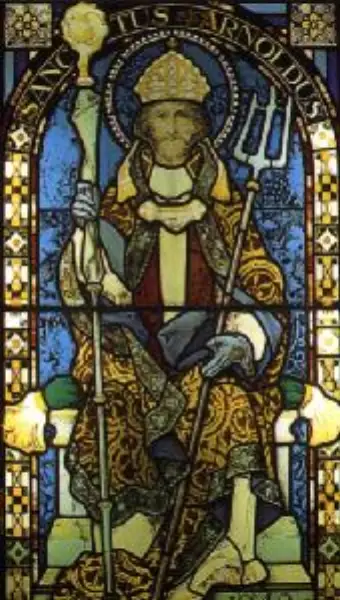
Overview
Arnold (Arnoul, Arnulf) of Soissons or of Oudenburg, born around 1040 at Tiegem in Brabant, son of a certain Fulbertus, is the Catholic saint patron of hop-pickers and Belgian brewers. First a career soldier, he settled at the Benedictine abbey of St Medard at Soissons, spending his first three years as a hermit before rising to be abbot — his hagiography says he tried to refuse the honour and flee, but was forced to return by a wolf. Made a priest and then, in 1080, bishop of Soissons — another honour he tried to refuse — he withdrew when a rival bishop occupied his see, choosing not to fight for it, and founded the abbey of St Peter at Oudenburg in Flanders. There he brewed beer and encouraged the local peasants to drink it instead of water, for its 'gift of health': the small beer of the period, weak and full of spent yeast, was safer than the water. In an outbreak of sickness he had the people consume the monastery brews instead of contaminated water, and many survived — a story also told of Arnulf of Metz, the other bishop patron of brewers. A council at Beauvais in 1121 looked into the miracles reported at his tomb and approved them, and his relics were translated to the church of St Peter at Oudenburg in 1131. In art he carries a bishop's mitre along with a mash rake; his feast falls on 14 August.
The Complete Life
A Soldier of Brabant
Arnold was born around 1040 at Tiegem in Brabant — the Flemish countryside south of the linguistic frontier — the son of a certain Fulbertus, of whom nothing more is recorded. His first career was arms: he was a professional soldier before he was anything else, in the armies of the eleventh-century counts of Flanders, whose wars were frequent and whose soldiers were many. The conversion of the soldier to the monk is one of the recurring plots of the eleventh century — the age of the Peace of God and the Gregorian reform, which between them made the knightly profession a problem for the conscience — and Arnold's version was thorough: he settled at the Benedictine abbey of St Medard at Soissons, one of the great royal houses of northern France, and spent his first three years there not in the common life but as a hermit, the soldier's austerity redirecting itself to the cell. From that beginning he rose, by the standards of the age rapidly, to be abbot of the monastery.
§ Biography
The Reluctant Abbot and Bishop
Arnold's hagiography insists on his reluctance at every step. Elected abbot, he tried to refuse the honour and flee — and was forced to return by a wolf, the tradition says: the animal blocking his road and turning him back to the office he had refused, one of the odder divine callings in hagiography, and cousin to the many beasts that serve the Flemish saints. He then became a priest. In 1080 he was made bishop of Soissons, another honour he sought to avoid, and governed the see through the difficult early years of the Investiture Controversy. When a rival claimant occupied his see — the era's disputed elections set up rival bishops with armies behind them — Arnold refused to fight for it. Instead he used the moment to step out of public life, walked away from a contest other bishops died in, and went to Flanders, where he founded the abbey of St Peter at Oudenburg, near Ostend on the North Sea coast. The soldier who had twice refused command ended as a founder on the sandy polders of the maritima.
§ Biography
The Brewer of Oudenburg
At Oudenburg Arnold did the work that made him famous. He brewed beer, and encouraged the local peasants to drink it instead of water, on account of its gift of health. The advice was sound. Beer was the normal drink at breakfast and through the day in this period — small beer — with a very low alcohol content and contained spent yeast; the boiling of the wort killed the waterborne pathogens that made the raw water of the Low Countries' canals and wells so dangerous. Probably the people of the place drank small beer from the monastery most of the time, or brewed their own following the instructions Arnold and his fellow monks gave them. When an outbreak of sickness came, Arnold counseled the people to drink beer rather than water, and the advice effectively saved lives; the miracle-tale version has him, at the time of an epidemic, put his monastery's brews into the hands of the people, many of whom survived the plague. The same story is told of Arnulf of Metz, the other bishop-patron of brewers — the two Arnolds share it as they share the mash rake — and it is as folklore that it belongs: the memory, in legendary form, of the real superiority of boiled over unboiled water.
§ Biography
Patron of Brewers
Arnold died in 1087, and his cult organized itself quickly: a council at Beauvais in 1121 looked into the miracles reported at his tomb and approved them, and in 1131 his relics were transferred to the church of St Peter at Oudenburg — the formal translation that marked an accepted saint, four decades before a canonization was canonized 6 January 1120 by Callixtus II, in the first generation of formal papal canonizations. His iconography fixed his identity: a bishop in mitre holding a mash rake, the brewing paddle that stirs the mash — by which he is distinguished from every other mitred saint in the church, and which appears today on the labels of Belgian abbey beers, such as Steenbrugge. He is patron of hop-pickers and of Belgian brewers, and each July a parade in Brussels marks the Day of Beer in his honour. His feast falls on 14 August. The medieval public-health bishop and the modern brewing industry have made him one another's patrons, to the satisfaction of both.
§ Legacy
Timeline
- 1040
Born at Tiegem in Flanders, son of a certain Fulbertus
§ Introduction
- 1080
Becomes bishop of Soissons, an honour he had sought to avoid
§ Biography
- 1087
Died at Oudenburg, where he had retired from public life as abbot
§ Introduction
- 6 Jan 1120
Canonized by Pope Callixtus II
§ Introduction
- 1121
A council at Beauvais examines and approves the miracles reported at his tomb
§ Legacy
- 1131
Relics transferred to the Church of St. Peter in Aldenburg
§ Legacy
The Record
- Patron of
- Hop-pickers·Belgian brewers·Beer brewing
- Symbols
- Bishop's mitre and mash rake
- Canonization
- Canonized 6 January 1120 by Callixtus II
Prayer
Bibliography
Show 11 sources
- ↑ Arnold has no connection with Oudenaarde , where several barons bore the name Arnulphus of Oudenaarde .
- ↑ Mulder-Bakker, Anneke B. (2003). The Invention of Saintliness . Routledge. p. 64. ISBN 978-1-134-49865-9 .
- ↑ John McClintock (1889). " Cyclopædia of Biblical, Theological and Ecclesiastical Literature ". A Gentleman of Brabant . s.v. Arnulph (St.)
- ↑ Alban Butler (1866). "A French nobleman". Lives of the Fathers, Martyrs, and Other Principal Saints . s.v. "Arnoul, or Arnuphus, C."
- ↑ Arnulf signifies "[noble] eagle-wolf
- ↑ At Oudenburg he is known as Arnold of Oudenburg ; the abbey was demolished at the time of the French Revolution .
- ↑ Millar, Rupert (August 14, 2015). "Beer Saint's Day: Arnold of Soissons" . The Drinks Business .
- ↑ Gately, Iain (2009). Drink: A Cultural History of Alcohol . New York: Gotham Books. p. 85. ISBN 978-1-592-40464-3 .
- 1 2 3 "Don't question our Beer City: Belga's Bart Vandaele to be DC's third Brewer's Guild knight" . DC Beer . August 28, 2009. Archived from the original on August 27, 2016 . Retrieved May 25, 2016 .
- ↑ Mason, Antony (October 23, 2020). "Once Matt Hancock's guiding light, Belgium now has one of the world's highest case rates" . Telegraph Media Group Limited.
- 1 2 "Saint Arnulf of Soissons" . Patron Saints Index . Archived from the original on March 22, 2009.
Profile text adapted from the Wikipedia article, licensed CC BY-SA 4.0.
Pray with this saint every day
Save St. Arnold of Soissons to your favorites, read the full profile, and get feast-day reminders in the Saints app.
Get the Saints AppFree on the App Store for iPhone and iPad