
c. 582-c. 645·Feast July 18
St. Arnulf of Metz
Bishop of Metz
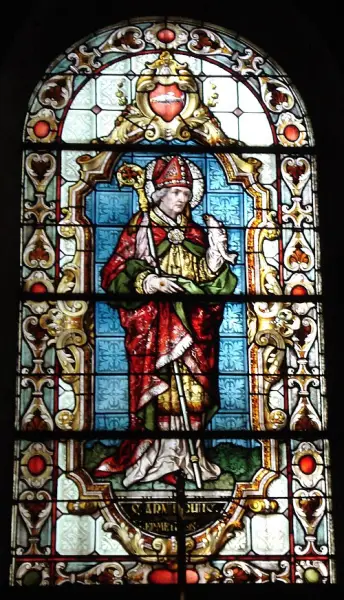
Overview
Arnulf of Metz was a Frankish bishop of Metz and one of the last of the Merovingian era's bishop-statesmen. Born around 582 to an important Frankish family near Nancy, whose domains lay between the Moselle and the Meuse, he was called as a youth to the court of Theudebert II of Austrasia and educated by Gondulf of Provence. He gave distinguished service as soldier and civil administrator, at one time governing six provinces, and married a noblewoman the later sources call Dode, by whom he had sons including Chlodulf. Around 611 he and his friend Romaric planned a pilgrimage to Lérins; instead, pressed by King Chlothachar, whose vacant see of Metz awaited him, Arnulf's wife took the veil and he became priest and bishop. As bishop he remained at court, joined Pepin of Landen in the revolt that overthrew Queen Brunhilda in 613, served as tutor and chief adviser to the young Dagobert I, and took part in the council of Reims in 625. Around 628 he withdrew to the hermitage he had built at Habendum in the Vosges, near the abbey his friend Romaric had founded at Remiremont, and there he died between 643 and 647. He is venerated as a saint, and is the patron of brewers. The tradition makes him the earliest named ancestor of the Carolingian dynasty.
The Complete Life
Early Life
Arnulf was born around 582 to a family the Vita Sancti Arnulfi, written within a generation of his death, describes as of sufficiently elevated and noble parentage, very rich in worldly goods, Frankish landowners whose domains stretched between the Moselle and the Meuse, in the country near modern Nancy. Later genealogies made his father a bishop's kinsman named Arnoald, but the modern historians of the Franks, Patrick Geary and Richard Gerberding among them, judge such constructions fabrications: with almost no contemporary documents, Arnulf's ancestry cannot be traced. His youth was spent at court: called to the service of Theudebert II of Austrasia, he was educated there by Gondulf of Provence, and then employed in both arms and administration, distinguishing himself as a military commander and civil governor, at one point with six provinces in his care. He married a noblewoman whom later sources call Dode, and by her had children, of whom the eldest son, Chlodulf, would himself be bishop of Metz. It was the classic career of the Austrasian aristocrat, and it was by no means finished when God interrupted it.
§ Life
From Court to Cathedral
Around 611 Arnulf and his friend Romaric, a fellow officer, planned to leave the world and make pilgrimage to Lérins, the great island monastery of the south. King Chlothachar, who appreciated Arnulf's administrative skills, had other plans: the see of Metz, the capital city of Austrasia, was vacant, and the king offered it to his servant. The custom of the age permitted what seems to us a strange arrangement: Arnulf's wife took the veil as a nun at Trèves, and Arnulf, reading in this the will of God, became priest and then bishop, while continuing to serve the king as steward and courtier. He was bishop of Metz from around 612, governing the church of one of the greatest cities of Gaul, and, in the manner of the Merovingian episcopate, remaining at the center of politics. The Vita says he was tormented by the violence around him and feared he had played a part in the wars and murders of the ruling houses, a conscience that prepared his later withdrawal; the legends of the ring thrown into the Moselle, and recovered in a fish's belly as a sign that he might leave, belong to this inward drama.
§ Life
The Politics of a Kingdom
Arnulf's episcopate was inseparable from the revolution that remade the Frankish kingdoms. He joined his politics to Pepin of Landen, the mayor of the palace, and led the aristocratic opposition to Queen Brunhilda, the aged regent whose rule had united Austrasia and Burgundy; the revolt of 613 led to her overthrow, torture and execution, and to the reunification of the Frankish lands under Chlothachar II. Under the new order Arnulf stood at the summit: when Dagobert I was made king of Austrasia, Arnulf and Pepin governed beside him, the bishop serving as the young king's tutor and chief adviser, and sharing, in 624, in the encouragement of Dagobert's murder of Chrodoald, an Agilolfing leader, an act the sources record without flinching. He took part in the council of Reims of 625 among the bishops of the realm. It was a career of power, service and compromise, of the kind the Merovingian church required of its great men, and Arnulf carried its weight to the end of his life.
§ Life
The Hermit of the Vosges
Around 628, with Dagobert established and the kingdom at peace, Arnulf left. He retired to a hermitage on a mountain in his own domains in the Vosges, at Habendum near Remiremont, the abbey his friend Romaric had founded with Amatus after the fall of Brunhilda, whose persecution had orphaned him; the two old courtiers thus ended as they had once intended, in the monastic life they had postponed for a generation of statecraft. Arnulf lived there as a monk, in poverty and prayer, for another fifteen years or so, and his death came at some point between 643 and 647. Remiremont became his burial place, and veneration of him began immediately; later his relics were translated to Metz, to the church that bears his name, and the Carolingian rulers who claimed descent from him, rightly or not, honored his tomb as that of their ancestor. The Vita Sancti Arnulfi of around 657, written by a contemporary who had known him, fixed the memory of the bishop who laid down power.
§ Life
Canonization
Arnulf belongs to the pre-congregation saints of the Frankish church, his cult established at Remiremont and Metz within years of his death and confirmed by the whole tradition of the Gallican calendars; his feast on 18 July stands in the Roman martyrology tradition, and the Eastern Orthodox Church, which venerates the saints of the undivided church, numbers him also. The question that has most occupied his modern students is genealogical rather than devotional: the tradition that makes him the earliest named ancestor of Charlemagne, through his close relative Ansegisel's marriage to Begga, Pepin's daughter, rests on texts written a century after his death, Paul the Deacon and the Annales Mettenses, whose accounts disagree with each other, and some scholars hold that the Carolingian descent from the saint was an invention of Charlemagne's own propaganda. The church's judgment of Arnulf was never in doubt; the dynasty's claim on him is the historian's problem.
§ Introduction
Legacy
Arnulf's legacy has three faces. Dynastically, as the traditional ancestor of the Carolingians, he stands at the head of the line that produced Charles Martel, Pepin and Charlemagne, whatever the historians conclude about the pedigree, and the greatest ruling family of the early middle ages claimed his blood as its blessing. Institutionally, he represents the Merovingian bishop-statesman, the type that governed Gaul between the kingdoms, and his withdrawal to Remiremont has made him a patron of the difficult art of leaving office. Popularly, he is the patron of brewers, a patronage that grew from the legends of his relief of the people's thirst and from the iconography that gives him a rake in his hand, and which has made his feast, 18 July, a festival of the brewing towns of Lorraine, Flanders and Germany. Few saints wear so many crowns: bishop, counselor, hermit, ancestor, and the friend of everyone who makes beer.
§ Introduction
Timeline
- 582
Born to an important Frankish family near Nancy in Lorraine, around this year
§ Life
- 596
Takes as wife a noblewoman whom later sources name Dode or Doda, aunt of Saint Glodesind
§ Life
- 611
Plans a Lérins pilgrimage with Romaricus, but instead accepts the vacant see of Metz from Chlothachar and becomes priest and bishop
§ Life
- 613
Joins Pepin of Landen in the noble revolt against Queen Brunhilda, whose overthrow reunites the Frankish lands under Chlothachar II
§ Life
- 624
With Pepin, encourages King Dagobert I in the murder of Chrodoald, a leader of the Agilolfings
§ Life
- 625
Takes part in a council of the Frankish bishops held at Reims
§ Life
- 628
Retires to a hermitage on a mountain site in his Vosges domains to become a monk, around this year
§ Life
- 629
After the death of Chlothachar, settles near Habendum
§ Life
- Jul 642
In the legend of the beer mug, parishioners of Metz recover his remains from Remiremont and his beer multiplies for them at Champigneulles
§ The Legend of the Beer Mug
- 643
Dies some time between this year and 647 and is buried at Remiremont
§ Life
- 657
The Vita Sancti Arnulfi, written shortly after his death, dates from around this year
§ Genealogy
The Record
- Patron of
- Brewers·Metz·Soldiers
- Symbols
- Bishop's staff·Rake in his hand (from the legend of the beer mash)
- Canonization
- Pre-congregation; cult from the seventh century
Prayer
Bibliography
Show 12 sources
- ↑ Vita Arnulfi c. 1, MG. SS. rer. Merov. 2, p. 432.
- ↑ MGH SS 13 p. 249
- ↑ Gerberding, The Rise of the Carolingians and the Liber Historiae Francorum , 6.
- ↑ Patrick Geary, Before France and Germany: The Creation and Transformation of the Merovingian World (New York: Oxford University Press, 1988), 192.
- ↑ Kempf, Liber de episcopis Mettensibus , 73.
- ↑ Unknown, “The First Section of Annales Mettenses priores (805),” 352.
- ↑ Fouracre and Gerberding, “Vita Domnae Geretrude (The Life of Saint Gertrude),” 311.
- ↑ Bouchard, “The Carolingian Creation of a Model of Patrilineage,” 141.
- ↑ Collins, Charlemagne , 24–25.
- 1 2 Monks of Ramsgate. “Arnoul – Bishop”. Book of Saints , 1921
- 1 2 3 Riché, Pierre – The Carolingians: A Family Who Forged Europe , University of Pennsylvania Press, 1993 ISBN 9780812213423
- 1 2 3 Schaefer, Francis. "St. Arnulf of Metz." The Catholic Encyclopedia. Vol. 1. New York: Robert Appleton Company, 1907. 18 Jul. 2014
Profile text adapted from the Wikipedia article, licensed CC BY-SA 4.0.
Pray with this saint every day
Save St. Arnulf of Metz to your favorites, read the full profile, and get feast-day reminders in the Saints app.
Get the Saints AppFree on the App Store for iPhone and iPad