
4th or 6th century (uncertain)·Feast November 12
St. Arsatius
Bishop (traditionally of Milan), Confessor of Bavaria
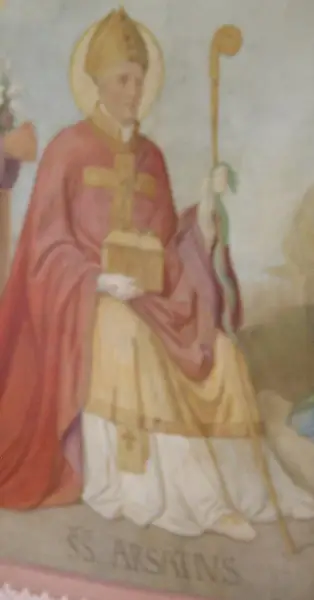
Overview
Arsatius, also spelled Arsacius, is a saint of whom virtually nothing is known — a point the oldest sources admit with remarkable candor. Tradition makes him a bishop of Milan, dating him either to about the year 400 or to the sixth century, and perhaps a martyr; but nothing supports either claim, and the tradition that he was a disciple of St. Ambrose, the great bishop of Milan, rests on nothing but the Milanese connection itself. What is documented is the cult: in 766 his relics were translated from Rome to the monastery of Ilmmünster in Upper Bavaria, where a basilica bearing his name still stands and where devotion to him grew through the Middle Ages. The relics were moved to Munich in 1495 and returned to Ilmmünster in 1846. The Roman Martyrology tradition keeps his feast on 12 November. Arsatius is thus a saint whose historical person has dissolved entirely, leaving only the veneration: a reminder that the cult of relics in early medieval Bavaria created saints as reliably as it honored them.
The Complete Life
A Saint Without a Biography
The sources on Arsatius are candid to the point of embarrassment: of his life virtually nothing is known. The traditions give him a Milanese episcopate in either the age of Ambrose (around 400) or the sixth century, and add the claims of martyrdom and of discipleship under Ambrose himself — each of which the standard reference works dismiss for lack of any evidence. The Milanese attribution itself may be nothing more than an inference drawn from relics that arrived labeled with a name common in northern Italy. In the eyes of the medieval church this did not matter as it matters now; a saint was present in his bones and active at his shrine, and a biography was a courtesy the liturgy could supply from its stock of formulas.
The Translation of 766
What gave Arsatius his place in history was an event three centuries after his supposed death: in 766 his relics were brought from Rome to the monastery of Ilmmünster, in the upper valley of the Ilm in Bavaria. The translation belongs to the great age of Carolingian relic-gathering, when the young church of Bavaria imported Roman saints to consecrate its new foundations — a pious commerce that filled the German countryside with Roman names. Around the relics at Ilmmünster a cultus grew, and the basilica that bears his name — the Arsatius-Basilika — became the center of his veneration, which the diocese of Munich and Freising administered for centuries.
Wanderings of the Relics
The relics' later history is better documented than the saint's life. In 1495 they were transferred to Munich; in 1846 they were restored to Ilmmünster, where they remain. The double movement mirrors the secular and ecclesiastical history of Bavaria — the concentration of institutions in the capital at the end of the Middle Ages, and the nineteenth-century romantic return of local identity — and it gave the small town a saint to lose and regain, which is more biography than Arsatius's own person ever had.
Cult
Arsatius's canonization is pre-congregation and purely cultic: no process, no acts, no vita — only a feast, a shrine, and a calendar entry on 12 November. His cult is essentially local to Upper Bavaria, though the diocesan records of Munich and Freising, which preserve the fullest accounts, carry him as a saint of the diocese. The historical dictionaries of the saints include him chiefly as a cautionary exhibit: the category of saints whose veneration is certain and whose existence is not.
Legacy
Arsatius's legacy is historiographical as much as devotional. He illustrates how the early medieval church of Germany was built: not only by missionaries and bishops whose names fill the chronicles, but by wagonloads of Roman bones that gave the new foundations apostolic and patristic pedigree. The basilica at Ilmmünster still stands, the feast is still kept, and the visitor who asks who Arsatius was receives the same answer the sources give: no one knows, and the people have honored him for twelve hundred years. In the economy of the cult of saints, that is a complete answer.
Timeline
- 766
His relics are brought from Rome to Ilmmünster Monastery, where a cult grows up around them
§ Introduction
- 1495
The relics are moved to Munich
§ Introduction
- 1846
The relics are returned to Ilmmünster
§ Introduction
The Record
- Patron of
- Ilmmünster, Bavaria
- Symbols
- Bishop's vestments
- Canonization
- Pre-congregation; cult centered on Ilmmünster, Bavaria
Prayer
Profile text adapted from the Wikipedia article, licensed CC BY-SA 4.0.
Pray with this saint every day
Save St. Arsatius to your favorites, read the full profile, and get feast-day reminders in the Saints app.
Get the Saints AppFree on the App Store for iPhone and iPad