
1840-1924·Feast November 10 (New Style); October 28 (Old Style)
St. Arsenios the Cappadocian
Archimandrite and Confessor of Pharasa
Overview
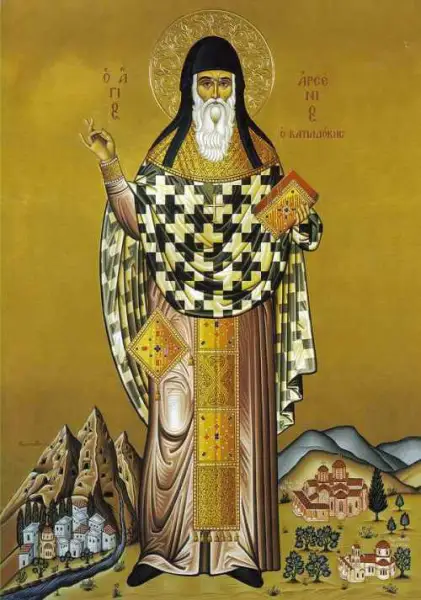
Arsenios the Cappadocian — born Theodorus Annitsalichos at Kephalochori in Pharasa, Cappadocia, in 1840 — was a Greek priest, teacher, and healer who kept Orthodox Christianity alive in the Muslim-ruled villages of central Anatolia for more than half a century. Orphaned young, both parents dying when he was very small, he was raised by a maternal aunt and educated at Niğde and Smyrna, learning Greek and Church studies along with Armenian, Turkish, and some French. At about twenty-six he entered the monastery of the Holy Forerunner of Phlavianai at Caesarea, was tonsured with the name Arsenios, and was sent by Metropolitan Paisios II to serve Pharasa and the neighboring villages as a priest, while also giving the children of the region secret lessons in the Greek language under the Ottoman authorities' rule. Consecrated archimandrite at thirty in 1870, he made a pilgrimage to the Holy Land, after which the villagers called him Hadjiephentis, the honored pilgrim. He was the respected spiritual guide of Pharasa, working with the village mayor — the father of the future Elder Paisios of Mount Athos, whom Arsenios baptized with his own name over the parents' wishes — and sick people, Christians and Muslims alike, were said to be healed when they came to him. In 1924 he led his parish in the population exchange between Greece and Turkey, conducting his people to the island of Corfu, and died there after three months, on 10 November 1924. He was recognized as a saint by the Ecumenical Patriarchate in 1986.
The Complete Life
An Orphan of Pharasa
Theodorus Annitsalichos was born in 1840 at Kephalochori, a village among the six Christian settlements of the Pharasa district in Cappadocia, an early center of Eastern Orthodox Christianity deep in the Anatolian interior. His father was himself a teacher; he lost both his parents in earliest childhood, and he and his brother were brought up by a maternal aunt. That implied schooling was carried forward by others: he was sent to Niğde, lodged with a paternal aunt who earned her own living as a teacher, and she arranged for him to continue his studies in Smyrna with relatives. Besides Greek and Church subjects he learned Armenian, Turkish, and some French — the linguistic equipment of a Christian professional class in the Ottoman Empire. At about twenty-six he left the world for the monastery of the Holy Forerunner of Phlavianai at Caesarea, the Cappadocian metropolis, where he was tonsured a monk and given the name Arsenios.
Priest and Secret Schoolmaster of Pharasa
Metropolitan Paisios II of Caesarea sent Arsenios to Pharasa and the neighboring villages as a priest — a pastorate that lasted, with one interruption, the rest of his active life. His work was double: at the altar he was the spiritual father of a Greek Orthodox island in a Muslim sea, and beyond the altar he gave the children of the region secret lessons in the Greek language, an undertaking the Ottoman authorities did not welcome, in the decades when the schools were the survival mechanism of the Greek communities of Asia Minor. Consecrated archimandrite in 1870 at the age of thirty, he went on pilgrimage to the Holy Land, and on his return the villagers gave him the title of Hadjiephentis, honored pilgrim. He worked closely with the mayor of Pharasa, who was the father of the child the world would know as Elder Paisios of Mount Athos; Arsenios baptized the boy with his own name, Arsenios, over the parents' wish to name him for a grandfather, and later became his spiritual father — the first formative saint in the life of one of the twentieth century's most read Orthodox elders.
The Healer of Christians and Muslims
The tradition that grew around Arsenios in his lifetime and after centers on healing. Sick people came to him — Christians and Muslims, the sources specify — and he was claimed to have healed them; the practice belongs to the long Cappadocian tradition of priest-healers, and to the plain fact that in a village of the Anatolian interior the priest was the only accessible healer of last resort. His inner discipline is visible in what survives of his practice: a collection of Psalms ordered by their specific use, the psalter applied as a manual of intercession for every condition, and teachings and admonitions preserved in the service books of the mother church of Pharasa, which his disciples brought to Greece as manuscripts in the Cappadocian dialect. His was a spirituality of the psalms and the liturgy carried on under permanent threat, and the Muslim neighbors' recourse to him is the strongest evidence the sources offer that his reputation was not sectarian.
Exodus and Corfu
The end of Arsenios's Cappadocian life was the end of Cappadocian Hellenism itself. In the population exchange between Greece and Turkey that followed the catastrophe of 1922, the Greeks of Pharasa were among those expelled, and Arsenios — eighty-four years old — led his parish out. The village went together to the island of Corfu, the priest conducting the exodus as he had conducted everything else, and there, three months after the arrival, he died, on 10 November 1924, at Kerkyra. He had spent fifty-eight years making Pharasa Christian and Greek, and his last act was to bring it, whole, to Greece. He was buried on Corfu, and his relics may also be venerated at the Greek Orthodox Church of Prophet Elias in Frankfurt, Germany. He was eighty-four when he led the village out, and he organized the exodus as he had organized everything else — the priest last, with his people.
Glorification
Arsenios was recognized as a saint of the Orthodox Church by the Ecumenical Patriarch Demetrios I of Constantinople in 1986 — one of the earlier glorifications of the modern Athonite and Anatolian revival, and in significant part the work of his spiritual son Paisios of Mount Athos, whose biography of the saint (published by the Hesychasterion of Evangelist John the Theologian at Souroti) carried his memory to the whole Orthodox world. Paisios himself was glorified by Patriarch Bartholomew I in 2015, so that the two names now stand together in the calendar, the godfather-saint and the disciple-saint of Pharasa and Athos. Arsenios's feast is kept on 10 November new style, 28 October old style. The glorification of 1986 by Patriarch Demetrios I was among the earlier acts of the modern Anatolian revival, and it carried the Pharasa tradition to the whole Orthodox world. His feast on 10 November new style is kept in the Greek calendars and by the diaspora, and Pharasa's exiles kept it wherever they settled.
The Last Priest of Pharasa
For the Cappadocian Greeks and their descendants, Arsenios is the emblematic figure of the end: the priest who kept the language and the faith in the villages, healed whoever came, and then walked his people out of the country when the walk was required. His cult today runs from Corfu to Mount Athos to the diaspora, fed above all by the writings of Elder Paisios, whose enormous readership has made the schoolmaster-priest of Pharasa known far beyond the boundaries of the communities he served. The manuscript teachings brought from the mother church of Pharasa, translated from Cappadocian Greek into Standard Modern Greek and published, preserve his voice — a voice of the psalms, of admonition, and of a village Christianity that no longer exists on the ground but survives in the church that honored its priest. The Souroti editions of his life and teachings, and the pilgrimage from Corfu to Frankfurt where his relics may also be venerated, keep his cult moving as he himself moved.
Timeline
- 1840
Born Theodorus Annitsalichos in Kephalochori, one of the six Christian villages of Pharasa in Cappadocia.
§ Life
- 1866
Goes at about twenty-six to the monastery of the Holy Forerunner at Phlavianai in Caesarea and is tonsured Arsenios.
§ Life
- 1870
Consecrated an archimandrite at thirty; after a Holy Land pilgrimage the villagers call him Hadjiephentis.
§ Life
- 1924
Leads his parish from Pharasa to Corfu during the population exchange between Greece and Turkey.
§ Life
- 10 Nov 1924
Dies at Kerkyra three months after the exodus, aged eighty-four.
§ Introduction
- 1986
Recognized as a saint of the Ecumenical Patriarchate under Patriarch Demetrios I of Constantinople.
§ Life
The Record
- Major works
- Collection of Psalms ordered by their specific use (Greek)·Teachings and admonitions preserved from the books of the mother church of Pharasa (Cappadocian Greek, later translated)
- Patron of
- Pharasa and the Cappadocian Greeks·Healing of the sick
- Symbols
- Priest's cross and phelonion·Psalter
- Canonization
- Glorified as a saint by the Ecumenical Patriarch Demetrios I of Constantinople in 1986
Prayer
Profile text adapted from the Wikipedia article, licensed CC BY-SA 4.0.
Pray with this saint every day
Save St. Arsenios the Cappadocian to your favorites, read the full profile, and get feast-day reminders in the Saints app.
Get the Saints AppFree on the App Store for iPhone and iPad