
c. 354-450·Feast May 8 (Orthodox and Catholic; July 19 pre-1970 Catholic); 13 Pashons (Coptic)
St. Arsenius the Great
Deacon of Rome, Tutor of Emperors, Desert Father
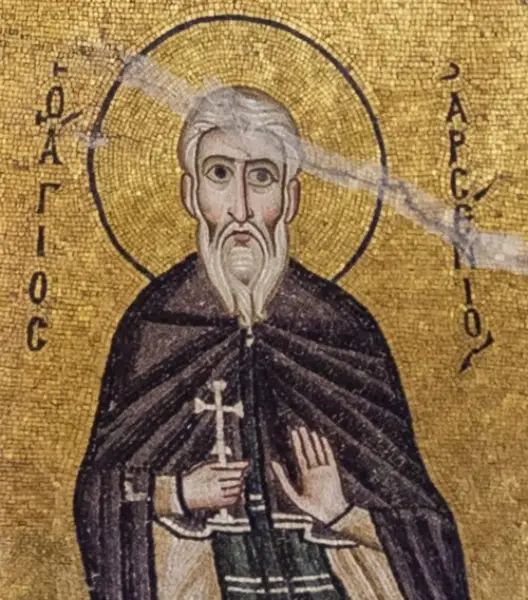
Overview
Arsenius the Deacon, called the Roman or the Great, was born in Rome about 354 to a Christian senatorial family, received a fine education in rhetoric and philosophy, and mastered both Latin and Greek. Made a deacon by Pope Damasus I, he was recommended to the emperor Theodosius I, who around 383 had asked Gratian and the pope to find him a tutor from the West for his sons Arcadius and Honorius, the emperors-to-be; the man chosen was Arsenius, deeply versed in Greek letters. He arrived at Constantinople in 383 and spent eleven years amid the great pomp of the palace, all the while feeling an increasing pull toward renouncing the world. He left the court by ship for Alexandria, fled into the wilderness, and presented himself to Macarius the Great, who committed him to John the Dwarf; the test of his humility at the monk's table satisfied his director, and John tonsured him into monasticism around the year 400 at Scetis. Contemporary admiration gave him the surname of 'the Great'. In 434 the raids of the Mazices forced him from the desert to Troe near Memphis and the island of Canopus, and after fifteen years of wandering he returned to Troe to die around 445-450 at about ninety-five. His sayings and life, put on record by Palladius and in the Apophthegmata, deeply shaped how asceticism and the contemplative life later developed.
The Complete Life
Early Life
Arsenius was born at Rome about the year 354 into a Christian family of the senatorial class, at the moment when the old aristocracy was quietly accepting the new faith while keeping its standards of education. He received the full literary formation of his rank, studying rhetoric and philosophy and mastering both of the empire's great languages, Latin and Greek, a double competence that made him a valuable man. He was ordained a deacon by Pope Damasus I, the pope under whom the Latin church's liturgy and scriptures were being given their definitive Roman form. His reputation as a man well read in Greek literature, at a time when Greek learning was becoming rare in the West, brought him to the attention of the imperial court: around 383 Theodosius I, through Gratian and Pope Damasus, requested a tutor from the West for his sons Arcadius and Honorius, the future rulers of the eastern and western empires, and Arsenius was chosen. The anecdote Theodosius' biographers preserved, that the emperor found the tutor seated while the princes stood, and reversed the arrangement, belongs to his Roman schooling in rank as much as in letters.
Vocation
For eleven years Arsenius lived at Constantinople as tutor to the imperial children, in the splendid establishment the emperor provided and, probably because the emperor so desired, in great pomp. The tradition insists that through it all he felt himself increasingly drawn to renounce the world: the palace was his furnace as the desert would be his freedom. When the moment came he slipped away secretly, taking ship for Alexandria, and from there made his way into the Scetis wilderness, where he put himself before Macarius the Great, father of that desert's monks. Macarius entrusted him to John the Dwarf, who tested the ex-tutor of emperors by leaving him standing while the others sat at table, and then throwing him bread as to an animal; Arsenius meekly took the bread and ate it sitting on the ground, and the proof of humility satisfied his judge. John kept him under direction and tonsured him into monasticism around the year 400. His vocation, in the desert's judgement, was thus twofold: to be a monk, and to be humbled out of the habits of a court into the habits of a servant.
Mission
Arsenius' mission in the desert was not the founding of institutions but the achieving and transmitting of an inner condition. Palladius, who visited the desert monasteries and recorded what he found, noted that through all the fifty-five years of solitude he never stopped weeping, and the Apophthegmata give the reason in his own reported words, that he had not yet fulfilled the one little word, 'flee'. His cell at Scetis became a place to which the monks came for a word, and his sayings, terse and severe, entered the common stock of the desert tradition: on repentance for speech and never for silence, on the danger of returning to what one has renounced, on the primacy of tears. He stands in the line of those Fathers whose teaching was their life rather than their writing, and whose authority came from the visible quality of their solitude. In 434, when the Mazice raiders swept down on the monasteries and hermitages of Scetis, his mission survived even flight: he moved to Troe near Memphis and to the island of Canopus off Alexandria, and the monks followed, so that his exile extended rather than ended his influence.
Spirituality
The spirituality of Arsenius is the spirituality of flight, silence, and tears, and it was formed in the painful transition from palace to cell. His sayings insist on the fragility of the former life: he reportedly cautioned that a monk who has left the world must not turn back toward it, and he wept over his own years at court even after decades of penance, saying that he often repented of speaking but never of silence. The word 'flee' was, in his self-assessment, the whole of monastic teaching and the one command he could not fully execute, a confession that made the ideal concrete for every generation after him. His practice was extreme even by desert standards: continual weeping, deliberate avoidance of the reputation that the visitors brought, and, when the crowds became too great, further withdrawal into solitude. The tradition also remembers him praying to be delivered from the memory of the pleasures he had known, and receiving the answer that had he not been a man of learning and study, he could not have endured; his education, sanctified, became the spine of his asceticism. His tears, which never stopped, were understood as the sign that the work of repentance is never finished in this life.
Final Years
The last fifteen years of Arsenius' life were years of wandering. After the Mazice raid of 434 he never re-established himself at Scetis, but moved between Troe near Memphis and the island of Canopus, living as a stranger in each place, before returning at last to Troe to die around the year 445, or by the longer reckoning in 450, at the age of about ninety-five. He had outlived his pupils the emperors, his teachers of the desert, and almost the whole first generation of the monastic movement, a living remnant of the age of Antony, whom he had known through the tradition, and of Scetis at its first flowering. His death, like his life, was quiet; the sources do not embellish it. Palladius preserves the essentials, and the Apophthegmata the manner of man he was. He had asked in the desert for the mercy of a continuous penitence, and his long dying, decades of it, was the answer to that request.
Legacy
Arsenius ranks among the most highly esteemed of the Desert Fathers; through the Lausiac History of Palladius and the Apophthegmata Patrum, his teachings powerfully shaped the growth of asceticism and the contemplative life in East and West alike. The type he established, the learned courtier who becomes a tearful hermit, has been a standing temptation and inspiration to every Christian generation tempted by accomplishment. His sayings circulate wherever the desert fathers are read, and the chief of them, on silence, on flight, on tears, are among the most quoted sentences of the monastic tradition. He is celebrated on May 8 in the Eastern Orthodox and Roman Catholic churches — Roman Catholics observed his feast on July 19 until the Roman Martyrology was revised after Vatican II — and, in the Coptic Orthodox Church, on 13 Pashons. For the church's contemplative minority in every age, he remains the patron and the reproach: the man who did everything, left everything, and still counted himself at the end a beginner.
Timeline
- 354
Born at Rome to a Christian senatorial family; the article's infobox dates this around 354, its Biography to 350
§ Introduction
- 383
Reaches Constantinople as tutor to the imperial princes Arcadius and Honorius, having been recommended by Pope Damasus I
§ Biography
- 400
Joins the desert monks at Scetis and is tonsured by John the Dwarf after proving his humility, around this year
§ Biography
- 434
Forced by Mazices raids to leave Scetis; relocates to Troe near Memphis and spends time on the island of Canopus
§ Biography
- 445
Returns to Troe to die at about ninety-five, around this year, after fifteen years of wandering the desert
§ Biography
- 1010
Al-Hakim's decree brings the sack of the Tura community, whose monastery is looted and destroyed
§ Tura monastery
- 1020
The caliph grants the petition for restitution of the monastery's property and permission to rebuild
§ Tura monastery
- 1321
Fourteen Chalcedonian monks of his monastery are burned in the anti-Christian violence, and the monastery is abandoned
§ Tura monastery
- 1941
British soldiers discover the Tura Papyri in a cavern at Tura; some scholars link the codices to Arsenius' monastery
§ Tura monastery
In Their Own Words
Many times have I repented of having spoken, but never have I repented of having remained silent.
As much as you are able, strive so that what goes on inside you be godly and you conquer your external passions.
God knows that I love you, but I cannot be with God and with people. The thousands and tens of thousands above have one will, but people have many wills, so I cannot forsake God and come among people.
The Record
- Major works
- Sayings preserved in the Apophthegmata Patrum (Alphabetic and Systematic collections)·Life recorded by Palladius in the Lausiac History
- Patron of
- Educators of rulers (by tradition)·Those seeking solitude
- Symbols
- Deacon's dress of Rome·The desert cell·Tears of penitence
- Canonization
- Pre-congregation; honoured in Roman Catholic, Eastern Orthodox, Oriental Orthodox, and Church of the East traditions
Prayer
Profile text adapted from the Wikipedia article, licensed CC BY-SA 4.0.
Pray with this saint every day
Save St. Arsenius the Great to your favorites, read the full profile, and get feast-day reminders in the Saints app.
Get the Saints AppFree on the App Store for iPhone and iPad