
1101-1206·Feast October 6
St. Artaldus
Carthusian Bishop of Belley
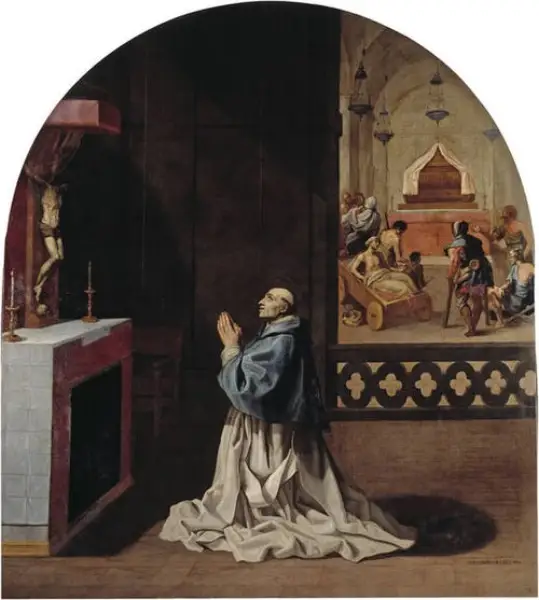
Overview
Artaldus, also called Arthaud, born in 1101 at the castle of Sothonod in Savoy, was a Carthusian monk who became bishop of Belley and lived to the age of one hundred and five. Little is known of his childhood; at eighteen he entered the court of Duke Amadeus III of Savoy, but after about a year he left to study for the priesthood. Entering the Carthusian house of Portes, in the present Bénonces, he was ordained priest and served there for many years until the prior of the Grande Chartreuse sent him to found a charterhouse in the Valromey, at a place called the cemetery. Taking six fellow priests from Portes, he established the community; when the first buildings were destroyed by fire, he chose a fresh site on the Arvières river, and there in 1132 founded the charterhouse of Arvières, dedicated to Our Lady. His fame there grew to resemble that of St. Bruno himself, and like Bruno he was called from his solitude to be a bishop, raised to the see of Belley when already past eighty. Within barely two years he stepped down and went back to Arvières, spending the remainder of his life there, visited in his great age by Hugh of Lincoln, and dying in 1206. His cult was confirmed by Pope Gregory XVI in 1834.
The Complete Life
Early Life
Artaldus was born in 1101 at the castle of Sothonod in Savoy, a child of the mountain nobility of the western Alps, in the generation after St. Bruno had founded the Grande Chartreuse in 1084. Of his childhood nothing is recorded. At eighteen he entered the court of Duke Amadeus III, the normal opening of a noble career in a state that was at bottom an aristocracy of warriors ruling its valleys; yet within about a year he walked away, resolved on the church. The choice between the court and the cloister was the standing drama of the twelfth-century aristocracy, and Artaldus made it early and completely: from the duchess's household to the priesthood, and from the priesthood to the strictest order of them all, the Carthusians, whose life of solitude, silence and prayer was just then attracting the most uncompromising of the age's religious spirits. He entered the charterhouse of Portes, in the hills of the present Bénonces, and was ordained priest there, spending many years in the community's round of cell and choir.
§ Early life
Founder of Arvières
The Grande Chartreuse then did for him what it did for its best sons: it sent him out. The prior commissioned him to found a charterhouse in the Valromey, at a place known as the cemetery, and Artaldus took six fellow priests from Portes to establish the community. The first buildings were ravaged by fire, and the founder chose a fresh site on the Arvières river, founding there in 1132 the charterhouse of Arvières, dedicated to Our Lady. The Carthusian method of foundation was always the same: a desert place, a few cells, the liturgy and the silence, and the fame of Arvières grew through the century, for its prior lived what he built. The sources compare his reputation to that of St. Bruno himself, his master in the second generation, and the comparison prepared the repetition of Bruno's own story: the hermit called out of his mountain to be a bishop. Artaldus was over eighty when the see of Belley, the small diocese between the Ain and the Rhone, fell to him.
§ Early religious life
Bishop and Return
He accepted the episcopate as Bruno had accepted his, and administered it with the same brevity. Belley in the late twelfth century was a country see, poor and exposed between the powers of Savoy and the empire, and an eighty-year-old Carthusian was not the obvious instrument of its politics; less than two years after his consecration Artaldus resigned and returned to Arvières. The gesture, in the church of his age, was not a failure but a judgment: he had given the see what it needed of him, and the desert claimed its own. Back in his cell he lived another quarter century, the father of a house whose fame had spread through the church, and in his extreme old age he received the visit of Hugh of Lincoln, the great Carthusian bishop of England, who had persuaded King Henry II to become a benefactor of Arvières; the meeting of the two monks, the hundred-year-old and the English bishop, belongs to the legend of both.
§ Later life and death
Final Years
Artaldus lived the remainder of his days at Arvières and died in 1206, at the age of one hundred and five by the chronology the tradition has always kept. Even discounted for the generosity of medieval arithmetic, his was one of the longest lives in the calendar, almost exactly spanning the century of St. Bruno's second and third generations, and his death closed the heroic first age of the Carthusian expansion in the west. His cult was immediate at Arvières and in the country of Belley, and it endured until its formal confirmation by Pope Gregory XVI in 1834, in the great series of confirmations by which the nineteenth-century church ratified the local saints of France after the Revolution's devastation. His feast is kept in the Carthusian order and the dioceses of his country.
§ Introduction
Legacy
Artaldus' legacy is the charterhouse of Arvières, whose ruins still stand in the Valromey, and the ideal he embodied: the founder who governed without leaving his cell, the bishop who gave the office back, the monk who lived a century. For the Carthusian order, whose statistica libera of solitude has continued unchanged for nine hundred years, he is one of the fathers of the second generation, the men who carried Bruno's experiment from the Chartreuse into the mountains of Europe. His extraordinary age made him a prodigy to his contemporaries and a gentle joke to posterity, the saint who outlived everyone who might have written about him. And the two-year episcopate has kept its lesson for the church: that a see can be served by a refusal to possess it, and that the man who returns to his cell may serve the church more by his prayer than his predecessor did by his palace.
§ Early religious life
Timeline
- 1101
Born at the castle of Sothonod in Savoy
§ Early life
- 1132
Founding the Arvières Charterhouse on a new site after fire, dedicated to Our Lady, with six priests from Portes
§ Early religious life
- 1206
Dies at Arvières aged about 105
§ Later life and death
- 1834
Pope Gregory XVI confirms his cultus
§ Later life and death
The Record
- Patron of
- Carthusians·The diocese of Belley·The very old
- Symbols
- Carthusian white habit·Bishop's crozier laid aside
- Canonization
- Cult confirmed 1834 by Pope Gregory XVI
Prayer
Bibliography
Show 2 sources
Profile text adapted from the Wikipedia article, licensed CC BY-SA 4.0.
Pray with this saint every day
Save St. Artaldus to your favorites, read the full profile, and get feast-day reminders in the Saints app.
Get the Saints AppFree on the App Store for iPhone and iPad