
died 362·Feast October 20
St. Artemius of Antioch
Megalomartyr, Imperial Prefect of Egypt
Overview
Artemius — Flavius Artemius in the imperial records, Shallita in the Syriac churches — was a general and imperial official of the mid-fourth century who ended as a Christian martyr under Julian the Apostate. A trusted companion of Constantius II, he held the post of dux Aegypti, military governor of Roman Egypt, in the final years of that emperor's reign; a papyrus listing of 360 names him Flavius Artemius in that rank. The Passion of Artemius credits him with carrying out Constantius's orders to translate the relics of the apostles Andrew, Luke and Timothy to Constantinople, in return for which he received Egypt — though the earlier sources for those translations do not mention him. In Egypt he supported the Arian bishop George of Cappadocia against both pagans and the orthodox, and joined the pursuit of Athanasius. Summoned to Antioch by Julian after that emperor's accession, he was accused of involvement in the death of Julian's half-brother Gallus and of supporting two tortured priests of Antioch; he was tortured, refused to sacrifice, and beheaded in 362. The Greek church honors him as a megalomartyr; the Syriac churches revere him as Mar Shalita, 'the empowered one,' with feast on 19 September in the Assyrian tradition and 20 October in the Byzantine.
The Complete Life
Between Record and Legend
Artemius is unusual among the martyrs for the amount of contemporary documentation that touches him — and for how little it agrees with the hagiography. The Passion of Artemius, an eighth-century compilation, makes him a senator and intimate of Constantine from the era of the Milvian Bridge; but the stories that place him at Constantine's side would make him at least eighty at his death, and the compiler's citation of Eusebius proves false, since Eusebius never mentions him. The claim that survives scrutiny is different: that he was a friend and companion of Constantius II, Constantine's son, under whom he rose to the prefecture of Egypt — and this the papyri confirm, a senate minute from Oxyrhynchus recording in 360 one Flavius Artemius, dux Aegypti. An Egyptian birth is reported in at least one tradition, though the sources do not settle it.
Prefect of Egypt
Egypt under Constantius was the storm center of the church. The emperor's man in Alexandria had to enforce the Arian settlement against Athanasius, the exiled orthodox bishop whose flock hid him, and to manage a pagan population whose great temple of Serapis still stood. Artemius did both. The sources record his support for George of Cappadocian, the Arian bishop installed in Alexandria, his participation in the sacking of the Serapeum's forerunner institutions, and his pursuit of Athanasius — a record that would seem to disqualify him from any church's calendar, and that the compilers of his Passion passed over. Yet the imperial service he was rewarded for included, on the same record, the translation of the relics of the apostles Andrew and Luke from Greece and of Timothy from Ephesus to Constantinople — Constantius's great project of filling the capital with apostolic bones.
The Turn of the Wheel
In 361 Constantius died and his cousin Julian came to the throne — and everything Artemius had enforced in the name of a Christian emperor became evidence against him under an emperor who had abandoned Christianity. The Passion places his death in Antioch: summoned from Alexandria, he found two priests of the city, Eugenius and Macarius, under torture, and stood by them; Julian, the account says, additionally accused him of complicity in the death of the emperor's half-brother Gallus, years before. The historical kernel beneath the accretions is credible enough: the servant of one regime rarely survives the next, and Julian's purge of Constantius's instruments was thorough. The Chronicon Paschale gives the execution a date in 362, and Antioch the place.
Martyrdom
The Passion recounts the interrogation in its full convention: Julian exhorting Artemius to sacrifice to the gods, Artemius refusing and confessing Christ, the tortures applied, the sentence pronounced, the beheading. A detail the church remembered is that he died defending two tortured priests — a switch of sides, in the story's architecture, from the persecutor's apparatus he had worked in Egypt to the confessors' bench. His relics were later translated to Constantinople, where a martyrion received them; the memory of his death under Julian, the apostate emperor, made him a natural hero of the anti-pagan polemic of the next centuries.
Cult East and East
Artemius is venerated across the eastern churches. The Byzantine tradition honors him as a megalomartyr — a great martyr — with his feast on 20 October; the Assyrian Church of the East keeps him on 19 September as Mar Shalita, 'the empowered one,' a Syriac epithet that became almost a second name and spread his cult across the Syriac-speaking world, where churches dedicated to Mar Shalita stand in historic Armenia, Syria, and Iraq. The Catholic tradition carries him in the martyrologies on the same October date. His patronages — archers, politicians, and those suffering hernias — belong to the folk elaboration of the later cult.
Legacy
Artemius's legacy is the paradox he embodies: a man who enforced Arianism and persecuted Athanasius, martyred for Christ by a pagan emperor and honored as a great martyr by the church whose orthodox heroes he had harried. The tradition simply holds both facts, letting the end interpret the middle: whatever he had been as Constantius's prefect, he died refusing to sacrifice, and the church that canonized him included the compiler who recorded — or suppressed — what he had done. Historians use him as a case study in how the fourth century actually felt from the inside, where the line between the persecutor's agent and the confessor was drawn in sand, and redrawn with every succession.
Timeline
- 360
Recorded in a minute of the Oxyrhynchian Senate as dux Aegypti under the name Flavius Artemius.
§ Biography
- 361
Constantius II died and was succeeded by his cousin Julian, who embraced the old Roman paganism.
§ Biography
- 362
Tortured on Julian's orders and beheaded, by the Passio's account at Antioch after defending tortured Christian priests.
§ Biography
The Record
- Patron of
- Archers·Politicians·Those suffering hernias
- Symbols
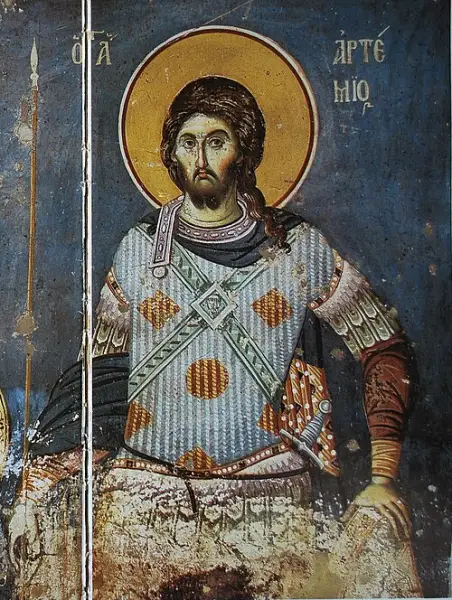
- Soldier's dress·Crown and cross (in Syriac art as Mar Shalita)
- Canonization
- Pre-congregation; venerated by Catholic, Orthodox and Assyrian traditions
Prayer
Profile text adapted from the Wikipedia article, licensed CC BY-SA 4.0.
Pray with this saint every day
Save St. Artemius of Antioch to your favorites, read the full profile, and get feast-day reminders in the Saints app.
Get the Saints AppFree on the App Store for iPhone and iPad