
died 1 May 596·Feast May 1
St. Asaph
First Bishop of St Asaph in Wales
Overview
Asaph (or Asaf, Asa) was a Welsh bishop and saint who died on 1 May 596 and is traditionally regarded as the first Bishop of St Asaph, the Welsh diocese that bears his name. The Bonedd y Saint records that he was a son of King Sawyl Penuchel of the Old North, his mother being Gwenaseth, daughter of Rhufon Rhufoniog. Wales has preserved no ancient life of the saint of its own, yet the country about Holywell in Flintshire remembers him in its landmarks — an ash tree, a church, a well, a valley — sufficient to suggest that a hermitage of his once stood in that district. As a young monk he joined the great Celtic monastery of Llanelwy, founded in about 545 by Kentigern, alias Saint Mungo, during his exile in Wales. There the community of 965 disciples lived under a strict discipline of labour and unceasing choir. In 573 the Battle of Arfderydd opened the way for Kentigern's return to Strathclyde; the disciple remained, was raised to the episcopate in his master's place, and thereby took rank as the first Welshman to govern the see. He is credited as well with founding the church of Llanasa in Flintshire, and his memory endures in the city, cathedral, and diocese that carry his name.
The Complete Life
A Son of the Old North
Wales has handed down no life of Asaph of its own composing; his origins must be gathered instead from the genealogical tracts and from the witness of the landscape. The Bonedd y Saint, the pedigree of the Welsh saints, records that he was a son of King Sawyl Penuchel, a ruler of the Old North, the Brittonic lands of what is now northern England and southern Scotland; his mother, it is said, was Gwenaseth, a daughter of Rhufon Rhufoniog. The blood of rulers thus flowed in him from birth the highest rank of the old British aristocracy in the early sixth century, in what is now northern Wales. If genealogy preserves his lineage, geography preserves his first retreat: popular memory attaches many landmarks to him in the country about Holywell in Tegeingl, Flintshire: an ash tree, a church, a well, a valley of his own. The names round about — Onnen Asa, Ffynnon Asa, Llanasa, Pantasa — all carry the element of his name, and together they point to a hermitage that probably once stood in that area. From these solitary beginnings, rooted in prayer among the hills of the clwydian country, he passed to the great monastery on the Elwy.
§ Biography
Disciple of Kentigern at Llanelwy
The story of Asaph's formation is preserved, indirectly, in Jocelyn of Furness's Life of St. Kentigern, which recounts how Cyndeyrn — Kentigern, alias Saint Mungo, founder of the diocese of Glasgow — during his exile in about 545 took himself to Wales and established a Celtic religious house beside the Elwy — Llanelwy, "the church on the Elwy", the name by which Welsh speakers still know the town of St Asaph. Unusually full information about the place survives: its church, we are told, was of planed timber, raised in the manner of the Britons, who had not yet learned to build with stone. Within it lived a community of 965 under rule, formed of three companies: 300 brethren without letters tilled the distant fields; 300 more served in the offices and workshops of the enclosure; and 365 — one for every day of the year — sang the divine services, arranged in three choirs whose worship passed unbroken from one company to the next. Asaph was one of these disciples. Kentigern himself prayed standing in the icy river; on one occasion, grievously suffering under that hardship, he sent the boy Asaph, then attending him, to fetch a burning brand to warm himself. Back the boy came, bearing live coals in his apron and unharmed by them; and in that sign Kentigern read the holiness God had planted in his disciple.
§ Biography
Bishop of the See That Bears His Name
The Battle of Arfderydd in 573 cleared the way for Kentigern's recall to Strathclyde; at Llanelwy the disciple was raised to the episcopate in his master's place, and thereby took rank as the first Welshman to govern the see. In receiving the office of his master he bound his name forever to the place: the city, the church, and the diocese would all thereafter be called St Asaph's, and he is traditionally regarded as the first Bishop of St Asaph. His episcopate belongs to the age in which the Celtic church of Wales organized its territorial sees around the great monastic foundations, where the bishop governed not a town of stone but a monastery of timber and prayer at the head of the Elwy valley. His pastoral care also extended back toward the country of his hermitage: he is recognized as the founder of the church of Llanasa in Flintshire, one of the early Christian foundations of the north coast, and the cluster of dedications around Holywell kept the memory of his earlier solitary life joined to his episcopal work.
§ Biography
Death on the First of May
Asaph is said to have died in the year 596, on the first day of May, at St Asaph in Flintshire — historically in that county, though it lies in modern Denbighshire. He passed his last years, so far as the record allows us to see, in the governance of the monastery-diocese he had inherited from Kentigern, maintaining the discipline of the 965 brethren and the unbroken round of prayer in which one choir succeeded another without pause. His burial and the fate of his shrine belong to the later history of the place: the cathedral of St Asaph in Flintshire, where his memory was chiefly honoured, has long since been destroyed. He died an old man, likely in his nineties if the traditional dates of his birth and death are weighed together, having shepherded the see for more than two decades after the departure of his master. The date of his death, 1 May, became the day of his commemoration and remains the date under which the Roman Martyrology records his name.
§ Biography
In the Martyrology and the Welsh Calendar
Asaph was never formally canonized, for he belongs to the age before canonization processes existed; his sanctity was recognized by the devotion of the church of Wales and confirmed by his inclusion in the universal calendars of the Latin church. The Roman Martyrology of 2004 enters him on 1 May under the Latin form Asáphi, in the spare formula "bishop and abbot of Elvae (Elwy) in Wales, from whom the see takes its title." The Church of Rome, the Orthodox East, and the Anglican Communion alike honour him among the saints, and the Anglican Diocese of St Asaph keeps alive his episcopal line. The traditional date of his death, 1 May, is honoured as his feast, but because that day is now designated for Saint Joseph the Worker, the current Roman Catholic liturgical calendar for Wales keeps his memorial on 5 May. The Concise Oxford Dictionary of the Christian Church adds that his celebration once fell on 11 May before it settled upon the later date — a drift of dates that traces the saint's commemoration through the centuries of Welsh church life.
§ Veneration
A Name Carried Across the World
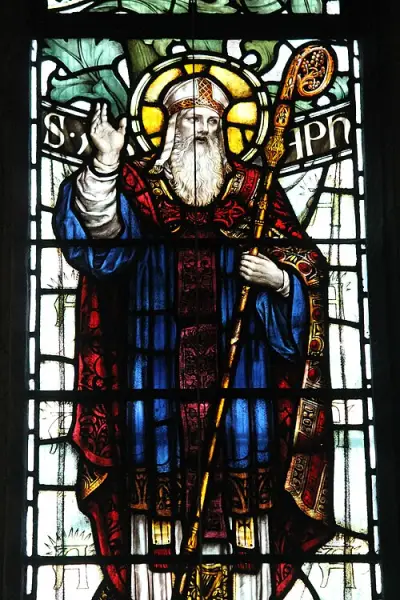
Few early Celtic saints left so durable a mark upon the map and the memory of their country as Asaph. The Welsh city of St Asaph and its diocese bear his name to this day, and the memory of his monastery of Llanelwy — the church on the Elwy — remains the root of the city's Welsh identity. His cult travelled with the Welsh diaspora and the English-speaking world: streets are named in his honour in Brockley in south-east London, in Christchurch, New Zealand, in Bala Cynwyd, Pennsylvania, in Alexandria, Virginia, and in Leominster, Massachusetts. His name even entered the music of the churches: Robert Archibald Smith, a musician of Edinburgh, printed in 1825 a hymn tune bearing the name St Asaph, set to the Scottish paraphrase "How bright these glorious spirits shine" and credited by its publisher to the composer Giovanni Maria Giornovichi. In iconography he appears as a bishop holding a book, or as a young monk carrying hot coals in his apron — the image of the miracle that first revealed his sanctity to his master, and an emblem of the meek fidelity that made the disciple worthy to inherit the see of his teacher.
§ Veneration
Timeline
- 545
Kentigern, in exile in Wales, founded the Celtic monastery of Llanelwy, which Asaph joined as a young disciple.
§ Biography
- 573
After the Battle of Arfderydd, Asaph was consecrated bishop to succeed Kentigern at Llanelwy.
§ Biography
- 1 May 596
Died at St Asaph in Flintshire, the see that bears his name.
§ Saint Asaph
In Their Own Words
As soon as one choir had terminated its service in church, immediately another entering commenced it: and that again being concluded another entered to celebrate.
The Record
- Major works
- Church of Llanasa, Flintshire·Governance of the monastery of Llanelwy and its diocese
- Patron of
- the city of St Asaph·the Diocese of St Asaph
- Symbols
- bishop with a book·monk carrying hot coals in his apron
- Canonization
- Pre-congregation canonization; venerated in the Catholic Church, Eastern Orthodox Church, and Anglican Communion; listed in the Roman Martyrology under 1 May
Prayer
Bibliography
Show 10 sources
- Pollen, John Hungerford (1907). "St. Asaph". The Catholic Encyclopedia. Vol. 1. New York: Robert Appleton Company.
- Rees, Rice (1836). An Essay on the Welsh Saints, or the Primitive Christians Usually Considered to Have Been the Founders of Churches in Wales. Longman, Rees, Orme, Brown, Green & Longman. pp. 265–266.
- "Early History". City of St Asaph.
- Martyrologium Romanum. Vatican City: Typis Vaticanis. 2004. p. 264.
- "National Calendar for Wales". Liturgy Office.
- Livingstone, E. A., ed. (2000). The Concise Oxford Dictionary of the Christian Church (2nd ed.). Oxford University Press. p. 40.
- Attwater, Donald; John, Catherine Rachel (1993). The Penguin Dictionary of Saints (3rd ed.). New York: Penguin Books. ISBN 0-14-051312-4.
- Thomas, Daniel Lleufer (1901). "Asaph". In Lee, Sidney (ed.). Dictionary of National Biography (1st supplement). London: Smith, Elder & Co.
- Thornton, David E. (2004). "Asaf (supp. fl. 6th cent.)". Oxford Dictionary of National Biography (online ed.). Oxford University Press. doi:10.1093/ref:odnb/728.
- "Ὁ Ἅγιος Ἀσάφιος Ἐπίσκοπος Οὐαλίας". ΜΕΓΑΣ ΣΥΝΑΞΑΡΙΣΤΗΣ.
Profile text adapted from the Wikipedia article, licensed CC BY-SA 4.0.
Pray with this saint every day
Save St. Asaph to your favorites, read the full profile, and get feast-day reminders in the Saints app.
Get the Saints AppFree on the App Store for iPhone and iPad