
died c. 218 (also given 220)·Feast October 18
St. Asclepiades of Antioch
Patriarch of Antioch, Confessor
Overview
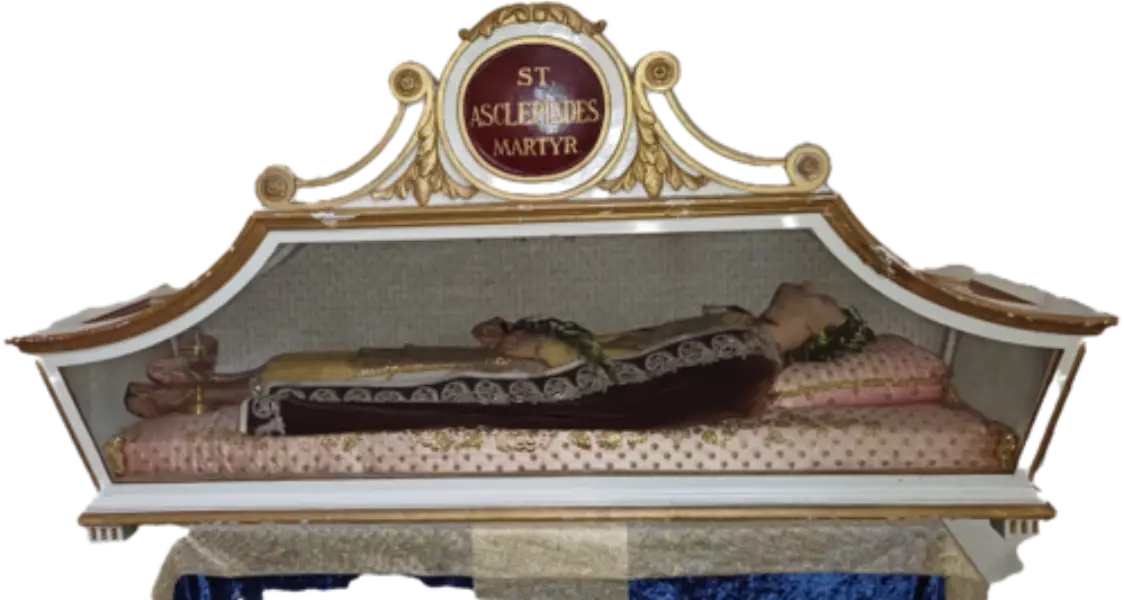
Asclepiades of Antioch, called the Confessor, was Patriarch of Antioch from 211 (or 212) until his death around 218 (or 220). He succeeded Serapion and was succeeded by Philetus. Eusebius of Caesarea reports that his tenure opened in Caracalla's first year as emperor, which is why 212 is the year most commonly assigned to his accession, though Harnack, appealing to another source, suspects a start somewhat earlier still. He is given the title of martyr in the tradition — in the broader early sense — on account of the trials he endured during the Roman persecution: the See of Antioch in his generation was the seat of confessors, and the church remembered him among those who suffered for the faith without being killed for it. The chronology of the Antiochene succession makes him the eleventh or twelfth holder of the see that traced itself to Peter, in the decades between Serapion, the writer-bishop, and Babylas, the great martyr-bishop who would die in chains under Decius. A relic of Asclepiades, said to comprise his whole body, is preserved in Austria at the Church of the Redeemer in Vienna. In the Roman Catholic Church his feast falls on 18 October.
The Complete Life
A Bishop in the Shadow of Persecution
Asclepiades governed the church of Antioch in the second decade of the third century, taking the see from Serapion — the bishop whose letters on the Petrine succession and against heresies Eusebius preserved — and handing it on to Philetus. Eusebius, the ultimate source for all of this, says that his tenure opened in the first year that Caracalla wore the purple; from which computation 212 is the usual date, though Harnack, drawing on another source, suspected a somewhat earlier beginning, and 211 is also given. Of his life before the episcopate nothing is transmitted: no birthplace, no formation, no sermons. The Antiochene succession of the age — Theophilus, Maximus, Serapion, Asclepiades, Philetus, Zebinnus, Babylas — is a list of names with scattered notices, of which Asclepiades' notice is among the shortest: he held the see, he suffered, he is called confessor, and the calendar took him up.
§ Introduction
Confessor of a Suffering See
Tradition bestows on Asclepiades the martyr's title because of the trials he underwent in the Roman persecution — language which in the early 200s covered every form of suffering short of death: arrest, confiscation, exile, the mines. The years of his episcopate, under Caracalla and Elagabalus, were not years of systematic persecution like those of Decius a generation later, but they were years of danger for the leading bishops of the great sees, and the church of Antioch in particular had been prominent enough, since Ignatius walked to Rome under Trajan, to attract precisely the official attention that produced confessors. To govern Antioch in such an era was itself a confession: the bishop of the see of Peter was a marked man, and the Church remembered Asclepiades as one who bore what that marking brought him without yielding the faith or the office.
§ Introduction
Cult and Relic
Asclepiades is a saint of the calendars: pre-congregational, venerated in the Eastern Orthodox Church and the Roman Catholic Church, with a memorial on 18 October. The survival that gives his memory a modern physical anchor is a surprising one: Austria's Church of the Redeemer in Vienna preserves a relic said to contain Asclepiades' whole body, among the many eastern relics that travelled west in the great medieval translations — in this instance into a nineteenth-century Viennese church. That a third-century patriarch of Antioch should lie in Vienna is a fair emblem of the wanderings of the Antiochene church itself, which in the centuries after his death would be swept by every Christological controversy, conquered by the Arabs, and finally dispersed — while its bishops of the age of the confessors, Asclepiades among them, kept their small place in the book of the saints.
§ Introduction
Timeline
- 211
Succeeds Serapion as Patriarch of Antioch; Eusebius places the start in Caracalla's first year, hence 212 is usually given
§ Introduction
- 218
Dies after governing Antioch; some sources place his death in 220, with Philetus as successor
§ Introduction
The Record
- Canonization
- Pre-congregation
Prayer
Bibliography
Show 1 sources
Profile text adapted from the Wikipedia article, licensed CC BY-SA 4.0.
Pray with this saint every day
Save St. Asclepiades of Antioch to your favorites, read the full profile, and get feast-day reminders in the Saints app.
Get the Saints AppFree on the App Store for iPhone and iPad