
fl. late 3rd - mid 4th century·Feast Saturday after the fifth Sunday after Pentecost (c. late June)
St. Ashkhen
Queen of Armenia, Wife of St. Tiridates III
Overview
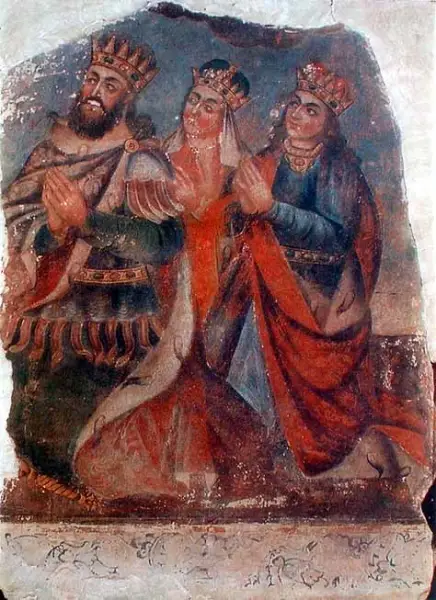
Ashkhen was Queen of Armenia, the wife of King Tiridates III, under whom Armenia in 301 became the first nation to adopt Christianity as its state religion. A monarch of Sarmatian origin on her father's side, she was the daughter of Ashkatar or Ashkhadar, king of the Alans, born between about 260 and 280 and married to Tiridates in 297, while the Armenian state religion was still Zoroastrianism. She and Tiridates had three children: a son, Khosrov III, and two daughters, one of whom, Salome, is remembered in the tradition, and one of whom married St. Husik I, an early Catholicos of the Armenian church. According to the received legend, after Tiridates had killed the Hripsimeyan nuns he lost his sanity; Ashkhen and the king's sister Khosrovidukht, themselves possibly already converts through the Christian underground, persuaded him to free Gregory the Illuminator, who cured him. Tiridates then converted, and Gregory baptized the royal family and the court on the Euphrates. Ashkhen and Khosrovidukht later donated their jewels toward the building of the churches of St. Gayane and St. Hripsime, and towards the end of her life the queen retired to the castle of Garni. The Armenian Apostolic Church keeps the memory of Ashkhen together with Tiridates and Khosrovidukht on the Saturday following the fifth Sunday after Pentecost.
The Complete Life
Early Life
Ashkhen was born between about 260 and 280 into the royal house of the Alans, the Sarmatian people of the steppe north of the Caucasus, as the daughter and only known child of their king, Ashkatar, also called Ashkhadar. Her name, in its Armenian form, derives from a word for grey or bluish-black, a colour-word name of the sort the Iranian-speaking peoples of the steppe used. Raised in the Alani kingdom, she would have known the horse-borne, fire-revering world of her father's people, a world connected by marriage and treaty to the states to the south. In 297, in an alliance that joined steppe and mountain, she was married to Tiridates III, the Roman client king of Armenia, who reigned from 287 to 330. At the Armenian court she entered a royal religion strongly flavoured by Zoroastrianism and an Arsacid dynasty that traced itself to the Parthian kings. Of her personal life before the great events of her husband's reign, the sources preserve nothing: she appears in history already a queen, and her significance is what she became after Armenia's conversion.
Vocation
Ashkhen's vocation was to be the first Christian queen of the first Christian kingdom. The legend of the conversion, told by Agathangelos and received by the Armenian church, places her and her sister-in-law Khosrovidukht among the first believers at court, converted perhaps through the Hripsimeyan nuns and the Christian underground before the great crisis. When Tiridates, after killing the nuns, was struck with madness, the two women are credited with the crucial interventions: they persuaded the deranged king to release Gregory the Illuminator from his pit-prison, and Gregory cured him. Tiridates then believed, and the royal family, Ashkhen, the children, and the court, were baptized by Gregory in the waters of the Euphrates. As queen of the newly Christian nation, Ashkhen's vocation took practical form: she and Khosrovidukht gave their jewels to help build the churches of St. Gayane and St. Hripsime over the graves of the murdered nuns, turning the ornaments of an Arsacid queen into the foundations of Armenian sacred architecture.
Mission
The mission of Ashkhen, in the Armenian tradition, was the consolidation of the conversion. A kingdom's change of religion is not accomplished by a king's baptism alone; it requires the royal household to become visibly Christian, the palaces to become patrons of churches, and the memory of the old wrongs, the murdered nuns above all, to be enshrined rather than buried. Ashkhen's donations to the churches of Gayane and Hripsime did exactly this, honouring the victims of her husband's fury and making the queen's own wealth a testimony. Her daughters' marriages linked the new Christian dynasty to the church itself, one daughter becoming the wife of Husik I, Catholicos and saint. In a court still crowded with Zoroastrian and pagan nobles, the queen's allegiance mattered politically as well as spiritually. Her later retirement from court with Khosrovidukht to the castle of Garni, high above the Azat river, gave the tradition its final image of the queen who had held power and chose to lay it down, ending her days in prayer at the edge of the pagan old world.
Final Years
Towards the end of her life Ashkhen withdrew with Khosrovidukht to the castle of Garni, the great Arsacid fortress south of Yerevan, whose Hellenistic colonnade still stands. The retirement of a queen and a king's sister to a royal castle was a recognized form of late-life devotion in the Armenian tradition, a withdrawal from the court's business for prayer without the formality of monastic vows. The year of her death is not recorded, but it fell within the reign of her husband or shortly after, in the middle decades of the fourth century, when the church Gregory planted was still young and persecution from the Sassanid east was already threatening. She did not live to see the wars that followed the partition of Armenia, but she lived long enough to see the churches of Hripsime and Gayane rise on ground her jewels had helped to buy. Her resting place is not recorded in the sources.
Cult and Canonization
Ashkhen is a saint of the Armenian Apostolic Church, canonized in the pre-congregation manner by the tradition of the nation's conversion and commemorated together with Tiridates III and Khosrovidukht on a movable Saturday in the week after Pentecost, generally falling near the end of June. On that day the Armenian church sings the hymn To the Kings in their honour. Her canonization is thus collective and national: the church that remembers the conversion of 301 remembers its royal household as a unity, the king who decreed, the queen who gave, and the sister who interceded. The historical sources for her life are the Conversion of Armenia ascribed to Agathangelos and the later historians, supplemented by the liturgical tradition, and the church has never distinguished between the legend and the history in its cult, receiving both as the nation's memory of its rebirth. The hymn To the Kings, sung on their day, keeps the three royal saints together in a single act of national thanksgiving.
Legacy
The legacy of Ashkhen is bound to the singular fact of Armenia's conversion: she was the queen of the first Christian state, and her jewels, in the tradition's telling, helped build the first great churches of a church that has survived seventeen centuries of empires. She represents in the Armenian memory the role of royal women in the conversion, the quiet persistence of faith at a court still officially pagan, and the transformation of royal wealth into sacred building. She is also part of the international dimension of that moment, an Alan princess whose marriage joined the steppe to the Armenian highlands and whose faith joined both to the Christian world. Armenians honour her beside Tiridates and Khosrovidukht as founders, and her feast, movable in the Armenian reckoning, keeps their three names together. For the universal church she is a witness that the conversion of nations has usually passed through households, and that the gifts of queens, no less than the courage of martyrs, built the house of God.
Timeline
- 270
Born at an unknown date around 260-280 in the Alani Kingdom, daughter of King Ashkatar.
§ Family and origins
- 297
Married King Tiridates III of Armenia, becoming queen consort during his reign as a Roman client king.
§ Biography
The Record
- Patron of
- Armenia·Armenian Apostolic Church (with Tiridates III and Khosrovidukht)
- Symbols
- Royal crown·Jewels given for the churches of Gayane and Hripsime
- Canonization
- Pre-congregation; canonized in the Armenian Apostolic tradition with Tiridates III and Khosrovidukht
Prayer
Profile text adapted from the Wikipedia article, licensed CC BY-SA 4.0.
Pray with this saint every day
Save St. Ashkhen to your favorites, read the full profile, and get feast-day reminders in the Saints app.
Get the Saints AppFree on the App Store for iPhone and iPad