
5th century·Feast April 27
St. Assicus
Bishop of Elphin, Metalworker
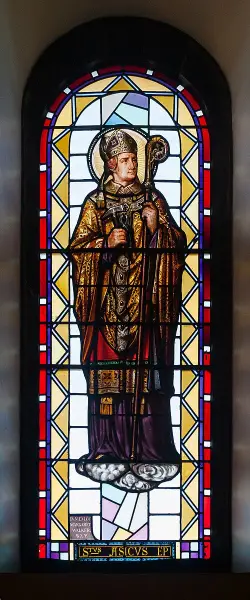
Overview
Assicus — also spelled Asicus or Assic — was the first bishop of Elphin in Ireland in the fifth century and the patron saint of that place, remembered equally as a churchman and as an artisan: he was Saint Patrick's coppersmith. Skilled in brass and copper work, converted to Christianity by Patrick, he is said to have served Patrick as his worker in iron, and the Book of Armagh calls the first bishop of Elphin the cerd — the wright or goldsmith — belonging to St. Patrick. At Elphin Patrick raised the church long known as Tempull Phadruig and set up an episcopal monastery among the first he founded, installing Assicus as abbot-bishop; with him were left Bite, the son of Assicus's brother, and Cipia, the boy's mother, and the land itself was obtained from Hono, a wealthy and influential druid of Assicus's own family. For the churches Patrick had founded, Assicus produced chalices, patens, and metal covers for books; the Tripartite Life credits him with altars, tables, square bookcases, and patens seen at Armagh, Elphin, and Donough-patrick. Of his last days the tradition is poignant: stung with shame over a lie — told either by him or, in another telling, about him — he fled into Donegal and for seven years lived as a hermit on the island of Rathlin O'Birne; his monks, seeking him out, found him in the mountain glens, but he fell sick on the journey home and died with them in the wilderness, and was buried at Rath Cunga — modern Racoo, near Ballintra — his grave, like Moses', hidden.
The Complete Life
Patrick's Coppersmith
Assicus belongs to the first generation of Irish Christianity, the generation made by Patrick himself. The tradition makes him a friend of Saint Patrick and a skilled metalworker in brass and copper, converted by Patrick and thereafter described as the apostle's worker in iron — the craftsman attached to the mission. In the Ireland of the Brehon Laws craftsmen were well respected, and Patrick's decision to keep a smith at his side was practical: a mission planting churches across a country needed someone to make the vessels those churches required. The Book of Armagh's description of the first bishop of Elphin as Patrick's cerd — wright or goldsmith — is the earliest and firmest fact about him, and it fixes his place in the mission's economy. In the Ireland of the Brehon Laws the craftsman stood high in the social order, and Patrick's mission kept a smith at its side for the most practical reasons.
Abbot-Bishop of Elphin
At Elphin Patrick raised a church known through the centuries as Tempull Phadruig, Patrick's church, and established beside it an episcopal monastery, among the first monasteries he founded. He appointed Assicus abbot-bishop, and left with him Bite, the son of Assicus's brother, and Cipia, the mother of Bite — a family establishment of the new see, in the Irish manner. The land itself had come from Hono, a druid of wealth and influence who was of Assicus's own family: the mission's foothold at Elphin was thus negotiated inside a kin network, and the craftsman-bishop was the connecting figure. The Tripartite Life of St. Patrick records the range of his work: Patrick's coppersmith was Bishop St. Assic, maker of altars, tables, and square bookcases, and of patens in honor of Bishop Patrick, of which the medieval writer had himself seen three — one at Armagh, one at Elphin, and a third at the great church of Donough-patrick near Tulsk.
The Hermit of Rathlin O'Birne
The end of Assicus's life is told by Archbishop Healy in a passage the Catholic Encyclopedia preserves: Assicus, stung by shame over a lie told either by him, or, in the other version, about him, took flight into Donegal, where for seven years he abode in the island of Rathlin O'Birne. The ambiguity — his lie or a lie about him — is ancient, and either way the fact is a bishop in penitential exile from his own see. His monks went in search of him, and after much labor found him at last in the mountain glens and strove to take him back to his monastery at Elphin; but on the road he fell sick and died with them in the wilderness. The venerable old man was buried in the churchyard of Rath Cunga — Racoo today — in Tirhugh barony in County Donegal, on top of a round hillock a mile south of Ballintra. Healy searched the old disused graveyard in vain for an inscribed stone, and drew the moral the tradition itself drew: he fled from the company of men while alive, and, like Moses, he lies in a grave hidden from men.
The School of Elphin
Assicus's legacy ran through the hands of his successors. Following the example of their master, the successors and spiritual heirs of St. Assicus built up a school of art and turned out beautiful pieces of Celtic craftsmanship in the diocese of Elphin — one of the regional workshops of Irish metalwork whose surviving treasures define the early Irish church in the museum age. He is venerated in the Catholic Church, the Eastern Orthodox Church, and the Anglican Communion, the last through the Church of Ireland's commemorations, and his feast of 27 April is recorded in the Martyrology of Tallaght. Some scholars have identified him with Tassac and Assam (or Assan), other named craftsmen of the Patrician mission; the identifications remain conjectural. The stained glass of Sligo Cathedral shows him with the tools of his two callings, and the modern diocese of Elphin still claims him as patron. The Elphin school of metalwork that claimed him as founder produced work for centuries, and his feast of 27 April stands in the Martyrology of Tallaght.
The Record
- Major works
- Chalices, patens, and metal book-covers for Patrick's churches (works of his hands, not writings)
- Patron of
- Elphin, Ireland·Metalworkers and bellfounders
- Symbols
- Bishop's crozier·Smith's hammer and bell
- Canonization
- Pre-congregation (ancient cult; feast in the Martyrology of Tallaght)
Prayer
Profile text adapted from the Wikipedia article, licensed CC BY-SA 4.0.
Pray with this saint every day
Save St. Assicus to your favorites, read the full profile, and get feast-day reminders in the Saints app.
Get the Saints AppFree on the App Store for iPhone and iPad