
died c. 98·Feast July 4 (July 6 in Albania)
St. Astius
Bishop and Martyr of Dyrrhachium
Overview
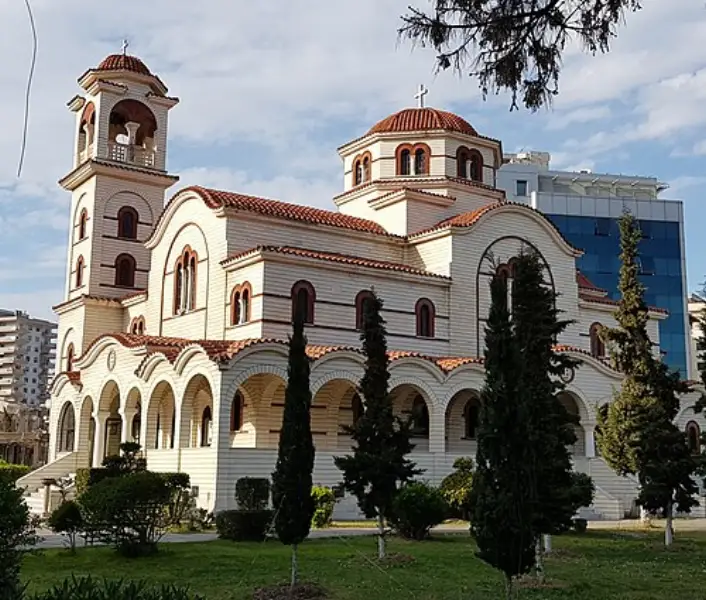
Astius — Albanian Shën Asti, Greek Astios — was a second-century bishop of Dyrrhachium, the great Adriatic port now Durrës in Albania, martyred around 98 in the persecution under the emperor Trajan. Tradition says the saint was once granted a dream foretelling the suffering and death he would undergo for Christ. Arrested on the order of Agricola, Dyrrhachium's Roman governor, he was put to the torture for refusing to worship the god Dionysus: beaten with leaden rods and oxhide whips, he did not renounce Christ; his tormentors coated his body in honey so that the stings of hornets and flies would heighten his agony, and at the last crucified him. His body was reverently buried by the Christians. His death had witnesses: in those years many Christians, fleeing Italy's persecutions, had taken refuge in Epirus; seven martyrs, all of them holy — Peregrinus, Lucian, Pompeius, Hesychius, Papius, Saturninus, Germanus — were among the refugees, and they publicly praised the courage and steadfastness of the crucified confessor — were arrested for it, and were drowned in the Adriatic; the waves bore their bodies ashore, and they lay concealed in the sand until, ninety years on, the martyrs appeared to the bishop of Alexandria, directing him to bury them and build a church over them. Astius's feast is July 4; in Albania he is commemorated on July 6, and the city of Durrës has declared him its patron protector.
The Complete Life
Bishop of the Adriatic Gate
Astius was bishop of Dyrrhachium, the port city of Epirus Nova at the western end of the Via Egnatia — the place where Italy met the Balkans and where, accordingly, every current of the early Christian world sooner or later passed. A church at Dyrrhachium in the late first century stands at the very edge of the historically visible, and the tradition of Astius, bishop and martyr around 98 under Trajan, is the city's own memory of its apostolic-age origin. He is the earliest figure the Albanian church claims, and its patron.
§ Introduction
Martyrdom
The tradition gives his end in detail: arrested by Agricola, the Roman governor, for refusing to worship Dionysus — the god whose cult the Greek city had long kept — he endured beating with leaden rods and oxhide whips, was coated in honey so that hornets and flies could heighten his torment, and was crucified. The theatrical cruelty belongs to the hagiographic manner, but the setting is exact: a port city of Dionysiac devotion, a bishop who would not bend, and a Roman governor who enforced the cult. Christians reverently buried his body.
§ Introduction
Veneration
Astius is venerated in the Roman Catholic and Eastern Orthodox Churches, with his feast on July 4; Eastern Orthodox Albanians keep him on July 6. The city of Durrës has named him its patron protector. In the Middle Ages a portrait of the saint in the church of St. Mary Peribleptos at Ohrid was likely donated by Progonos Sgouros, the Albanian nobleman and Byzantine general who restored the church — evidence of how closely Durrës and Ohrid were tied within the Byzantine world.
§ Veneration
Legacy
Astius's legacy is the church of Albania, which numbers him its first shepherd and martyr. His death also generated a second martyrdom: the seven Christians who had fled from Italy and praised his courage were drowned in the Adriatic, and their bodies, buried on the shore and revealed ninety years later to the bishop of Alexandria, are commemorated on 7 July — the martyr and his witnesses joined in the calendar. For the ancient Christian memory of the Balkans, the crucified bishop of the Adriatic gate stands first.
§ Life
Timeline
- 98
Serves as bishop of Dyrrachium during the reign of Emperor Trajan
§ Life
- 98
Arrested by Agricola, the Roman governor, after a dream foreboding his death for Christ
§ Life
- 98
Crucified at Dyrrhachium for refusing worship of Dionysus, after scourging and being smeared with honey
§ Life
- 98
Seven refugee martyrs who praised his courage are seized and drowned in the Adriatic
§ Life
The Record
- Patron of
- City of Durrës
- Symbols
- Crucified bishop·Honey and hornets of his torture
- Canonization
- Pre-congregation; patron protector of the city of Durrës
Prayer
Bibliography
Show 7 sources
- ↑ Elsie, Robert. A Dictionary of Albanian Religion, Mythology, and Folk Culture , NYU Press, 2001, p. 15 ISBN 9780814722145
- ↑ Elsie, Robert. "The Christian Saints of Albania", Balkanistica 13 , p. 36, 2000
- ↑ "Martyr Peregrinus of Dyrrachium in Macedonia", Orthodox Church in America
- ↑ Nicol 1986 , p. 161 (Note #87): "An Albanian by the name of Progon Sgouros (Πρόγονος τοũ Σγούρου) and with the title of hetaireiarches restored the church of St. Clement of Ochrida about 1295."
- ↑ Christidou, Anna (2014). "Political 'expedience' and peripheral saints: assimilating St. Asteios of Dyrrachion in the Byzantine Orthodox tradition". Byzantine and Modern Greek Studies . 38 (2): 166. doi :10.1179/0307013114Z.00000000042. S
- ↑ "Hieromartyr Astius the Bishop of Dyrrachium in ", Orthodox Church in America
- ↑ https://www.scribd.com/doc/139765547/Kalendari-Orthodhoks-2013 Archived 2013-10-22 at the Wayback Machine This is the day the Divine Liturgy is served in his memory at the church named for him, the cathedral in Durres.
Profile text adapted from the Wikipedia article, licensed CC BY-SA 4.0.
Pray with this saint every day
Save St. Astius to your favorites, read the full profile, and get feast-day reminders in the Saints app.
Get the Saints AppFree on the App Store for iPhone and iPad