
died c. 1030/1040·Feast November 12
St. Astrik of Pannonhalma
First Abbot of Pannonhalma, Archbishop
Overview
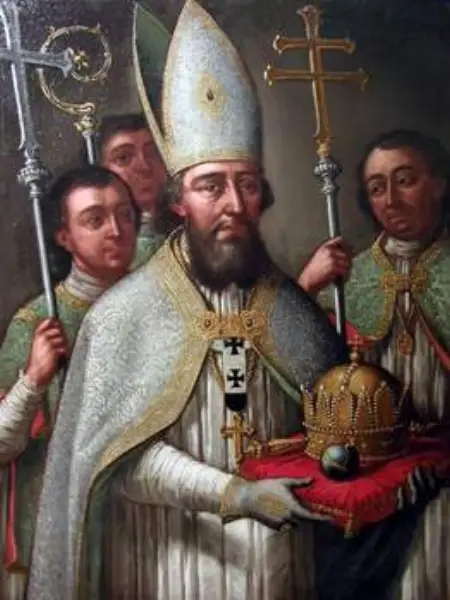
Astrik — also Anastasius, Astericus, or by his original name Radla — was the monk, abbot and archbishop who built the institutional church of the young kingdom of Hungary. A Czech or Croat from Bohemia, probably professed at Brevnov, he accompanied St. Adalbert on his mission among the Bohemians, and in time he became the first abbot of the monastery of Brevnov near Prague. When Adalbert's position in Prague collapsed, Radla went to the kingdom of the Magyars to serve its Christianizing royal house. His first service was to the wife of Grand Prince Géza; in 997 he was appointed the first abbot of St. Martin's Abbey at Pannonhalma, the earliest ecclesiastical institution on Hungarian soil, a foundation of Géza himself; afterwards he served Géza's son Stephen. Astrik carried Stephen's embassy to Pope Sylvester II, which returned with papal recognition of Stephen as king; with a crown traditionally associated with the pope and the emperor Otto III, Astrik himself crowned Stephen in 1001. He is counted the first archbishop of the Hungarian church, in the see of Kalocsa from about 1002, then Esztergom. Modern archaeology has returned his story to the ground: a tomb excavated at Kalocsa cathedral in 1910, long disputed, was radiocarbon-dated in 2014 to a death between 1001 and 1030, matching Astrik. He died around 1030 to 1040, with his feast on 12 November.
The Complete Life
Radla of Bohemia
Astrik began life as Radla, a Czech or a Croat of Bohemia, in the second half of the tenth century. He probably received the monastic habit at Brevnov — the first Benedictine monastery in Bohemia, founded 993 — taking in religion the name Anastasius, of which Astrik is a diminutive. His path crossed the towering figure of Adalbert of Prague, the missionary bishop of the Bohemians: Radla worked beside him in the Bohemian mission and became the first abbot of Brevnov itself. When Adalbert's position in Prague collapsed — the second and final collapse that sent him to his death among the Prussians — his circle dispersed into the missionary field, and Radla went not north with Adalbert but south, to the court of the Magyars, where Géza, grand prince of the Hungarians, had married a Christian wife and begun, with spectacular severity, to open his people to baptism.
First Abbot of Pannonhalma
In the Magyar kingdom Radla's career ran through the whole ladder of the new church. He served first the Christian wife of Géza — Bavarian-born, the bringer of priests to the court — and in 997 Géza gave him the headship of the abbey of St. Martin on the hill of Pannonhalma, the first religious house of Hungary, founded by the prince himself. To be first abbot of Pannonhalma was to be something more than an abbot: the house was conceived as the spiritual center and, in effect, the administrative school of the entire mission, the place where a pagan aristocracy's sons would learn the religion their princes had adopted. Astrik held it while the mission became a state.
The Crown and the Coronation
Géza died in 997; his son Stephen — canonized as the founder of Christian Hungary — had both the vocation and the ruthlessness to finish the work. Astrik became his man for the decisive errand: the embassy to Pope Sylvester II that asked, in effect, for Hungary's admission into Christian Europe. The pope's reply — doubtless at the emperor Otto III's prompting — recognized Stephen as king and carried with it a crown. Astrik carried it back, and in 1001 it was his hand, as the sources of the Hungarian church relate, that set the crown on Stephen's head — the act by which the Magyar people entered the Latin world. Around 1002 he took the see of Kalocsa as first archbishop of the Hungarian church, transferring later to Esztergom; the catalogues of both houses carry his name at the head of their lists, and the tables give him until 1036.
A Tomb Recovered
Astrik died around 1030 to 1040 — the sources give c. 1030/1040 — and where he was buried became a puzzle the twentieth century took up with instruments. When Kalocsa cathedral was restored between 1907 and 1912, a red marble archiepiscopal tomb was found under the sanctuary in the axis of the eleventh-century church, with an intact skeleton, a gilded crosier, a silver chalice and paten, golden rings, crosses, and a pallium with three jeweled pins. The excavator identified the grave as Astrik's; the Jesuit art historian Joseph Braun dated the objects a century and a half later and reattributed the tomb to a thirteenth-century archbishop. The question stood until 2014, when radiocarbon dating of bones from the skeleton returned a death date of 1001-1030 — the era of Astrik, not of his later successors. The man who crowned the first king of Hungary was found, in the end, under his own cathedral floor.
Veneration
Astrik is honored as a pre-congregation saint of the Hungarian church, with his feast on 12 November in the diocesan calendars of Hungary. He is claimed as a founder by both Kalocsa and Esztergom, and by Pannonhalma as its first abbot — an apostolic trio of titles that no other figure of the Hungarian conversion holds. Latin-rite Catholics and Hungarian tradition generally keep his memory alongside the greater names of Stephen and Adalbert, as the builder whose administrative and liturgical work made their visions operable.
Legacy
Astrik's legacy is the church of Hungary as a going institution. Pannonhalma still stands as an archabbey, a thousand years after he led it; the crown he placed on Stephen's head — whatever its exact provenance — became the sacred object of Hungarian statehood, kept and fought over for nine centuries; and the episcopal structure he organized survived the Mongols, the Turks, and the twentieth century. He represents the indispensable second rank of great missions: not the martyr or the apostle-king, but the organizer who crosses the Alps for a crown, founds the first abbey, serves the first sees, and turns a conversion into a church.
Timeline
- 997
Became first abbot of the abbey of St. Martin's at Pannonhalma, Hungary's earliest ecclesiastical institution, founded by Duke Géza
§ Life
- 1001
Crowned Stephen I king of the Hungarians with a royal crown sent by Pope Sylvester II
§ Life
- 1002
Took charge of the see of Kalocsa as bishop, holding it until about 1005
§ Introduction
- 1005
Served as Archbishop of Kalocsa, an office he held until 1007
§ Introduction
- 1007
Appointed Archbishop of Esztergom, succeeding Sebastian and leading the see until 1036
§ Introduction
- 1030
Died around this time, within a lifespan dated by sources to about 1030 or 1040
§ Introduction
- 1910
A red marble archiepiscopal tomb with an intact skeleton and regalia was excavated beneath Kalocsa cathedral's sanctuary
§ Discovery of remains
- 1912
The tombstone was moved into the new Archbishop's Crypt with an epitaph naming twelfth-century archbishops
§ Discovery of remains
- Jan 2014
Radiocarbon testing of the skeleton dated its death to 1001-1030, supporting identification with Astrik
§ Discovery of remains
The Record
- Patron of
- Hungarian Church·Pannonhalma Archabbey
- Symbols
- Benedictine habit·Crosier and crown (he crowned a king)
- Canonization
- Pre-congregation; honored as a founder-saint of the Hungarian Church
Prayer
Profile text adapted from the Wikipedia article, licensed CC BY-SA 4.0.
Pray with this saint every day
Save St. Astrik of Pannonhalma to your favorites, read the full profile, and get feast-day reminders in the Saints app.
Get the Saints AppFree on the App Store for iPhone and iPad