
c. 790-860·Feast August 15 (or 14 April, her repose)
St. Athanasia of Aegina
Abbess and Confessor of Aegina
Overview
Athanasia of Aegina, born around 790 of the Christian nobles Niketas and Irene, was a Byzantine saint and abbess whose hagiographer described her as a woman deserving praise, one who bore the name of immortality and lived it out admirably. At the age of seven a vision moved her to seek entrance into a convent, yet her parents obliged her to marry twice: first, at sixteen, to a soldier who fell in battle scarcely a fortnight after the wedding, and then to a man who himself embraced the religious life. Once free she took up the ascetic life, distributed everything she owned, raised churches, and with other women established a convent on Aegina, becoming its abbess and later moving the community to Timia. She advised the empress Theodora, and departed Aegina to spend seven years in seclusion at Constantinople before going back home. She died on the island — the traditions give 15 April or 15 August 860 — and the greater part of the miracles credited to her took place after her passing. Her Life was written by an anonymous author not long after her death and appeared in 916.
The Complete Life
Early Life and Visions
Athanasia was born around 790 on Aegina, the island in the Saronic gulf whose stone houses and churches were already famous, daughter of Niketas and Irene, Christian nobles of the provincial Byzantine world. She received the standard education of a girl of her rank — scripture, psalmody, household management — and something more: at seven years old a vision came to her that made her long for the convent. This detail the anonymous hagiography, written soon after her death, keeps as the key to her character: the child wanted God, and the world wanted her married. Her parents forced the issue. At sixteen she was given to a soldier; a little over two weeks after the wedding he was killed in battle, and the teenage widow was returned to her family. The parents tried again, and the second marriage, though it ended differently, ended the same way: her husband chose the religious life as she had always wished to, and the couple separated by mutual consent into chastity.
Foundress on Aegina
Freed at last from the marriage market, Athanasia became an ascetic with the thoroughness of the delayed vocation. She gave away all her possessions to the poor, built churches on the island — endowing them from her own goods — and gathered other women into a convent, becoming its abbess. The community she organized combined the cenobitic and the charismatic: common psalmody at fixed hours, manual work, and a strong ministry of hospitality to the poor and to passing pilgrims, for Aegina lay on the sea roads. In time she moved the convent to Timia, where its site became her shrine. Her rule and example made the house a centre of the island's religious life, and her reputation crossed the water: she served as an advisor to Theodora, the empress then ruling with Theophilus' memory against her, a dangerous honour she bore without ambition.
Constantinople and Seclusion
At the height of her fame Athanasia did the thing her biographer most admired: she left. Withdrawn from Aegina, she lived sequestered in Constantinople for seven years — obscurity, prayer, and the anonymity a known holy woman can scarcely ever obtain — until recalled, by the account, to her island and her sisters. The episode belongs to her spirituality of flight from honour, the old desert instinct translated to a convent abbess. Her practice as recorded was psalmody: the Life describes her at prayer with the sisters through the night offices, and her particular devotion to the poor at the gate. She read the scriptures with the simple and counselled the powerful with the shrewd; the empress's ear and the beggar's bowl were both hers to use, and she used both. Her name, her hagiographer notes, means immortality — athanasia — a text she is said to have fulfilled.
Death and Miracles
Athanasia returned from Constantinople to Aegina shortly before her death, which the traditions date to 860, on 14 April or on 15 August — the latter shared with the Dormition, which her Greek keepers thought fitting for a woman of her devotion to the Mother of God. She died in her convent at Timia, and her grave began at once to work: by the Life's account the greater number of her miracles happened after she had died — cures of the sick who came to the tomb, and help for the island's fishermen and sailors. The Life itself came from an anonymous hand not long after her death and saw publication in 916 — a half-century's delay that, by Byzantine standards, preserved a relatively sober memory. Her relics remained the island's treasure, and her cult spread through the Aegean dioceses, where abbesses took her as model.
Legacy
Athanasia of Aegina is the best-remembered Byzantine woman of her century, precisely because her Life survived when almost no others did, and through it she represents a whole class otherwise invisible: the aristocratic widow-foundress, the woman who turned compulsory marriage into chosen monastic life and then into institution-building. Her两次 marriages, both dissolved by death or grace, structure a lesson the Church has long read in her: the vocation delayed is not the vocation destroyed. For Aegina she is the local patron of the island's Christian identity, her shrine at Timia an object of pilgrimage, and for Greek monasticism a mother among the founders. Historians use her Life as a document for ninth-century provincial society — slavery's edges, widows' property, empresses' patronage — read most safely beside its plain purpose: the praise of a praiseworthy woman.
Timeline
- 790
Born on Aegina to the Christian nobles Niketas and Irene
§ Life
- 797
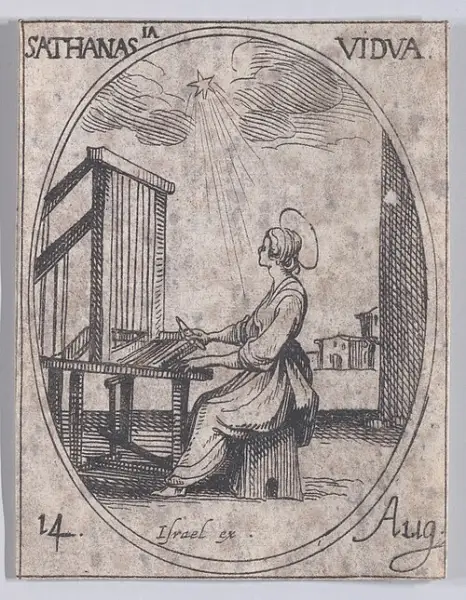
Aged seven, sees a shining star in a vision while weaving, stirring her desire for monastic life
§ Life
- 806
Forced into a first marriage at sixteen; her soldier husband is killed in an Arab raid about two weeks later
§ Life
- 15 Aug 860
Dies at Timia on the feast of the Dormition, twelve days after falling ill on her return from Constantinople
§ Life
- 861
A year after her burial, her body is lifted from the grave into a coffin kept open for veneration
§ Life
- 916
Her anonymous hagiography, written shortly after her death, is published
§ Life
The Record
- Patron of
- Aegina·Widows·Founders of religious communities
- Symbols
- Abbess's veil·Psalmody with her sisters·Alms to the poor
- Canonization
- Pre-congregation; venerated especially in the Orthodox Church
Prayer
Profile text adapted from the Wikipedia article, licensed CC BY-SA 4.0.
Pray with this saint every day
Save St. Athanasia of Aegina to your favorites, read the full profile, and get feast-day reminders in the Saints app.
Get the Saints AppFree on the App Store for iPhone and iPad