
1722-1813·Feast June 24; First Sunday of September (with the Saints of Paros and Naxos)
St. Athanasios Parios
Greek Hieromonk, Theologian and Hymnographer
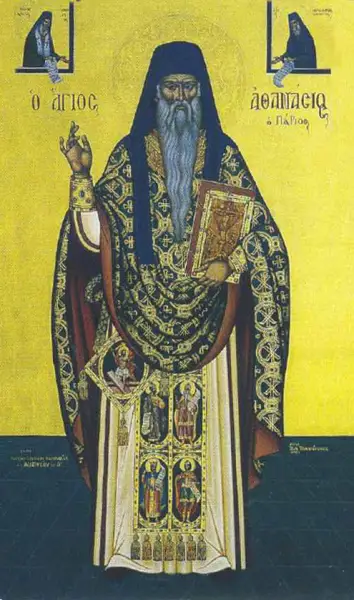
Overview
Athanasios Parios, born in 1722 in the village of Kostos on Paros and dying on 24 June 1813 at the hermitage of St. George on Chios, was a Greek hieromonk — theologian, philosopher, educator and hymnographer — counted among the 'Teachers of the Nation' of the Modern Greek Enlightenment and the second leader of the Kollyvades movement, succeeding Neophytos Kausokalyvites. His common letters he learned on Paros, followed by six years at the Greek school of Smyrna; in 1752 he went to Mount Athos and enrolled at the Athonite Academy, studying under Kausokalyvites and Eugenios Voulgaris, while Corfu came later, with Nikephoros Theotokis as his teacher. Thessaloniki held him as a teacher from 1767 to 1770, after which he went back to head the Athonite school. The year 1776 brought his downfall: pronounced a heretic, he lost his orders and suffered excommunication from Patriarch Sophronios II sitting with the Holy Synod — a sentence he successfully overturned before Patriarch Gabriel IV in 1781, which restored him to communion and to the priesthood. The school of Chios had him as principal from 1788 to 1811, and he closed his life in a hermit's cell at ninety. Modern Greek critics have judged him a reactionary, an enemy of the French Revolution's ideas and an opponent of Rigas Feraios and Adamantios Korais.
The Complete Life
Early Life and Studies
Athanasios was born in 1722 at Kostos, a small village of Paros — the plaque on his church there fixes the year, though sources range from 1721 to 1725. He learned his 'common letters' on the island, then left home for Smyrna, studying six years at the city's Greek school, founded in 1717 and later famed as the Evangelical School. From there the ladder of Greek learning carried him to Mount Athos: in 1752 he entered the Athonite Academy, studying under Neophytos Kausokalyvites and Eugenios Voulgaris, the two great schoolmen of the Holy Mountain, and afterwards at Corfu under Nikephoros Theotokis.
§ Life
Teacher and Kollyvades Leader
His working life was spent in schoolrooms: teaching at Thessaloniki from 1767 to 1770, then returning to the Athonite Academy as its director, and from 1788 to 1811 serving as principal of the school of Chios, which he made one of the leading schools of the Aegean. He became the second leader of the Kollyvades movement, succeeding Kausokalyvites — the Athonite agitation for frequent communion, exact memorial practice, and the patristic inheritance against watering-down. With Makarios of Corinth and Nikodemos the Hagiorite, he was one of the three great spiritual leaders of eighteenth-century Greece.
§ Life
Condemned and Vindicated
In 1776, at the height of the Kollyvades controversy, Patriarch Sophronios II and the Holy Synod of Constantinople condemned Athanasios as a heretic, defrocked him, and excommunicated him. He fought the sentence for five years; in 1781 he successfully defended himself before Patriarch Gabriel IV and the same Holy Synod, and was restored to communion and the priesthood. The episode — a saint condemned by a patriarchate and vindicated by it — is a standing rebuke to easy certainties about church authority, and the vindicated man returned not to polemic but to school-teaching.
§ Life
Final Years
From 1788 to 1811 Athanasios directed the Chios school; among those who passed through its rooms was Nikephoros of Chios, himself later canonized, who met Athanasios as the school's director and learned from him a love of learning and respect for teachers. Ninety years of age by then, Athanasios retired to the cell of St. George the Refston, and it was there that death found him on 24 June 1813.
§ Life
Canonization
The Greek Orthodox Church canonized Athanasios in 1995, one of the modern glorifications of the Enlightenment-era teachers. He is commemorated on 24 June, and again on the first Sunday of September together with the other saints of Paros and Naxos. His shrines are at Kostos on Paros and the Church of the Naxian Saints on Naxos.
§ Introduction
Legacy
Athanasios's reputation is contested in exactly the way he contested his century: modern Greek critics have called him a reactionary Orthodox fundamentalist, an enemy of the Western ideas of the French Revolution, an opponent of Rigas Feraios and Adamantios Korais — his 1802 'Response to the Irrational Zeal of the Philosophers Coming from Europe' being the exhibit. The church that canonized him reads the same record as fidelity: a theologian, hymnographer and hagiographer who kept the tradition's books open while refusing its captivation by the age. His students — including the martyr Athanasios of Koulakia and the scholar Minas Minoidis — carried both his learning and his combativeness into the Greek revival.
§ Introduction
Timeline
- 1722
Born at Kostos, a village on Paros
§ Life
- 1752
Enters Mount Athos and enrolls in the Athonite Academy under Kausokalyvites and Voulgaris
§ Life
- 1767
Teaches at Thessaloniki for the following three years
§ Life
- 1770
Returns to the Athonite School to serve as its director
§ Life
- 1776
Is sentenced for heresy, stripped of his orders, and cut off from communion under Patriarch Sophronios II
§ Life
- 1781
Successfully defends himself before Patriarch Gabriel IV and is restored to communion and the priesthood
§ Life
- 1785
Publishes the Antipapas, analysing the work of Mark of Ephesus
§ Works
- 1787
Publishes his treatise on rhetoric, pragmatics, and metaphysics
§ Works
- 1788
Becomes principal of the school on Chios, serving until 1811
§ Life
- 1797
Writes the Paternal Teaching, issued under Patriarch Anthimos of Jerusalem's name
§ Works
- 1798
Publishes his Christian apologies
§ Works
- 1802
Answers the zeal of philosophers arriving from Europe in a published reply
§ Works
- 1806
Issues the Epitome, a theology textbook made with Makarios of Corinth
§ Works
- 24 Jun 1813
Dies in the cell of St. George the Refston on Chios, aged ninety
§ Life
- 1995
Canonized as a saint in the Orthodox Church
§ Veneration
The Record
- Major works
- Antipapas (1785), on St. Mark of Ephesus·Paternal Teaching (1797)·Christian Apologies (1798)·Rhetorical Pragmatics and Metaphysics (1787)·A Response to the Irrational Zeal of the Philosophers Coming from Europe (1802)·Epitome (1806), theology textbook with St. Makarios of Corinth·Lives of various saints
- Symbols
- Long white beard·Priestly vestments·Gospel book
- Canonization
- Canonized by the Ecumenical Patriarchate in 1995
Prayer
Bibliography
Show 2 sources
Profile text adapted from the Wikipedia article, licensed CC BY-SA 4.0.
Pray with this saint every day
Save St. Athanasios Parios to your favorites, read the full profile, and get feast-day reminders in the Saints app.
Get the Saints AppFree on the App Store for iPhone and iPad