
6th century – 28 July 631·Feast January 3 (Martyrology of Rabban Sliba)
St. Athanasius I Gammolo
Syriac Orthodox Patriarch of Antioch
Overview
Athanasius I Gammolo served as Patriarch of Antioch and leader of the Syriac Orthodox Church, holding the see from 594/595 or 603 up to his death on 28 July 631, and is commemorated as a saint in the Martyrology of Rabban Sliba with a feast on 3 January. Born into a wealthy family at Samosata and raised with his brother Severus by their widowed mother Joanna, he became a monk at the Monastery of Qenneshre, the great Syriac house of learning, where he was trained in the recitation of the Bible. After the death of Patriarch Julian II, a synod that had fasted and prayed three days chose the monk it saw driving a camel past the monastery at dawn — Athanasius, taken against his will and elected; his request to finish his duty of bringing salt from the Gabbula mine earned him the surname Gammolo, 'camel driver'. As patriarch he healed the schism with the Coptic Church over tritheism, meeting Pope Anastasius of Alexandria's delegation at a monastery outside the city and issuing a joint condemnation of Chalcedon and Leo's Tome; re-established union with the non-Chalcedonians of the Sasanian empire, raising Marutha to metropolitan of Tagrit; commissioned Paul of Tella's Syro-Hexapla (615–617); refused Heraclius's monothelite formula at Mabbogh in 629 after twelve days of debate; and died on 28 July 631, buried at the Monastery of the Garoumaye.
The Complete Life
A Monk of Qenneshre
Athanasius was born in the sixth century at Samosata on the Euphrates, into a wealthy family. His father died when the boys were young; their mother Joanna raised Athanasius and his brother Severus, distributing most of the family's money to the poor while retaining enough to pay for their education. The two brothers became monks at the Monastery of Qenneshre — the great school of the Syriac church on the Euphrates, where Greek, Syriac and the biblical text were taught to generations of scholars — and were trained there in the recitation of the Bible. Athanasius later wrote a biography of Patriarch Severus of Antioch, and prefaced it with a family claim: that his father had been a priest who was friendly with the patriarch, and his grandfather a friend in turn of the patriarch's grandfather. Scholars doubt the claim — Severus was a convert from a pagan family, so the friendship of two priestly grandfathers is improbable — and read it as an attempt to Christianize and dignify an ancestry that was in fact wealthy but lay.
§ Early life
The Camel Driver Elected Patriarch
After the death of Patriarch Julian II, a synod met at a monastery close to Qenneshre to choose his successor. The bishops shut themselves away and spent three days in fasting and prayer; on the evening of that third day it was made known to them that the monk they would see going past the monastery early in the morning had been chosen by the Holy Spirit. In the morning they saw Athanasius driving a camel along the road; they tested his knowledge, discovered he was a monk of Qenneshre, and took him against his will. He agreed — but asked to be allowed to return first to complete his duty, bringing salt from the mine at Gabbula to his monastery. The year's delay gave him the name he bears in history: Gammolo, 'camel driver' in Syriac — the patriarch whose heraldic title was the beast he led. The sources disagree on the date of the consecration: the Chronicle of Thomas the Presbyter and Jacob of Edessa place it on 6 November 603, while Michael the Syrian gives 594, probably suppressing the vacancy to protect the legitimacy of the succession.
§ Early life
Healing Schisms, East and West
Athanasius's patriarchate was a work of reunion among the non-Chalcedonians. The Syriac and Coptic churches, though both had rejected Chalcedon, had been in schism since the tritheist dispute of Peter III and Damian of Alexandria. In 610 or 616/617, in response to a letter from Pope Anastasius of Alexandria, Athanasius and five bishops traveled to Egypt; meeting at a monastery outside Alexandria — non-Chalcedonians being barred from the city — with Paul of Tella and Thomas of Mabbogh representing him, an agreement was reached and the schism ended, sealed by a joint declaration condemning Chalcedon and Leo's Tome. After the Roman-Persian war ended in 628, he sent his syncellus John to the shah Ardashir III and on to the Monastery of Saint Matthew near Nineveh, re-establishing union between the Syriac non-Chalcedonians of the two empires: the eastern bishops returned with monks whom Christopher consecrated, and Marutha was raised to metropolitan of Tagrit with primacy over all bishops of the Sasanian empire — the founding of the Church of the East's Syriac Orthodox counterpart in Persia, the maphrianate in embryo.
§ Patriarch of Antioch
Mabbogh and Death
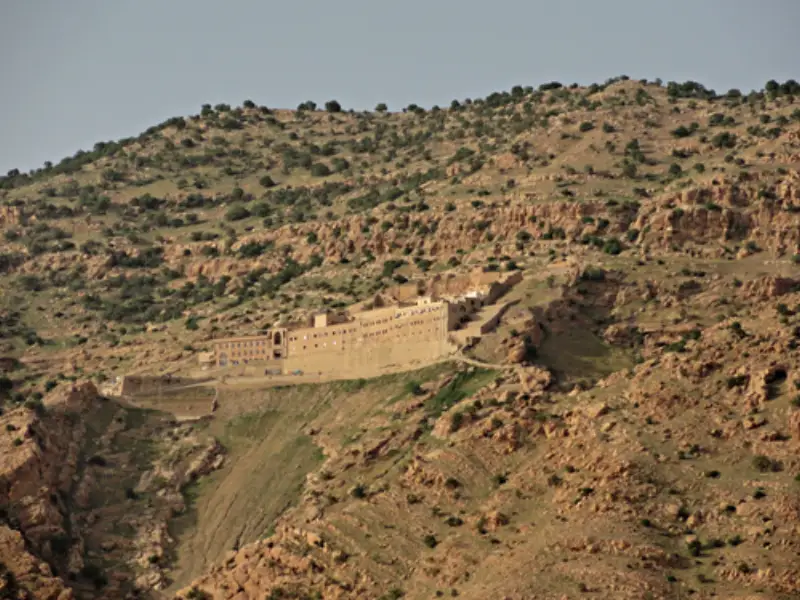
In 629 the emperor Heraclius — who had recovered the True Cross from the Persians and was attempting to reunite his religiously divided empire — summoned Athanasius to Mabbogh to resolve the schism between the Chalcedonian imperial church and the Syriac Orthodox. Athanasius came with eleven bishops. The debate lasted twelve days; Heraclius demanded they accept a Chalcedonian creed incorporating monothelitism and monoenergism, the compromise formulas he had adopted to square the circle. The Syriac bishops refused; the enraged emperor ordered the persecution of non-Chalcedonians in the empire. The Chronicle of Theophanes claims instead that Athanasius agreed to accept the creed to gain imperial recognition as patriarch of Antioch; the Syriac tradition denies it, and his own church's memory of persecution supports the denial. He died on 28 July 631 and was laid to rest at the Monastery of the Garoumaye; the Syriac Orthodox Church honors him as a saint on 3 January.
§ Later life
Scholar-Patriarch
Athanasius's deepest mark was scholarly. At his commission, Paul of Tella produced the Syro-Hexapla (615–617), the Syriac translation of the Old Testament made from the Septuagint column of Origen's Hexapla — one of the most important textual monuments of ancient Christianity, which preserves Septuagint readings lost in the Greek transmission. He may also have patronized Paul of Edessa's Syriac translation of Gregory of Nazianzus's homilies, and Thomas of Mabbogh's Harklean version of the New Testament, the rigorous literal revision that gave the Syriac church a scholarly text. His own biography of Severus of Antioch is lost in its original, but survives in Coptic fragments, an Arabic copy, and an Ethiopic translation. The patriarch whom a camel made famous thus made the Bible in Syriac more exact; the joke of his election and the gravity of his patronage are the two faces of a career that carried Syriac learning through the last decades before the Islamic conquest changed everything.
§ Works
Timeline
- 500
Born into a wealthy family at Samosata in the sixth century, raised by his widowed mother Joanna
§ Early life
- 6 Nov 603
Consecrated patriarch of Antioch on the date given by the Chronicle of Thomas the Presbyter; Michael the Syrian prefers 594
§ Early life
- 616
Travels with five bishops to Alexandria at Pope Anastasius's invitation, ending the tritheist schism with the Coptic Church
§ Patriarch of Antioch
- 617
Paul of Tella completes the Syro-Hexapla, the Syriac Old Testament, on Athanasius's commission (615-617)
§ Works
- 629
Confirms the primacy of the Monastery of Saint Matthew over the Sasanian monasteries in a letter after the war of 602-628
§ Patriarch of Antioch
- 629
Summoned by Emperor Heraclius to Mabbogh, rejects the imperial Chalcedonian creed after twelve days of debate
§ Later life
- 28 Jul 631
Dies and is buried at the Monastery of the Garoumaye
§ Later life
The Record
- Major works
- Syro-Hexapla (commissioned)·Biography of Patriarch Severus of Antioch (lost original; Coptic fragments, Arabic and Ethiopic versions)·Patron, probably, of Paul of Edessa's Syriac Gregory of Nazianzus and the Harklean New Testament
- Canonization
- Pre-congregation; commemorated by the Syriac Orthodox Church
Prayer
Bibliography
Show 12 sources
- 1 2 3 4 5 Tannous (2011) .
- 1 2 3 Tannous (2018) , p. 205.
- ↑ Jeanne-Nicole Mellon Saint-Laurent (17 August 2016). "Athanasius I Gamolo" . A Guide to Syriac Authors . Retrieved 24 May 2020 .
- ↑ Fiey (2004) , p. 38.
- ↑ Tannous (2018) , pp. 184, 204.
- 1 2 3 4 5 6 Barsoum (2003) , pp. 318–319.
- ↑ Palmer (1990) , p. 25.
- ↑ Tannous (2018) , p. 184.
- 1 2 3 Tannous (2018) , p. 204.
- 1 2 Palmer (1993) , pp. 257–258.
- 1 2 3 Atiya (1991) .
- ↑ Barsoum (2003) , pp. 315–316.
Profile text adapted from the Wikipedia article, licensed CC BY-SA 4.0.
Pray with this saint every day
Save St. Athanasius I Gammolo to your favorites, read the full profile, and get feast-day reminders in the Saints app.
Get the Saints AppFree on the App Store for iPhone and iPad