
c. 296-373·Feast May 2
St. Athanasius of Alexandria
Bishop and Doctor of the Church
Overview
Born to a Christian family of Alexandria around 296, Athanasius received a solid Greek education and attached himself early to Bishop Alexander, first as companion and secretary. Still a deacon, he accompanied Alexander to the Council of Nicaea in 325, where the Church affirmed that the Son is consubstantial with the Father against the teaching of the priest Arius. Chosen as Alexandria's twentieth patriarch in 328, he spent the next forty-five years defending that settlement against nearly every power of his age: Arian churchmen led by Eusebius of Nicomedia, and the emperors Constantine, Constantius II, Julian, and Valens. He was driven from his see five times, totaling some seventeen years of exile in Trier, Rome, the desert of Upper Egypt among the monks, and hiding places outside the city. Between banishments he shepherded Egypt and Libya, kept contact with his flock through annual Festal Letters announcing the date of Easter, and wrote the works that anchored Nicene orthodoxy: On the Incarnation, the Orations Against the Arians, the Life of Antony, and letters defending the divinity of the Holy Spirit. Honored East and West as the Father of Orthodoxy, he died quietly in Alexandria on 2 May 373, having named Peter II as his successor.
The Complete Life
Early Life
Athanasius was born around 296 in Alexandria, the greatest city of the Greek East after Rome itself, the seat of a church renowned for its catechetical school and notorious for the violence of its ecclesiastical politics. He was born a Greek-speaking native of the city, not of the Egyptian countryside, though his command of Coptic later made him the first patriarch of Alexandria to preach to the native population in their own tongue. Tradition, and the fifth-century historian Rufinus, tell of his boyhood game of baptism on the beach, played with other children, which bishop Alexander watched and turned into a prophecy of his office. He was taken into the clergy of Alexandria young, serving as reader and then as deacon to bishop Alexander, and in that capacity he accompanied the bishop to the Council of Nicaea in 325, a young secretary at the assembly that defined his life's argument.
§ Education
Conversion and Vocation
Athanasius's vocation was inseparable from the crisis that broke over Alexandria in 318, when the presbyter Arius began teaching that the Son of God was a creature, not eternal, not of the Father's substance. The controversy convulsed the city, and the young deacon stood with his bishop in the defense of the church's faith as Alexander had received it. When Alexander died in 328, Athanasius, still in his early thirties, was elected bishop of Alexandria over protests that would pursue him for the rest of his life. His consecration made him the champion of Nicaea at the moment when the council's formula, homoousios, of one substance with the Father, was beginning to look like a lost cause, and his episcopate, forty-five years, was spent almost entirely in that single argument.
§ Citations
Mission and Ministry
His ministry as patriarch was conducted from a storm center. Five times driven from his see by imperial force, he spent in all some seventeen years in exile, hiding in the deserts of Egypt among the monks who were his firmest allies, harried by an empire that changed emperors, policies, and theological factions while he would not change his position. From exile he governed by letter, and his Festal Letters, written annually to announce the date of Easter, carried to his church both the calendar and the doctrine, the thirty-ninth of them containing the earliest surviving list of the books of the New Testament canon. In Alexandria itself his periods of rule were filled with the ordinary and extraordinary work of a patriarch: the ordination of clergy, the care of the poor, the church's hospitals, the building up of the church among the Coptic population, and the resistance of successive prefects. His alliance with the monastic movement, his biography of Anthony and his welcome of the desert fathers, welded asceticism to the episcopate and set the pattern for the church's next thousand years.
§ Education
Spirituality and Teaching
Athanasius was not a speculative theologian; he described himself as holding the faith the apostles announced and the fathers handed down, the tradition and teaching of the church, and his works are the application of that inheritance to the crisis of the fourth century. His two-part apologetic, Against the Heathen and On the Incarnation of the Word, written probably before the Arian controversy broke, remains the classic statement of the patristic doctrine of redemption, that the Word became man that men might become divine. His later polemical works, the Orations against the Arians and the Letters to Serapion on the Holy Spirit, carried the Nicene argument from the Son to the Spirit and prepared the doctrine of the Trinity that Constantinople would complete. His Life of Anthony, the biography of the desert ascetic he knew personally, became one of the most influential books ever written, the charter text of monasticism across three continents and languages, read by Augustine at the moment of his conversion. He held that the Son is of the essence of the Father, that only the Creator could redeem the creature, and that the faith of the apostles admits no revision by council or emperor.
§ Introduction
Trial and Final Years
The last decade of Athanasius's life, after the final restoration under the emperor Valens's brief reversal, was spent in peace broken once more. In October 364, threatened again, he withdrew quietly from Alexandria to a country house, and within weeks the emperor, fearing the city's reaction, allowed him back. He spent his final years repairing the damage of the years of violence, dissent, and exile, resuming his writing and preaching, and re-emphasizing the faith defined at Nicaea at the moment when a new generation, the Cappadocian fathers, was winning the argument church-wide. Having consecrated Peter II as his successor, he died peacefully in his own bed on 2 May 373, an ending so ordinary that it reads as a marvel in the life of a man who had been hunted through the marshes of the Nile.
§ Patriarch
Canonization
Athanasius is a pre-congregation saint, honored by the church East and West from his own century as the pillar of Nicaea. He was declared a Doctor of the Church in the West, among the four great doctors of the East with Basil, Gregory Nazianzen, and John Chrysostom, and his feast, 2 May, entered both calendars. The Coptic church, whose language he was the first patriarch to honor in preaching, numbers him among its greatest patriarchs, and his relics, removed from Alexandria in the seventh century, are venerated at Venice and, in part, returned to Egypt in our own time.
§ Introduction
Legacy
Athanasius's legacy is the Nicene faith itself. The formula he defended against the world, that the Son is of one substance with the Father, is recited in the creed of every church that descends from Nicaea, and the fact that it is recited at all is in large measure his doing, since the council's settlement collapsed in his lifetime and was rebuilt on foundations he laid in exile. Athanasius contra mundum, Athanasius against the world, the tag the tradition fixed on him, states the pattern of the confessor bishop that the church has invoked ever since. His Life of Anthony shaped the monastic civilization of both East and West; his Easter letters preserve the first list of the New Testament canon; his alliance of hierarchy and monasticism set a course for a millennium. For the Coptic church he is the Greek patriarch who became its father, and for all churches he remains the proof that one stubborn man, right and out of favor, can hold a truth until the world comes round.
§ Introduction
Timeline
- 297
Born to a Christian family at Alexandria, possibly at Damanhur in the Nile Delta
§ Biography
- 318
Writes the apologetic pair Contra Gentes and De Incarnatione, before Arianism arises
§ Biography
- 319
Ordained a deacon by Bishop Alexander of Alexandria
§ Education
- 325
Serves as Bishop Alexander's secretary at the First Council of Nicaea
§ Education
- 9 May 328
Elected on 9 May to succeed Alexander; refuses to lift Arius's excommunication that same year
§ Patriarch
- 335
Deposed by the Eusebian faction after answering charges at the First Synod of Tyre
§ First exile
- 6 Nov 335
Condemned before Constantine at Constantinople on a grain-supply charge and banished to Trier
§ First exile
- 336
Reaches Trier, where Bishop Maximin receives him honorably for two years
§ First exile
- 337
Allowed to return to his see after the death of Constantine
§ Second exile
- 338
Constantius II renews his banishment; he sails to Rome and appeals to Pope Julius
§ Second exile
- 339
Nearly one hundred bishops meeting at Alexandria declare in his favor
§ Second exile
- 340
A Roman synod summoned by Pope Julius proclaims him rightful bishop of Alexandria
§ Second exile
- 343
Goes with Hosius of Cordoba to the Council of Serdica, where his innocence is reaffirmed
§ Second exile
- Apr 345
Celebrates his final Easter in exile at Aquileia, received by Bishop Fortunatianus
§ Second exile
- 353
Council of Arles condemns him under the emperor's pressure
§ Second exile
- 355
Council of Milan extracts a fourth condemnation from nearly all the bishops
§ Second exile
- 8 Feb 356
After an armed party storms his church on 8 February, he flees six years to the Upper Egyptian desert
§ Third exile
- 22 Feb 362
Returns to Alexandria under Julian's edict and convenes a council there with Eusebius of Vercelli
§ Third exile
- 23 Oct 362
Urges his protesting people to accept Julian's renewed expulsion order and leaves
§ Third exile
- 363
After Julian's death on 26 June, he slips back to Alexandria and Emperor Jovian reinstates him
§ Fourth exile
- Oct 364
Quietly withdraws when Valens banishes exiled bishops, returning within weeks by imperial order
§ Fifth exile
- 367
His 39th Festal Letter lists the 27 books of the New Testament in use today
§ New Testament canon
- 2 May 373
Dies peacefully at Alexandria, having consecrated Peter II as his successor
§ Final years and death
- 15 May 1973
A relic returns to Egypt, given by Pope Paul VI to Coptic Patriarch Shenouda III
§ Veneration
In Their Own Words
They are, it is true, in the places, but outside of the true Faith; while you are outside the places indeed, but the Faith, within you. Let us consider whether is the greater, the place or the Faith. Clearly the true Faith.
He was made man in order that we might be made gods.
[Christ] manifested himself by a body that we might receive the idea of the unseen Father; and He endured the insolence of men that we might inherit immortality.
Jesus that I know as my Redeemer cannot be less than God.
The Record
- Major works
- On the Incarnation (De Incarnatione)·Against the Heathen (Contra Gentes)·Orations Against the Arians·Life of Antony·Festal Letters·Letters to Serapion (on the divinity of the Holy Spirit)·Letter to Marcellinus on the Psalms
- Patron of
- Theologians·Defenders of the faith against heresy·The Coptic Orthodox Church (as Athanasius the Apostolic)
- Symbols
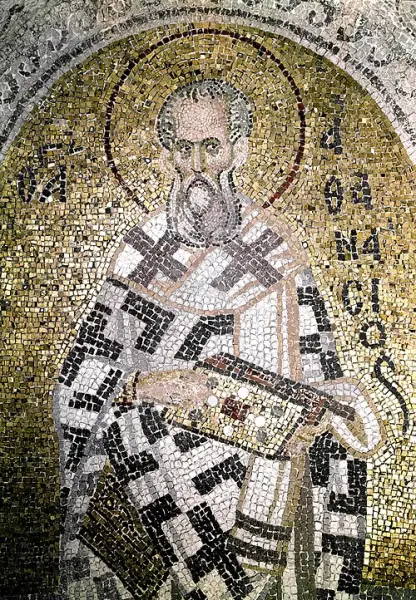
- Bishop's vestments·A book or scroll (his writings)·A ship or church (from his long defense of Nicene faith)
- Canonization
- Pre-congregation (ancient cult); declared Doctor of the Church by Pope Pius V in 1568
Prayer
Bibliography
Show 1 sources
- ↑ / ˌ æ θ ə ˈ n eɪ ʃ ə s / ⓘ ; Ancient Greek : Ἀθανάσιος Ἀλεξανδρείας , Athanásios Alexandrías ; Coptic : ⲡⲓⲁⲅⲓⲟⲥ ⲁⲑⲁⲛⲁⲥⲓⲟⲩ ⲡⲓⲁⲡⲟⲥⲧⲟⲗⲓⲕⲟⲥ or Ⲡⲁⲡⲁ ⲁⲑⲁⲛⲁⲥⲓⲟⲩ ⲁ̅ ; [ 2 ]
Profile text adapted from the Wikipedia article, licensed CC BY-SA 4.0.
Pray with this saint every day
Save St. Athanasius of Alexandria to your favorites, read the full profile, and get feast-day reminders in the Saints app.
Get the Saints AppFree on the App Store for iPhone and iPad