
1597-1648·Feast September 5; also July 20 (uncovering of relics)
St. Athanasius of Brest
Hieromartyr, Abbot
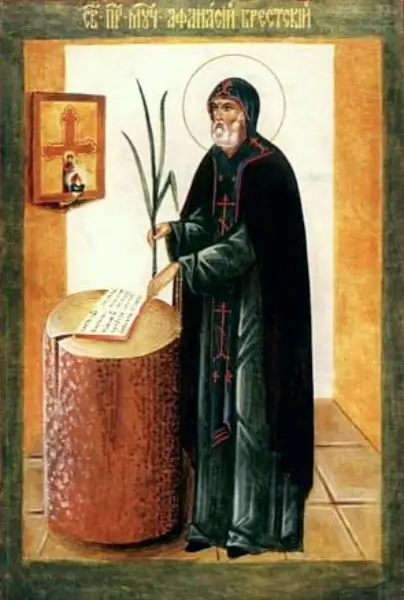
Overview
Athanasius Filipovich, hieromartyr of Brest, was a Belarusian Orthodox monk who died for his opposition to the Union of Brest — the 1595 arrangement by which much of the Ruthenian hierarchy entered communion with Rome. Born to a petty Lithuanian noble family in 1597, he was educated in modern and ancient languages, the Fathers, and Western philosophy and theology, then passed several years in private tutoring. In 1627 he joined the Monastery of the Holy Spirit in Vilnius, passed between monasteries, and was ordained priest. A fundraising journey of 1637 was marked, the tradition says, by visions and dangers. In 1640 he became hegumen of the monastery of St. Simeon Stylites in Brest, and from that position preached against the Union openly — including before the Polish sejm in 1643, where he was declared insane, arrested, stripped of his titles, and sent to Metropolitan Peter Mogila of Kiev, who returned him to Brest. Arrested again in 1644 and released, he was seized once more in 1648, accused of ties to the Khmelnytsky uprising, tortured, and executed. His remains were found in 1649; the uncovering of his relics in 1679 is commemorated on 20 July, his martyrdom on 5 September.
The Complete Life
A Nobleman's Son on the Frontier
Athanasius Filipovich was born in 1597 at Brest-Litovsk, the great treaty city on the western edge of the Ruthenian lands, to a family of petty Lithuanian nobility. The Commonwealth into which he was born had, two years before, watched its Ruthenian bishops conclude the Union of Brest, placing the Orthodox hierarchy of the Polish-Lithuanian state in communion with Rome — an ecclesiastical settlement with the force of a political earthquake. Filipovich received the education of his class and more: he learned modern and ancient tongues, read the Fathers, and studied what the Western philosophers and theologians had written, a curriculum that fitted him for the tutoring by which he lived for several years. The sources stress the learning because it mattered later: the man who stood before the sejm denouncing the Union was not a peasant prophet but a controversialist fully armed.
Monk and Hegumen
In 1627, at thirty, he entered the Monastery of the Holy Spirit in Vilnius, one of the strongholds of Orthodox monasticism in the Commonwealth. He moved between monasteries, was ordained priest, and in 1637, while collecting donations for the restoration of a church, underwent the experiences the tradition records as visions and miraculous signs — the experiential warrant for the public career that followed. In 1640 he was appointed hegumen of the monastery of St. Simeon Stylites at Brest: an obscure house, but located in the very city that gave the Union its name, and from that pulpit Athanasius began to preach against it with the learning, the visions, and the authority of office all engaged at once.
Against the Union of Brest
The substance of Athanasius's mission was a single refusal: that the church of his fathers had not been legitimately absorbed. He advocated against Roman proselytism and the Union from his appointment onward, and in 1643 he carried the case into the Polish parliament itself — appearing before the sejm to speak for Orthodoxy. The chamber's answer was to proclaim him insane, arrest him, and strip him of his monastic rank; he was sent to Peter Mogila, the learned Metropolitan of Kiev, who examined him and sent him back to Brest. The pattern repeated: arrested again in 1644, released in 1645, preaching again. His cause was not abstract church politics; for the Orthodox of the Commonwealth the Union meant the loss of hierarchy, property, and legal standing, and monks like Athanasius were the institution that survived when the episcopate did not.
Martyrdom in the Uprising
In 1648 the Khmelnytsky uprising broke the Commonwealth apart, and Athanasius's world inverted. He was seized a third time on a charge of connection with the Cossack rebels, tortured, and put to death. His remains were recovered on 20 July 1649 — a date kept as an alternative feast — and in 1679 his relics were solemnly uncovered, the church of the persecuted having outlived its persecutors. The parallel his hagiographers draw is exact and deliberate: as Josaphat Kuntsevych died for the Uniate cause at the hands of an Orthodox mob in 1623, so Athanasius died for the Orthodox cause at the hands of Uniate power in 1648; and as Josaphat is not venerated by the Orthodox, so Athanasius is not venerated by the church of his persecutors.
Veneration
Athanasius was glorified by the Russian Orthodox Church, which numbers him among its hieromartyrs, and he is venerated equally by the Polish Orthodox Church — the two jurisdictions that inherited the church of the former Commonwealth lands. His feast of martyrdom is kept on 5 September, with the uncovering of his relics on 20 July. In Belarus, whose Orthodox church remembers the Union of Brest as the defining wound of its history, he is among the most honored of the national saints.
Legacy
Athanasius's legacy is the memory of what the Union of Brest cost — and, from the other side of the same history, what it made. His life documents the mechanisms of enforced church union in the seventeenth century: the insanity ruling, the prison, the strip of rank, and finally the axe under cover of wartime. It also documents resistance that did not depend on hierarchy: a monk with languages and visions holding a city's Orthodox memory together through the worst decades. For the Belarusian and Polish Orthodox churches he is the confessor of churchly identity under pressure; for the historian he is one of the two martyrs — with Josaphat — whose paired deaths measure the tragedy of a church divided by decree rather than by faith.
Timeline
- 1597
Born to a petty Lithuanian nobleman at Brest, in the Polish-Lithuanian Commonwealth
§ Biography
- 1627
Entered the Monastery of the Holy Spirit in Vilnius after years as a private tutor
§ Biography
- 1637
Moved to the Kupyatitsk monastery near Minsk; his fundraising journey brought visions and dangers
§ Biography
- 1640
Became hegumen of the Monastery of St Simeon Stylites in Brest and opposed the Union
§ Biography
- 1643
Spoke before the Polish sejm for Orthodoxy; declared insane, arrested, and stripped of office
§ Biography
- 1644
Arrested again after returning to Brest, then released about a year later
§ Biography
- 5 Sep 1648
Accused of ties to the Khmelnytsky Uprising, he was tortured and executed
§ Introduction
- 20 Jul 1649
His remains were discovered, a date later kept as an alternative feast
§ Biography
- 20 Jul 1679
His relics were solemnly uncovered, an event commemorated on 20 July
§ Veneration
The Record
- Patron of
- Belarus·Orthodox Christians under pressure to change church allegiance
- Symbols
- Monastic schema·Crosier (as hegumen)·Palm of martyrdom
- Canonization
- Glorified by the Russian Orthodox Church; venerated also by the Polish Orthodox Church
Prayer
Profile text adapted from the Wikipedia article, licensed CC BY-SA 4.0.
Pray with this saint every day
Save St. Athanasius of Brest to your favorites, read the full profile, and get feast-day reminders in the Saints app.
Get the Saints AppFree on the App Store for iPhone and iPad