
1887-1962·Feast October 15
St. Athanasius Sakharov
Bishop of Kovrov, Confessor of the Faith
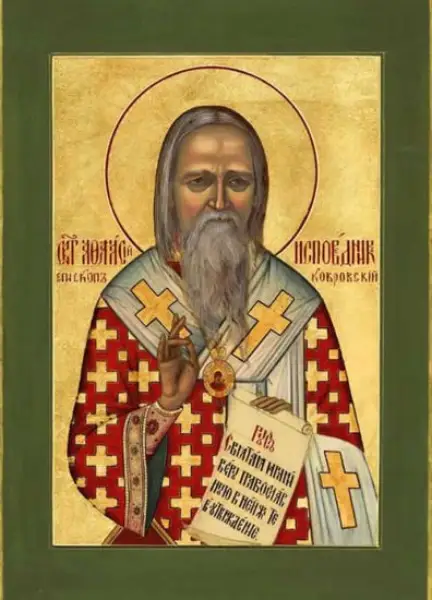
Overview
Athanasius Sakharov, born Sergei Sakharov on 2 July 1887 at Tsarevka in the Tambov governorship, was a Russian Orthodox bishop, hymnographer and confessor whose full title is Saint Athanasius Sakharov, Confessor of the Faith, Bishop of Kovrov. His father, a court councillor, died when he was eighteen months old, and his mother Matrona, of peasant stock, embraced the monastic life, forming her son's piety. A child of long services, he announced his intention of priesthood to his schoolmates, learned to sew in order to make vestments and embroider icon covers, and at twelve composed his first hymn. After the Vladimir seminary, where he refused to join the revolutionary strikes, he graduated from the Moscow Theological Academy in 1912, taking the monastic name Athanasius after Athanasius of Alexandria. He became archimandrite and abbot of the Nativity monastery at Vladimir in 1920, and was secretly consecrated bishop of Vladimir-Suzdal after being threatened at the secret police headquarters on the eve of his ordination. Arrested in March 1922 for refusing to renounce his title, he was condemned, exiled, rearrested, and made bishop of Kovrov. Of his forty-two years as bishop he spent thirty-three in exile or the camps, at Onega, Kargopol, Mariinsk, Temnikov, Dubravlag and the Siberian camps, felling timber and cleaning manure, teaching Orthodoxy even in his cell. He died in 1962 at the end of his confessor's road. He was canonized in 2000.
The Complete Life
Early Life
The future Bishop Athanasius was born Sergei Sakharov on 2 July 1887, at the village of Tsarevka in the Tambov governorship, and grew up in Vladimir, the ancient capital of northeastern Russia. His father, Gregory, held the civil rank of court councillor; his mother, Matrona, came of the peasantry, and when her husband died during her son's second year, her piety deepened into the monastic life she thereafter led as a married ascetic, and the boy was formed by it. He was, by his own and others' account, a church child: devoted to the long services and liturgies, telling his friends and classmates that he would be a priest, and learning, with practical simplicity, to sew, that he might make vestments and embroider the covers of icons. His schooling was difficult and his perseverance remarkable: having struggled, he finished top of his class, and at twelve composed his first troparion, a hymn honoring the Shuisk-Smolensk icon of the Mother of God. At the seminary in Vladimir, in those years of revolutionary unrest, he kept apart from politics, refusing to join the striking students of 1901, having come to study theology rather than to make revolution.
§ Early life
Monk and Bishop
From Vladimir he passed to the Moscow Theological Academy, taking the monastic tonsure there with the name of Athanasius, after the great confessor-bishop of Alexandria, a name he would spend a lifetime earning. He graduated in theology in 1912, and the years that followed brought the collapse of the world he had been trained to serve: war, revolution, and the church's persecution. He served in his native Vladimir, and in 1920 was raised to archimandrite as abbot of the Nativity of the Theotokos monastery. The episcopate in the Soviet 1920s was an invitation to martyrdom: the privileges of a bishop in the old Russia had become pretexts for arrest, and Athanasius knew this when he consented to be consecrated for the see of Vladimir-Suzdal. The day before his ordination he was hauled to the headquarters of the secret police and threatened; ordained all the same, he was arrested a few months later, in March 1922, for refusing to lay down his title.
§ Education
Confessor of the Catacombs
His first sentence was a year; he was released by pardon without serving it, rearrested, and exiled to Ust-Sysolsk in the east for his refusal of the renovationist schism, the state-favored movement that sought to split the church from within. From exile he was made bishop of Kovrov, a title he would carry for forty years, most of them in confinement. His prisons and camps included Onega, Kargopol, Mariinsk, Temnikov and Dubravlag, and the Siberian camps, where the labor was felling trees, building roads, weaving bast shoes and cleaning manure; in the intervals of freedom he served a scattered flock, ordaining secretly, corresponding, and holding the church together in the manner of the catacombs. His own estimate of his situation, written to his community from confinement, has become one of the classic documents of the Russian confessors: confinement, he wrote, left him far better off than liberty would have, and he insisted he was not exaggerating in the least, for the true Orthodox Church was to be found precisely there.
§ Imprisonment and Torture
Hymnographer
Athanasius was one of the greatest hymnographers of the Russian church, and his liturgical work, much of it composed in prison, is his enduring monument. He labored above all on the services of the New Martyrs and Confessors of Russia, composing, in conditions of censorship and concealment, the hymns by which the church would one day celebrate the very company to which he himself belonged; the irony was exact and he noted it, a confessor writing the office of the confessors before their glorification. He was also a scholar of the Typikon, the church's rule of services, and his work on the order of burial and the commemoration of the dead reflects the experience of a man who buried the church's dead for forty years of persecution. In this he stands in the tradition of the Russian hierarch-literati, combining ascetic endurance with exact scholarship; the church that canonized him in 2000 canonized in him both the prisoner and the poet, the man who kept the faith and the man who gave it words.
§ Introduction
Final Years
Of Athanasius' forty-two years as bishop, thirty-three were spent in exile, prison or camp. Released in the amnesties of the 1950s, he lived his last years under restriction, continuing his liturgical work and his correspondence with the scattered church, and died in 1962, one of the last of the great senior confessors of the Soviet era. His burial place became a place of quiet veneration, and the liturgical studies and hymns he had written circulated among those who knew their author's history. The church he served underground would outlive the state that had imprisoned him by three decades, and the men and women of the revival that followed were, in many cases, formed by his services.
Canonization
The Russian Orthodox Church canonized Bishop Athanasius in August 2000, in the great act of glorification of the New Martyrs and Confessors of Russia, by which the church, free at last, numbered its twentieth-century dead among the saints. His formal title, Saint Athanasius Sakharov, Confessor of the Faith, Bishop of Kovrov, joins the confessor's crown, for the suffering borne without bloodshed, to the bishop's; and his hymnography stands as the liturgical charter of the company, the services of the New Martyrs owing more to him than to any other single hand. His commemoration is kept with the confessors, and pilgrims honor his memory at Vladimir and at his grave. The canonization was also, in its way, the completion of his own work: the hymnographer of the martyrs was enrolled among them.
§ Introduction
Legacy
Athanasius' legacy lives wherever the Russian church sings. The services he composed for the New Martyrs are used throughout the Russian Orthodox Church and, in translation, beyond it, and his scholarship on the Typikon and the rites of the dead remains a working reference of the liturgical tradition. As a confessor he belongs to the central company of the Soviet-era bishops, the men whose refusals kept the church from dissolution; his thirty-three years of confinement stand in the record beside the greater names of the era, and his letters from the camps, published since the canonization, have taken their place among the documents of Christian endurance in the twentieth century. For prisoners of conscience everywhere, and for church musicians, he is a patron of the two things that saved him: fidelity and song.
§ Church Life
Timeline
- 2 Jul 1887
Born Sergei Sakharov at Tsarevka village in the Tambov governorship
§ Early life
- 1912
Graduated from the Moscow Theological Academy with a theology degree, having taken the name Athanasius
§ Education
- 1918
Joined the diocesan council in Vladimir and served its association until 1920
§ Church Life
- 20 Jan 1920
Was raised to archimandrite as abbot of the Nativity of the Theotokos Monastery in Vladimir
§ Church Life
- Mar 1922
Months after becoming Bishop of Vladimir-Suzdal, he was arrested for refusing to step down
§ Imprisonment and Torture
- 1922
Pardoned after a one-year sentence, he was rearrested and exiled to Ust-Sysolsk
§ Imprisonment and Torture
- 2000
Canonized by the Russian Orthodox Church as Confessor of the Faith, Bishop of Kovrov
§ Introduction
In Their Own Words
I am far better off here than at liberty, and I am saying so without the slightest exaggeration. The true Orthodox Church is here.
The Record
- Major works
- Services and hymns for the New Martyrs and Confessors of Russia (hymnography)·Writings on the church year and the office for the dead
- Patron of
- Prisoners for the faith·Confessors·Hymnographers and church composers
- Symbols
- Prisoner's rags·Hierarch's vestments
- Canonization
- Canonized August 2000 by the Russian Orthodox Church
Prayer
Bibliography
Show 7 sources
- 1 2 "Saint Athanasius (Sakharov), a Steadfast Confessor of the Faith" . obitel-minsk.org/ . Retrieved 2024-05-11 .
- 1 2 "Hiero-confessor Athanasius (Sakharov), bishop of Kovrov" . Retrieved 2024-05-11 .
- ↑ "St. Afanasy (Athanasius) Sakharov, Bishop of Kovrov, Confessor and Hymnographer" . Православие.RU . Retrieved 2024-05-11 .
- ↑ "St. Afanasy (Athanasius) Sakharov, Bishop of Kovrov, Confessor and Hymnographer" . Православие.RU . Retrieved 2024-05-12 .
- 1 2 "Saint Athanasius (Sakharov), a Steadfast Confessor of the Faith" . obitel-minsk.org/ . Retrieved 2024-05-12 .
- ↑ "Saint Athanasius (Sakharov), a Steadfast Confessor of the Faith" . obitel-minsk.org/ . Retrieved 2024-07-26 .
- ↑ "Saint Athanasius (Sakharov), a Steadfast Confessor of the Faith" . obitel-minsk.org/ . Retrieved 2024-07-27 .
Profile text adapted from the Wikipedia article, licensed CC BY-SA 4.0.
Pray with this saint every day
Save St. Athanasius Sakharov to your favorites, read the full profile, and get feast-day reminders in the Saints app.
Get the Saints AppFree on the App Store for iPhone and iPad