
c. 920 – c. 1003·Feast July 5
St. Athanasius the Athonite
Founder of the Great Lavra on Mount Athos
Overview
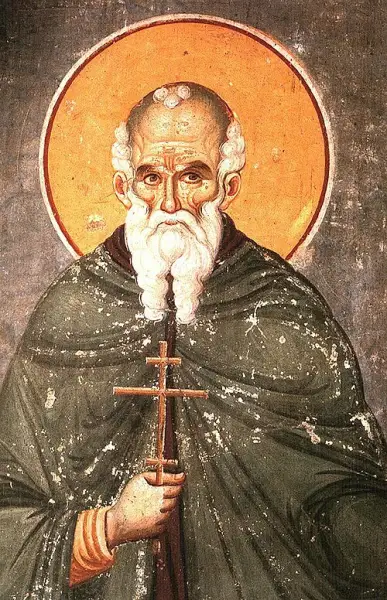
Athanasius the Athonite was a Byzantine monk, born about 920 at Trebizond to Antiochene parents, reckoned the founder of the monastic commonwealth of the Athos peninsula — the community that in time grew into Eastern Orthodoxy's greatest center of monasticism. Michael Maleinos took him under his patronage in his youth; at Constantinople he studied and won fame as Abraham, a fervent preacher whose authority was great with Maleinos's nephew, Nicephoros Phocas, later emperor. The lax morals of the capital's monks left him uneasy; he took the name Athanasios instead and went to join the monks of Mount Kyminas in Bithynia, moving on to Mount Athos in 958.There he helped defend the hermits and sketes against Saracen raiders and began to incorporate the scattered solitaries into what became the Great Lavra, built with the financial assistance of Nicephoros, now on the throne, and dedicated in 963 — the first of the great coenobitic houses of the Holy Mountain, still in use today. A divine vision spurred Athanasius to come back as hegumen, and he introduced a cenobitic typicon drawing on Theodore the Studite and Basil of Caesarea. He died when the cupola of his church collapsed, killed by falling masonry, and was immediately glorified as a saint. His feast is 5 July.
The Complete Life
From Trebizond to Constantinople
Athanasius was born about 920 at Trebizond on the Black Sea, into a family of Antiochene origin, and was taken up young by Michael Maleinos, the abbot whose house on Kyminas trained several of the century's leading churchmen. His education continued at Constantinople, where his fame grew as Abraham, a preacher of fervor who carried great weight with Maleinos's nephew Nicephoros Phocas — then the empire's great general, later its emperor. The patronage mattered for everything that followed: the friendship formed between the ascetic and the soldier in these years would build the Great Lavra a decade later. Living among the capital's monks, Abraham found their morals too lax; his answer was the standard one of the era's reformers: he changed his name to Athanasios, left Constantinople, and joined the monks at Mount Kyminas in Bithynia, in Asia Minor, one of the houses of the Studite renewal.
The Great Lavra
In 958 Athanasius relocated to Mount Athos, then a peninsula of scattered hermits — the sketes and cells of solitaries living under no common rule. He helped defend the hermits against the Saracens, whose raids had long made the Holy Mountain dangerous, and began to incorporate the sketes already there into a coenobitic monastery built with the financial assistance of Nicephoros Phocas, who had by then ascended the imperial throne. The monastery was dedicated in 963 and is still in use today, referred to by the people of the area simply as Lavra, The Monastery: the Great Lavra, the first and still the first-ranked of the Athonite houses. Three other foundations followed shortly after, and all remain. The step was controversial. His intrusion, and his efforts to impose order and discipline on their lives, were resented by the hermits already on Athos — the permanent tension of the Holy Mountain between the solitary and the common life was there at the founding.
Exile, Charter, and Death
Nicephoros died in 969, Athanasius's enemies gained the upper hand, and Athos had to be exchanged for Cyprus; there he stayed until the new emperor, John Tzimisces, took up the Great Lavra's patronage again and granted the monastery its first charter in 972. The charter — the Tragos, so called because it was written on goatskin parchment — is kept at the Protaton in Karyes today, the founding document of organized Athonite monasticism. A divine vision spurred him to return to Athos immediately as hegumen, and he introduced a cenobitic typicon drawn from the compilations of Theodore the Studite and Basil of Caesarea: the common life, common table, common office, and common obedience that the Great Lavra still keeps. Death came by accident: masonry fell as the cupola of his church collapsed, and he was killed — a builder's death for the builder of the Holy Mountain — around the year 1003, and was glorified as a saint upon his death.
The Holy Mountain
Athanasius's legacy is the thing itself: Mount Athos, grown in the centuries since into Eastern Orthodoxy's greatest center of monasticism, a peninsula monastic republic that has kept the life he organized for over a thousand years. The typicon he introduced — Studite and Basilian in its sources — became the framework of Athonite coenobitism, and the Tragos charter fixed the Holy Mountain's relation to emperor and church in a form whose memory still governs its self-understanding. Two vitae of him survive: Vita A, written by Athanasios of the Panagiou Monastery in Constantinople in the early eleventh century, and Vita B, written anonymously at the Great Lavra between 1050 and 1150 and translated into English by Alice-Mary Talbot in the Dumbarton Oaks Medieval Library's Holy Men of Mount Athos. A historic bridge near the Great Lavra is still attributed to his building. His feast is kept on 5 July, and he is honored as well by the Catholic Church, which carries his notice in the western dictionaries of the saints.
Timeline
- 920
Born at Trebizond to parents from Antioch, and patronized by Michael Maleinos.
§ Biography
- 958
Ill at ease with the capital's lax monks, he leaves Mount Kyminas in Bithynia for Mount Athos.
§ Biography
- 963
The Great Lavra, built with Nicephoros Phocas's financial assistance, is dedicated.
§ Biography
- 972
Emperor John Tzimisces grants the Great Lavra its first charter, the Tragos; Athanasios returns as hegumen.
§ Biography
- 1003
Killed when falling masonry brings down the cupola of his church; glorified as a saint upon his death.
§ Biography
The Record
- Major works
- Typicon for cenobitic life on Mount Athos (based on Theodore the Studite and Basil of Caesarea)
- Patron of
- Mount Athos·Monastic founders
- Symbols
- Monk's habit and klobuk·Model of the Great Lavra·Falling cupola (in iconography of his death)
- Canonization
- Glorified as a saint shortly after his death (Byzantine cult, pre-congregation in form)
Prayer
Profile text adapted from the Wikipedia article, licensed CC BY-SA 4.0.
Pray with this saint every day
Save St. Athanasius the Athonite to your favorites, read the full profile, and get feast-day reminders in the Saints app.
Get the Saints AppFree on the App Store for iPhone and iPad