
c. 1302-1380·Feast April 20
St. Athanasius the Meteorite
Founder of the Great Meteoron, Meteora
Overview
Athanasius the Meteorite, born Andronikos at New Patras — the modern Ypati in Phthiotida — in 1302 or 1303, was a fourteenth-century Greek monk, founder of the monastery of the Great Meteoron at Meteora. Baptized Andronikos and probably of a wealthy noble family whose origins he never mentioned, he was orphaned young and taken in by an uncle. Around 1319 the city fell to the Catalan troops of Alfonso Fadrique of Aragon and passed to the Duchy of Athens, and Andronikos and his uncle fled to Thessalonica. Though the family had few resources, local teachers, impressed by his enthusiasm, taught him philosophy and classical literature without tuition. He went on to Mount Athos, asking to become a monk, but was refused as too young. He continued instead on pilgrimage and in study, eventually taking the monastic habit and the name Athanasius, and around 1344 he came with his elder Gregory to the rock pillars of Meteora in Thessaly. There, on the Broad Rock, he founded the community that became the Great Meteoron, organizing coenobitic life on the summit. He died in 1380, and his feast is kept on 20 April.
The Complete Life
Early Life
Andronikos — the baptismal name of the future Athanasius — was born at New Patras, the present village of Ypati in Phthiotida, in 1302 or 1303. He is assumed to have come from a wealthy noble family, though he never spoke of his origins, a silence his biographers respect as part of his renunciation. Orphaned while still young, he was taken in by an uncle who cared for his upbringing; around 1319 the Catalan soldiery of Alfonso Fadrique of Aragon — the power newly installed in the Duchy of Athens — overran their city, and the two fled north to Thessalonica as refugees. The family had few resources, but the boy's enthusiasm for study impressed the local teachers, who taught him philosophy and classical literature free of charge — a detail his Life preserves as the charity that made everything else possible. In Thessalonica, too, he encountered the hesychast circle around Gregory of Sinai's disciples, the movement then remaking Byzantine monasticism, and his direction was set.
Athos and Pilgrimage
A few years later Andronikos presented himself at Mount Athos and asked to take the monastic habit there, but the brothers refused him as too young — the mountain's discipline sparing the adolescent from vows. He did not turn home. He went on pilgrimage instead, to the holy places of the empire, and continued his studies, a wandering student of the sacred geography that Byzantium offered. In time he received the monastic habit and the name Athanasius, and attached himself to Gregory, an elder of the Athonite-hesychast line. With Gregory, around 1344, he came to the strange rock forest of Meteora in Thessaly — the sandstone pillars above the Peneios plain, where hermits had already settled in the caves and on the summits, drawing themselves up by rope-ladders and nets. The elder and the young monk climbed the Broad Rock, the highest of the pillars, and found on its summit the space for what Athanasius had begun to envision: not a hermitage but a monastery.
The Great Meteoron
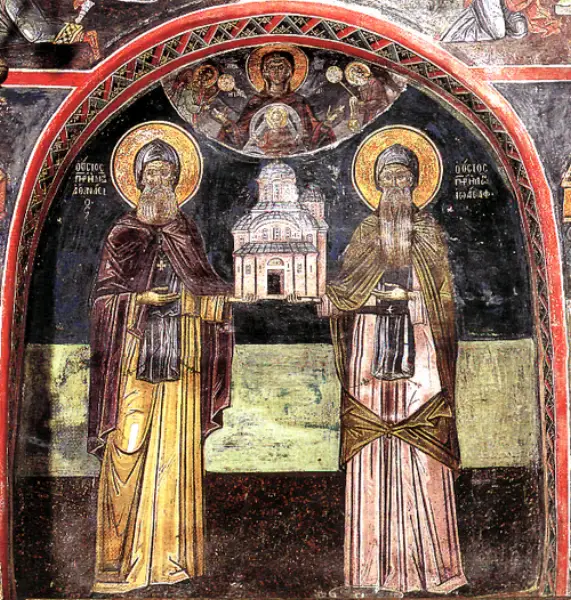
On the Broad Rock — the Meteoron, the suspended place, whose name passed to the whole cluster — Athanasius founded a coenobitic monastery: a common life with church, cells and refectory organized on the summit of a stone finger hundreds of feet above the plain. The enterprise demanded everything his noble education and hesychast formation had given him: building under conditions in which every stone was hoisted by windlass, discipline among men who could leave only by rope, and the diplomatic management of the local Serbian and Byzantine powers, under whose protection the monastery grew. He gathered a brotherhood and gave it a typicon of the Athonite pattern, and the community became the Great Meteoron, first in rank among the monasteries that followed it onto the neighbouring rocks — a whole monastic city in the air. His disciple and successor Joasaph, of the Serbian imperial line, shared and completed the founding, and the two are commemorated together in the monastery's frescoes.
Legacy
Athanasius died in 1380 and was canonized by the Eastern Orthodox Church, his feast kept on 20 April. His legacy is visible from thirty miles: the Meteora monasteries, of which the Great Meteoron is mother and eldest, became after Athos the greatest centre of Orthodox monasticism, a refuge in the Turkish centuries for manuscripts, theology and the tradition of prayer — the rope-nets by which visitors were hauled to the summits remained in use into the twentieth. What he built answered the hesychast ideal with architecture: the unceasing prayer of the heart raised onto pillars no distraction could climb. For the church of Greece he is a father of Thessalian monasticism; for the pilgrim, the man whose folly on a rock proved wiser than the plains. His image in the monastery he founded shows him with his successor, the founders holding the model of their suspended lavra between them.
Timeline
- 1302
Born at New Patras (modern Ypati), probably into a wealthy noble family, and baptized Andronikos.
§ Early life
- 1319
New Patras fell to the Catalan forces of Alfonso Fadrique of Aragon; he fled with his uncle to Thessalonika.
§ Early life
- 1332
Received monastic tonsure at about age thirty in an isolated Athonite skete, taking the name Athanasius.
§ Beginning of monastic life
- 1356
Organized his community on the highest rock under a cenobitic rule drawn from Athonite typika, with a church dedicated to the Transfiguration.
§ The Monastery of the Transfiguration
- 1372
Was credited with foretelling the unsuccessful Ottoman siege of Thessalonika that year.
§ The Monastery of the Transfiguration
- 1380
Died at Meteora, leaving the Great Meteoron as the leading monastery of the region.
§ The Monastery of the Transfiguration
The Record
- Major works
- Organizer and typikon-giver of the Great Meteoron community
- Patron of
- Meteora·Greek monasticism
- Symbols
- Monastic habit·Rock pinnacle and rope-ladder·Church on the summit
- Canonization
- Canonized by the Eastern Orthodox Church
Prayer
Profile text adapted from the Wikipedia article, licensed CC BY-SA 4.0.
Pray with this saint every day
Save St. Athanasius the Meteorite to your favorites, read the full profile, and get feast-day reminders in the Saints app.
Get the Saints AppFree on the App Store for iPhone and iPad