
c. 115-c. 190·Feast August 6 (Orthodox; 24 July O.S. in some lists)
St. Athenagoras of Athens
Christian Apologist and Philosopher
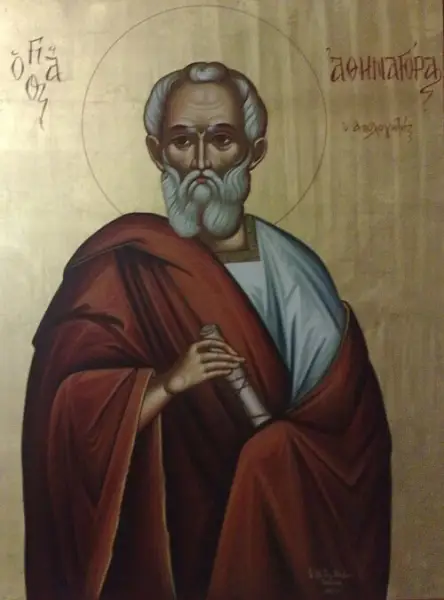
Overview
Athenagoras, Ancient Greek Athenagoras ho Athenaios, was an Ante-Nicene Church Father and Christian apologist of the second half of the second century, of whom little is known with certainty: that he was Athenian (though perhaps not originally from Athens), a philosopher — plausibly a Platonist — and a convert to Christianity. In his writings he styles himself 'Athenagoras, the Athenian, Philosopher, and Christian.' After his conversion he went to Alexandria and taught at the school that would become its famous Christian academy. His writings seem to have circulated widely and carried influence in their day, yet other apologists pass over him in silence — Eusebius's extensive works notably never mention him — perhaps, scholars conjecture, because his treatises circulated anonymously and were attributed to another. Only two mentions of him survive in early Christian literature: quotations in Methodius of Olympus and untrustworthy biographical fragments in Philip of Side, who says he converted after first reading scripture to refute it. Two of his works are preserved: the Embassy for the Christians, addressed to Marcus Aurelius and Commodus in 176-177, and On the Resurrection of the Dead.
The Complete Life
The Man Behind Two Books
Nearly everything personal about Athenagoras must be inferred from his own signature: 'Athenagoras, the Athenian, Philosopher, and Christian.' He was probably Athenian by origin, though possibly not; he was a philosopher, probably a Platonist — Alexander Wilder groups him with Pantaenus and Clement as thoroughly instructed in the Platonic philosophy — and he was a convert. Philip of Side's late and untrustworthy fragments say that, hoping to refute the Scriptures, he first made himself familiar with them, and was won over by what he read: the classic convert's route, though the source is weak. His sentences' rhythm and his material's arrangement lead scholars to surmise a schooling in rhetoric. To Alexandria he went, teaching at the school that would become its famous Christian academy; Philip's claim that he preceded Pantaenus as its head is probably incorrect and contradicted by Eusebius.
§ History
The Embassy
The Embassy for the Christians — the Legatio — is dated by internal evidence to late 176 or 177, and is a carefully written plea for justice addressed to the emperors Marcus Aurelius and his son Commodus, whom Athenagoras flatters as conquerors, 'but above all, philosophers.' The work makes one of the earliest efforts to bring Platonic thought to bear on Christian belief before a Greek and Roman public. He complains first of the illogical and unjust discrimination against Christians, then meets the charge of atheism — the standard accusation, since disbelieving the Roman gods looked like believing in nothing — with the first powerfully reasoned case for God's unity in Christian writing, supplemented by a capable exposition of the Trinity. He justifies Christian abstention from the national cults as absurd and indecent, quoting the pagan poets at length against them; and he answers the charges of immorality and cannibalism by laying bare how purity is the Christian ideal even in thought, how sanctity surrounds the marriage bond, and the refusal of Christians to attend gladiatorial games or to tolerate abortion, which he calls murder for which women will answer to God.
§ Legatio Pro Christianis
On the Resurrection
The treatise On the Resurrection of the Dead, written later than the Apology as its appendix, is the first complete exposition of the doctrine of the resurrection in Christian literature. Athenagoras brings to its defence the best contemporary philosophy could adduce: the possibility of resurrection from the power of the Creator or the nature of our bodies; its fitness — such power being neither unworthy of God nor unfair to the other creatures; and its necessity — man's nature and end requiring that the life of body and soul go on. He asserts both the resurrection body and the soul's unconsciousness between death and resurrection — the dead and the sleeping, he writes, subject to similar states, without sense even of existence itself.
§ Work and writings
Legacy
Later scholars credit his works with having moved their first audience more deeply than the writings, better known today, of his more combative contemporaries: courtesy was his method, and philosophy his native tongue. He is among the earliest Christian voices against the death penalty — the church, he wrote, could not bear even the sight of a man being put to death, however justly — and against abortion. The Orthodox Church keeps his feast on 24 July (O.S.)/6 August, honoring the philosopher who answered an empire without learning to hate it.
§ Introduction
Timeline
- 115
Born around this time, probably at Athens; a philosopher, likely trained in Platonism.
§ Introduction
- 176
Addressed his Embassy for the Christians, dated by internal evidence to late 176 or 177, to Marcus Aurelius and Commodus.
§ Legatio Pro Christianis
- 190
Died around this time, probably at Athens.
§ Introduction
In Their Own Words
We cannot endure even to see a man put to death, though justly.
The Record
- Major works
- Embassy for the Christians (Legatio pro Christianis), 176-177·On the Resurrection of the Dead (De resurrectione mortuorum)
- Patron of
- Christian philosophers·Apologetics
- Symbols
- Philosopher's cloak·Scroll of the apology
- Canonization
- Pre-congregation
Prayer
Bibliography
Show 9 sources
- 1 2 "Online Chapel — Greek Orthodox Archdiocese of America — Athenagorus the Apologist", Retrieved 2011-07-27
- ↑ Wilder, A. (1869) “New Platonism and Alchemy” Albany, N.Y., p.4, quoted in Blavatsky H.P. (1928) [1897] “The Secret Doctrine: The Synthesis of Science Religion and Philosophy Volume III” TPH:London.
- 1 2 Britannica, The Editors of Encyclopaedia. "Athenagoras". Encyclopedia Britannica
- 1 2 3 Peterson, John Bertram. "Athenagoras." The Catholic Encyclopedia Vol. 2. New York: Robert Appleton Company, 1907. 22 September 2021 This article incorporates text from this source, which is in the public domain .
- ↑ "Introductory Note to the Writings of Athenagoras", Roberts-Donaldson translation, Kirby, Peter. "Athenagoras of Athens." Early Christian Writings. 2018.
- ↑ "Saint Athenagoras of Athens", OCA
- ↑ "The Death Penalty: Inadmissible and Doctrinally Continuous" . 10 January 2022.
- ↑ , "Ante-Nicene Fathers, Vol. II — Writings of Athenagoras — A Plea For the Christians — Chapter XXXV – The Christians Condemn and Detest all Cruelty", Retrieved 2012 -11-06
- ↑ Athenagoras, On the Resurrection . Chap. xvi., retrieved 7 July 2018
Profile text adapted from the Wikipedia article, licensed CC BY-SA 4.0.
Pray with this saint every day
Save St. Athenagoras of Athens to your favorites, read the full profile, and get feast-day reminders in the Saints app.
Get the Saints AppFree on the App Store for iPhone and iPad