
died 17 July 303 (or 304)·Feast July 16 (Orthodox); June 24 (Byzantine tradition)
St. Athenogenes of Pedachtoë
Priest, Chorepiskopos and Martyr
Overview
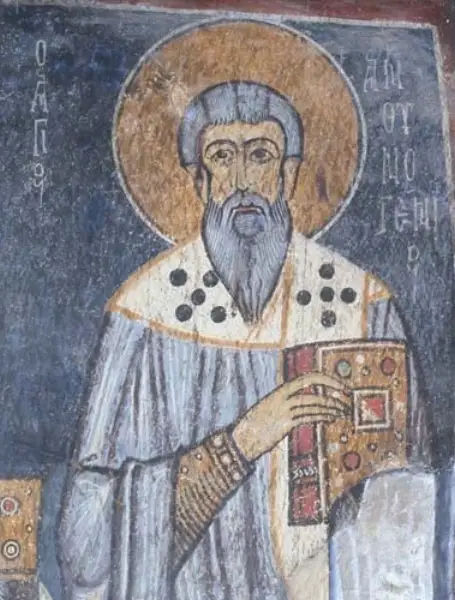
Athenogenes of Pedachtoë, who died in 303, was a priest and chorepiskopos — a rural bishop — and the leader of the Christian community at Pedachtoë in Roman Armenia, put to death in the persecution's first or second year. He came from a Christian family in an obscure village called Epiklesoi, near Sebastopolis or Sebastea; a married man, he had a son, Patrophilos, and the early hagiographies depict a wonder-working holy man whose power reached over animals real and mythical (a dragon among them) and over water, in the manner of Gregory Thaumaturgus of neighbouring Neocaesarea. The earliest known story of his martyrdom begins with two Christian men of a village near Pedachtoë, Ariston the reader and Severianos the cantor, arrested at Sebastea by the governor Agricolaus for arson and circulating literature critical of the Tetrarchy; Ariston refused to cooperate and was sentenced to burning, and Severianos under torture declared Athenogenes the author of the libellus and instigator. Athenogenes was arrested, brought to Sebastea, questioned, and sentenced to death by fire, on 17 July 303, his trial beginning 12 July; some traditions add ten disciples martyred with him. The earliest surviving life, the Passion by Anysius in Codex Sabaiticus 242, offers what scholars regard as a quite realistic record of the court proceedings, probably drawn from an original transcript.
The Complete Life
A Married Country Bishop
Athenogenes came from a Christian family in an obscure village called Epiklesoi, in the Black Sea region of today's Turkey, beneath either Sebastopolis (today's Sulusaray) or Sebastea (today's Sivas). A married man, he was father to a son, Patrophilos — a detail worth marking, since the married rural clergy of the early centuries have left few named representatives in the martyrologies. He served as a priest and chorepiskopos, the 'country bishop' of the later Roman system, and led the Christian community of the town of Pedachtoë. The hagiographies show him as a holy man who worked wonders in the mold of Gregory Thaumaturgus, the great wonderworking bishop of neighbouring Neocaesarea: dominion over beasts both real and mythical — a dragon among them — and mastery over water. The cult formed early: he is described by writers only a few decades after his death, among them Basil of Caesarea, whose attention is itself evidence that a church and shrine existed and were honoured in Cappadocia and Armenia within living memory.
§ Life
The Libellus and the Fire
The central story of his martyrdom, as it developed between the fourth and sixth centuries, begins not with him. Two Christian men of a small village near Pedachtoë — Ariston, an anagnostes (reader), and Severianos, a psaltes (cantor) — were arrested at Sebastea by Agricolaus, the governor of Roman Armenia, apparently the same prosecutor as in the story of the Forty Martyrs of Sebaste. Arson was charged, together with the circulating of Christian literature critical of the Tetrarchy — a libellus. Ariston would not cooperate and was condemned to die by fire; Severianos, tortured, named Athenogenes as the libellus's author and the instigator of their crimes. The country bishop was arrested and brought to Sebastea, where he and Severianos were questioned and both sentenced to death by fire. Scholars date the trial with some confidence to 12 July 303, and the martyrdom five days later on 17 July; others place both in 304. Some traditions add ten disciples martyred with him; later versions quietly dropped Severianos from the plot.
§ Martyrdom
The Passion, the Hymn, the Shrine
The earliest surviving version of his life is the Passion of Athenogenes of Pedachtoë by Anysius, preserved in Codex Sabaiticus 242, a tenth-century manuscript now in the Patriarchal Library in Jerusalem, the composition dated to about the sixth century. The text is unusual among hagiographies in providing what scholars deem a notably realistic rendering of the court proceedings — pieced together, they suspect, from some original transcript handed down rather than spun as pure literature. One claim attached to his memory must be refused: later writers credited Athenogenes with composing the evening hymn Phos Hilaron, which he was said to have sung on the way to his death; the attribution is incorrect, and was already denied in the fourth century by Basil of Caesarea. When the early hagiography was written there was a church on the site of his death and a shrine at Pedachtoë, built over an octagonal underground crypt he had constructed for the remains of earlier martyrs, to which his own remains were taken from Sebastea. Gregory the Illuminator, the apostle of the Armenians, carried a relic of Athenogenes to Vagharshapat, installing it in Etchmiadzin Cathedral — the Roman Armenian martyr honoured at the mother church of Armenia.
§ Hagiography
Timeline
- 12 Jul 303
His trial opened at Sebastea before the governor Agricolaus, dated by scholars to 12 July
§ Hagiography
- 17 Jul 303
Was sentenced to death by fire and martyred at Sebastea five days after his trial began
§ Martyrdom
- 400
Gregory the Illuminator carried a relic of Athenogenes to Etchmiadzin Cathedral at Vagharshapat
§ Monuments and relics
- 600
The Passion of Athenogenes was composed, later preserved in the tenth-century Codex Sabaiticus 242
§ Hagiography
The Record
- Canonization
- Pre-congregation; cult attested by Basil of Caesarea within decades
Prayer
Bibliography
Show 11 sources
- ↑ Limberis, Vasiliki M. (2011). Architects of Piety: The Cappadocian Fathers and the Cult of the Martyrs . Oxford University Press . p. 42. ISBN 9780199842643 . Retrieved 2024-09-12 .
- 1 2 3 4 Mitchell, Stephen (2019). "Hagiography and the Great Persecution in Sebastea and Armenia Minor". In Pilhofer, Philipp; Mitchell, Stephen (eds.). Early Christianity in Asia Minor and Cyprus: From the Margins to the Mainstream . Brill
- ↑ Some scholars believe this to be a transmission error, as a village of "Epiklesoi" is otherwise unknown, and sounds suspiciously like the Greek for "also known as". The speculation is that there were place names before and after this word
- ↑ Rizos, Efthymios (2019). "Sixth-century Asia Minor through the lens of hagiography: ecclesiastical power and institutions in city and countryside". In Jacobs, Ine; Elton, Hugh (eds.). Asia Minor in the Long Sixth Century: Current Research
- 1 2 3 4 Rizos, Efthymios (2017). "The Greek Life and Martyrdom of Athenogenes" . Cult of Saints in Late Antiquity . University of Oxford . Retrieved 2024-09-12 . This extensive version of the Martyrdom of Athenogenes is the earliest extant
- ↑ Wiśniewski, Robert (2020). "Clerical Hagiography in Late Antiquity". In Gray, Christa; Corke-Webster, James (eds.). The Hagiographical Experiment: Developing Discourses of Sainthood . Brill Publishers . p. 96. ISBN 9789004421332 . Retriev
- ↑ Barnes, Timothy David (2010). Early Christian Hagiography and Roman History . Mohr Siebeck . pp. 147– 148. ISBN 9783161502262 . Retrieved 2024-09-12 .
- 1 2 Rebillard, Éric (2020). The Early Martyr Narratives: Neither Authentic Accounts Nor Forgeries . University of Pennsylvania Press . pp. 22– 23. ISBN 9780812252606 . Retrieved 2024-09-12 .
- 1 2 Nicholson, Oliver (2018). "Athenogenes of Pedachthoe" . In Nicholson, Oliver (ed.). The Oxford Dictionary of Late Antiquity . Oxford University Press . p. 172. ISBN 9780192562463 . Retrieved 2024-09-12 .
- ↑ Basil of Caesarea , On the Holy Spirit 100.29
- ↑ Aleksidze, Nikoloz (2024). Sanctity, Gender and Authority in Medieval Caucasia . Edinburgh University Press . p. 45. ISBN 9781474498630 . Retrieved 2024-09-12 .
Profile text adapted from the Wikipedia article, licensed CC BY-SA 4.0.
Pray with this saint every day
Save St. Athenogenes of Pedachtoë to your favorites, read the full profile, and get feast-day reminders in the Saints app.
Get the Saints AppFree on the App Store for iPhone and iPad