
6th century·Feast August 11
St. Athracht (Attracta)
Virgin, Founder of Hospices in Connacht
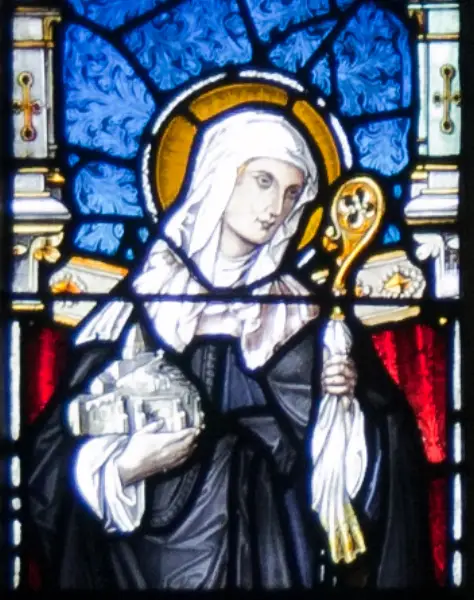
Overview
Athracht — Attracta in the Latin sources — is patron saint of the Lough Gara (Locha Techet) parish and of Tourlestrane in County Sligo, and one of the beloved women saints of the Irish church. A sister of Bishop Conal of Drumconnell, she resolved in youth to devote herself to God, and when her parents opposed the vow she fled to south Connacht, making her first foundation at Drum in County Roscommon, where her brother had founded a church, and the place came to be known as Drumconnell. From there she went on to Greagraighe or Coolavin in County Sligo, where, her legend relates, she made her profession as a nun in St. Patrick's own presence, and at length she reached Lough Gara, where at the spot now named Killaraght in her honour she established a hostel for travellers, a house that survived until 1539. She was renowned for charity and hospitality to travellers and the homeless, her convents were famous for their care of the poor, and local tradition remembers her great healing powers. She is associated with St. Conainne, and her memory remains vivid in Sligo, where schools, churches, and even an aircraft carry her name.
The Complete Life
Early Life
Athracht was a native of County Sligo, born in the sixth century into a family of the local Christian nobility; her brother Conal became a bishop and established the church of Drum, which took the name Drumconnell from him. The Ireland of her childhood was the Ireland of the monastic explosion that followed Patrick, in which foundations for men and, increasingly, for women multiplied across the country. She resolved early to devote herself to God in virginity, but her parents, as in so many of the Irish saints' lives, had other plans and opposed the vow. The conflict between a daughter's consecration and a family's expectations is one of the standing themes of early Irish hagiography, and its usual resolution, in the lives of Brigid, Moninne, and Athracht alike, is flight: the young woman leaves, and God provides. Athracht fled south into Connacht, to the protection of her brother's church, and began there the life of foundation and hospitality that made her name.
Vocation
Athracht's vocation was monastic and practical at once. At Drum in Roscommon, her brother's foundation, she established her first religious house; from there she moved to Greagraighe, or Coolavin, in Sligo, where her legend states that St. Patrick himself received her vows as a nun, a detail that belongs to the Irish habit of attaching local saints to the national apostle. What is distinctive in her vocation is its outward turn: at Killaraght on Lough Gara she founded not a cloistered community only but a hostel for travellers, one of the Irish houses of hospitality that cared for pilgrims, the sick, and the destitute on the roads. The hostel of Killaraght, extraordinary to relate, survived for nearly a thousand years, lasting until 1539, so that the work she began in the sixth century was still being done at the Reformation. Her convents were famous for charity to the poor, and her own reputation for healing made the house a destination for those in need of body as well as soul.
Mission
The mission of Athracht was the sanctification of hospitality. In the Irish Christian ideal, the guest is Christ, and the monastery that fed and lodged the traveller was performing a sacramental act as real as the office it sang. Athracht made this the organizing principle of her foundations: the hostel at Killaraght stood on the western shore of Lough Gara, on the road where travellers passed between Connacht's scattered settlements, and it served them for centuries. Her association with Conainne, another woman saint of the region, suggests a network of female religious foundations in Sligo and Roscommon in the sixth century, cooperating in the work of settlement, healing, and hospitality. Local tradition's memory of her great healing powers indicates that her houses functioned as centres of care in a world without hospitals. Her mission, in the terms her people understood it, was to stand at the crossroads with bread and a bed, and to say to every stranger, in effect, that God's house had no closing hour.
Spirituality
The spirituality of Athracht is visible in the shape of her life rather than in preserved writings, of which she has none. Its first element is the consecrated virginity she defended against her family's opposition, the founding act of her freedom. Its second is obedience to the tradition: the legend of her profession under Patrick places her explicitly in the apostolic line of the Irish church. Its third is hospitality, lived out structurally in the hostel rather than occasionally in almsgiving; in the Irish idiom, hospitality was a virtue of houses and institutions, not merely of individuals. Its fourth is healing, the charism her neighbours remembered long after her death and attached to the well that bears her name. This is a lay-facing spirituality, grounded in the ordinary needs of travellers and the poor, and it made her one of the most practically useful saints of a church whose monasteries were often the only providers of welfare their society possessed.
Cult and Canonization
Athracht is a saint of the pre-congregation Irish church, honoured from early times in the calendars and traditions of Connacht and never formally canonized in the later sense, because no process was needed for a saint whose cult was continuous. Her feast is kept on August 11. The survival of her hostel at Killaraght until 1539 gave her cult a material anchor that outlasted most Irish foundations, and her patronage of the parish of Lough Gara and Tourlestrane continues the medieval relationship into the present. Local tradition, calendars, and the collections of John Colgan and the Bollandists preserve the outline of her life. The healing well named after her remained a place of resort into modern times, the classic form of an Irish saint's continuing cult. She belongs to the great company of Irish holy women whose official recognition in the universal calendar is thin but whose hold on their own places has never loosened.
Legacy
The legacy of Athracht is unusually tangible for a sixth-century saint: a hostel that lasted a millennium, a parish that still claims her, wells, churches, and schools in her name, and even an Aer Lingus aircraft, the Saint Attracta, christened in 2019. St. Attracta's Senior School in Dublin and the second church of the parish of Kilmactigue, among others, carry her name, and the new secondary school in Tubbercurry bears it too. This persistence reflects the real character of her work: hospitality and healing are the two services every age understands. She also stands for the women's foundations of early Ireland, nearly all of which vanished from the record, and for the Irish ideal of the guest received as Christ. For the church today, facing a world again full of travellers and homeless, she is a natural patron of practical charity, a woman who heard a call, left everything, and spent nine hundred years' worth of her foundation's life feeding people at a lake in Sligo.
The Record
- Major works
- Foundation of the hostel of Killaraght on Lough Gara·Foundations at Drum (Drumconnell) and Coolavin
- Patron of
- Parish of Lough Gara and Tourlestrane, County Sligo·Travellers and the homeless (by tradition)
- Symbols
- Hermits's and nuns' habit·Hostel and loaf (hospitality)·Healing well at Killaraght
- Canonization
- Pre-congregation; ancient cult in the Irish church
Prayer
Profile text adapted from the Wikipedia article, licensed CC BY-SA 4.0.
Pray with this saint every day
Save St. Athracht (Attracta) to your favorites, read the full profile, and get feast-day reminders in the Saints app.
Get the Saints AppFree on the App Store for iPhone and iPad