
died 622·Feast March 10
St. Attala
Second abbot of Bobbio and disciple of Columbanus
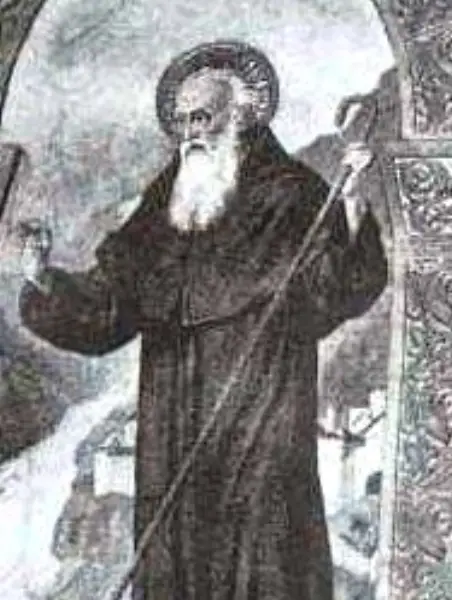
Overview
Attala, sometimes written Atala, came from Burgundy and died at Bobbio in 622 as the second abbot of that Lombard monastery. He first embraced monastic life on the island of Lérins, but the looseness of observance he found there troubled him, and he transferred to Luxeuil, the newly founded house of Columbanus, whose severe rule answered the hunger that Lérins had left unsatisfied. When King Theuderic II drove Columbanus out of Luxeuil, Attala stood next in line for the abbacy, yet he declined it and chose banishment beside his master. Together they settled on the river Trebbia northeast of Genoa and raised up Bobbio. After Columbanus died in 615, Attala took his place as abbot and led the community through years of hardship under the Arian king Arioald. He held firmly to strict discipline, and when a large party of monks rebelled he let them go rather than soften the rule; their miserable deaths, his biographer Jonas records, brought the survivors back in penitence. He also attended to the monastery's books, and a palimpsest of Ulfilas bearing his name survives. Bobbio keeps his feast on March 10.
The Complete Life
From Burgundy to Lérins
Attala was born in Burgundy, the Frankish kingdom in the river country of the Saône and Rhône, at a time when monasticism was reshaping the religious landscape of Gaul. The island abbey of Lérins, off the coast near Cannes, was the most celebrated school of holiness in the region, and it was there that the young man sought the monastic habit. Lérins had trained generations of bishops and ascetics, yet by the late sixth century its observance had grown slack in the eyes of stricter souls. Attala found himself among them. What he met in the island community was a discipline too relaxed to feed his purpose, and the discovery set the whole course of his life. Rather than settle into a comfortable mediocrity, he resolved to seek a rule of greater rigor, and his thoughts turned north to Luxeuil, where Columbanus, an Irish monk of formidable severity, had just established one of the most demanding monasteries in the Frankish lands. The move from one abbey to another looks small; in truth it was the first of a series of choices by which Attala steadily chose the harder, narrower road.
§ Notes
A Monk of Luxeuil
At Luxeuil Attala submitted himself to Columbanus, whose rule of exacting fasts, perpetual prayer, and uncompromising obedience had already drawn a crowd of disciples and provoked the suspicion of bishops and courtiers alike. Under such a teacher the Burgundian monk was formed. He learned the Irish discipline of confession and penance, the chanting of the whole psalter, and the hardness of a life in which the abbot's word settled every question. The years of formation were cut short by politics. King Theuderic II, offended by Columbanus's refusal to bless his irregular marriages and by his rebuke of the royal house, moved against the monastery and expelled the abbot from Luxeuil. By every human calculation the moment belonged to Attala: the community was left without a head, and as a leading disciple he would naturally have been chosen to succeed. He judged otherwise. To keep the office while his master wandered would have looked too much like profiting from injustice, and so he laid aside ambition, followed the old man into exile, and let another govern Luxeuil in his place. The choice marked him for good: whatever honors came later would come, as they came to Bobbio itself, only along the road his master had already opened.
§ Notes
Exile and the Founding of Bobbio
The road of exile carried Columbanus and his companions out of Frankish territory, through the lands of the Alemanni, and at last into the Lombard kingdom of Italy. On the banks of the Trebbia, a little northeast of Genoa, the refugees found a ruined basilica and a valley given over to wild beasts, and there, with the patronage of the Lombard king, they founded Bobbio. Attala shared in the whole enterprise: the clearing of the ground, the building of the first monastic quarters, the gathering of the early community, and the beginnings of the great library for which Bobbio would one day be famous. When Columbanus died in 615, the succession fell where it had long pointed; Attala became the second abbot of Bobbio. His tenure brought new trials from outside. King Arioald favored the Arian confession rather than the Catholic faith, and the monastery, an outpost of orthodox Irish monasticism in Lombardy, suffered many hardships at his hands. Through it all Attala kept the community at its work of prayer, copying, and mission, holding together what his master had gathered in a land still half converted.
§ Notes
Rigor That Refused to Compromise
As abbot, Attala insisted on the strict discipline he had learned at Luxeuil, and he would not dilute the Columbanian rule to make it palatable. The test came from within. A large number of his monks rose in protest, declaring his observance too rigorous for human strength, and demanded a milder way. Attala's answer was characteristic: he did not coerce them, but permitted the dissidents to leave the monastery and seek a house that suited them. His biographer Jonas tells what followed. Some of the departing monks perished miserably, and their comrades, reading in those deaths a punishment sent from God, considered their rebellion and returned to Bobbio to take up the yoke again. The episode reveals the temper of Attala's government: firmness without violence, a rule held steady not by force but by the conviction that holiness cannot be negotiated downward. The same care appears in a quieter register in his treatment of the monastery's books, whose bindings he had repaired and kept in order, so that even the material vessels of the Word received from the abbot a shepherd's attention.
§ Notes
A Book from Atala's Cupboard
Attala died at Bobbio in 622 and was buried in the monastery he had governed, where his liturgical feast came to be celebrated each year on March 10. The house he left behind grew into one of the great monasteries of early medieval Europe, famed above all for its scriptorium and library, and the abbots who succeeded him stood in the line he had established. Of himself he left no writings, but a remarkable witness survives. A palimpsest manuscript containing the works of Ulfilas, the fourth-century Gothic bishop and translator of Scripture, carries an inscription recording that the volume once stood in Atala's own book-cupboard, a surviving scrap of the library that his diligence maintained. The notice ties the second abbot of Bobbio permanently to the scholarly vocation of his house, the patient preservation of texts in a crumbling world. Later hagiographers, beginning with the monk Jonas who knew the community's memory at first hand, preserved the story of the rebellious monks and their return, making of Attala an enduring example for superiors tempted to think that rigor and charity must be traded against each other.
§ Notes
Timeline
- 615
On the death of Columbanus, Attala succeeds him as abbot of Bobbio.
§ Notes
- 622
Died at Bobbio after seven years as abbot; buried there and commemorated on March 10.
§ Notes
The Record
- Major works
- Restoration of the bindings of the monastic library at Bobbio
- Canonization
- Pre-congregation; his liturgical feast has been kept at Bobbio since the early medieval period
Prayer
Bibliography
Show 2 sources
- Curtin, D.P. (2006). The Life of St. Attala. Dalcassian Press. ISBN 9798349387302.
- Nicholas Everett, Literacy in Lombard Italy, c. 568-774 (Cambridge: Cambridge University Press, 2003), 279.
Profile text adapted from the Wikipedia article, licensed CC BY-SA 4.0.
Pray with this saint every day
Save St. Attala to your favorites, read the full profile, and get feast-day reminders in the Saints app.
Get the Saints AppFree on the App Store for iPhone and iPad