
died 10 October 425·Feast January 10 or 11 (Byzantine calendars)
St. Atticus of Constantinople
Archbishop of Constantinople
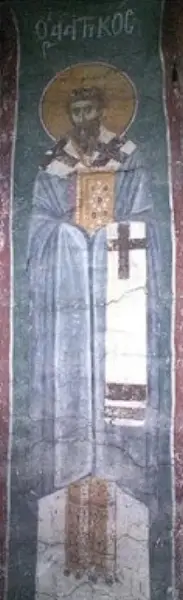
Overview
Atticus, archbishop of Constantinople from March 406 until his death on 10 October 425, was born at Sebasteia in Armenia in the second half of the fourth century, embraced the monastic life early, and was educated by Macedonian monks, a formation that limited his philosophical learning and left him an Armenian accent unpleasant to Greek ears. Coming to Constantinople he was ordained presbyter, and rose by intelligence, charm and political moderation, becoming, however, one of John Chrysostom's bitterest adversaries: he organized the Synod of the Oak and was among the seven witnesses against the bishop, whose expulsion on 10 June 404 opened the way, after the brief reign of Arsacius, to Atticus' own election. With Theophilus of Alexandria and Porphyrus of Antioch he persecuted the adherents of Chrysostom by imperial rescript, yet after Chrysostom's death in 407 he worked toward reconciliation, placing his predecessor's name in the diptychs around 412 to 415. He opposed the Pelagians, which increased his popularity, contributed to the developing Marian cult, rebuilt the church that preceded Hagia Sophia, took a leading part in the regency of the child Theodosius II, and obtained rescripts enlarging his see's authority over Illyricum. He died in 425.
The Complete Life
Early Life
Atticus was born at Sebasteia, the modern Sivas, in Armenia, in the second half of the fourth century, and his origins stayed with him: he received his education from Macedonian monks, a formation pious but narrow, which restricted his philosophical learning and left him with an Armenian accent that the Greek-speakers of the capital considered unpleasant, a detail the ancient sources preserve with the unkind accuracy of the well-bred. He embraced the monastic life early, and moving to Constantinople he adopted, or conformed to, the orthodox faith, was ordained presbyter, and was soon known as a rising man: intelligent, charming, and politically moderate, qualities that in the episcopal politics of the age could be weapons. He attached himself to the party of Theophilus of Alexandria, and when the great quarrel with John Chrysostom came to its crisis, Atticus proved himself one of the patriarch's most bitter adversaries. Palladius of Galatia, Chrysostom's biographer, asserts that he was the architect of the whole cabal; whether or not the charge is exact, the Synod of the Oak — the court of 403, rigged to depose Chrysostom — was organized in large part through his practical skill, and he stood among the seven witnesses summoned to give testimony.
§ Biography
Episcopate and Persecution of the Johannites
Chrysostom was expelled on 10 June 404; his aged successor Arsacius died on 5 November 405; after four months of intrigue the choice fell on Atticus as archbishop in March 406. Vigorous measures followed at once, in conjunction with the triumvirate to which the Eastern church was then subjected, Theophilus of Alexandria and Porphyrus of Antioch: an imperial rescript imposed the severest penalties on all who rejected the communion of the patriarchs, and a large number of the Eastern bishops who persevered in the refusal suffered persecution, while the lesser clergy and laity were driven into concealment or exile. The minority of bishops who deserted Chrysostom's cause for peace's sake were made to feel their past, compelled to leave their sees for others in the inhospitable regions of Thrace, where Atticus could watch them. The church of the capital was thus governed by a man whose title had been won in a faction fight he had helped organize, and the city knew it: a large proportion of the Christian population, the Johannites, refused his communion and held assemblies of their own in the open air of the suburbs, gatherings that drew larger crowds than the churches.
§ Biography
Reconciliation and Achievement
When Chrysostom died on 14 September 407 the original ground of the schism was removed, though the schism itself remained, and Atticus, to his lasting credit, understood that government by persecution was failing. He made strides to reconcile with the Johannites, and around 412 to 415 he placed the name of John Chrysostom in the diptychs of the church, the formal act by which the dead bishop's memory was restored to communion, an act of justice that anticipated the full rehabilitation at the translation of Chrysostom's relics in 438. His remaining years were prosperous for church and city: under the regency of the child Theodosius II he exercised leading influence, gaining the particular confidence of the princesses Pulcheria, Arcadia and Marina; churches, shrines and monasteries rose through the capital; he rebuilt, after the fire, the small church standing where the later Hagia Sophia would one day rise; he welcomed the Armenian delegation that sought approval of the newly invented Armenian alphabet; he opposed the Pelagians, which the people approved; and he contributed to the theology of the developing cult of the Virgin Mary. He died on 10 October 425.
§ Biography
Veneration
Atticus is venerated as a saint in the Eastern tradition, his memory kept in the Byzantine calendars, an honor that has sat uneasily with his history in the judgment of later ages, since the man who helped depose Chrysostom must share the church's guilt for that deed even while he is honored for the government and building of the greatest see of the East. The Byzantine church, in venerating him, has weighed his whole episcopate: the persecution, certainly, but also the reconciliation, the orthodoxy against Pelagius, the care of the city's worship, and the Marian theology that helped prepare the council of Ephesus. His feast stands in the January cycle of the Constantinopolitan calendars. The modern student may hold both judgments together, as the sources do: Atticus the factional churchman and Atticus the builder and reconciler were the same man, and the church that honors him honors a reminder that its bishops are sinners whose offices outlast their sins.
§ Biography
Legacy
Atticus' legacy is the rise of Constantinople. His nineteen years of vigorous labor went, as the sources say, into upholding and enlarging the authority of the see, and from Theodosius II he obtained the rescripts subjecting Illyricum and the Provincia Orientalis to Constantinople, a claim that offended Pope Boniface I and the emperor Honorius and was never executed, and the more effectual right to confirm the elections of the province's bishops, which he exercised from Philippopolis to Nicaea. The church he rebuilt on the site of Hagia Sophia carried the see's liturgical life until Justinian's greater building, and his patronage of the city's shrines and monasteries prepared the capital's Christian topography. Against all this stands the Oak: the church has never quite forgotten, because it has never quite forgiven, the seven witnesses. Atticus' own act of inserting Chrysostom in the diptychs remains his best defense, the correction of a record by the man who had helped to falsify it.
§ Biography
Timeline
- 5 Nov 405
His predecessor, the aged Arsacius of Tarsus, dies at Constantinople
§ Biography
- Mar 406
Chosen archbishop of Constantinople after four months of intrigue; vigorous measures against Chrysostom's adherents follow at once
§ Biography
- 14 Sep 407
John Chrysostom dies in exile, removing the original ground of the schism dividing the capital
§ Biography
- 408
Emperor Arcadius dies leaving child heirs; Atticus takes a leading part in the regency and influences the princesses
§ Biography
- 412
The walls of Constantinople are greatly expanded during his episcopacy
§ Biography
- 412
Places Chrysostom's name in the church diptychs around this time, seeking reconciliation with the Johannites
§ Biography
- 425
Some time before this year, receives Armenian clergy seeking approval for the newly invented Armenian alphabet
§ Biography
- 425
Asserts his right to ordain in Bithynia and puts it into practice at Nicaea
§ Biography
- 10 Oct 425
Dies at Constantinople after a nineteen-year archiepiscopate
§ Introduction
The Record
- Patron of
- Constantinople·The Armenian faithful of the Byzantine church
- Symbols
- Archbishop's vestments·Model of Hagia Sophia's predecessor church
- Canonization
- Venerated as a saint in the Eastern tradition
Prayer
Bibliography
Show 12 sources
- 1 2 3 4 5 6 7 8 9 10 11 12 13 14 Constas, Nicholas (2003). Proclus of Constantinople and the cult of the Virgin in late antiquity - homilies 1–5, texts and translations . Brill . ISBN 90-04-12612-0 . OCLC 801325432 .
- ↑ Venables 1911 cites Palladius c. xi.
- ↑ Venables 1911 cites Photius, Cod. 59.
- ↑ Baring-Gould, Sabine, "Saint Atticus, Patriarch of Constantinople", Lives of the Saints , 1897, catholicsaints.info, 7 January 2014
- ↑ Venables 1911 cites Socrates, VII, p. 36; Niceph., XIII, p. 30; Palled., c. xx.
- ↑ Venables 1911 cites Niceph. xiv. 23, 27.
- ↑ Venables 1911 cites Socrates, VII, pp. 25, 28, 37.
- ↑ Venables 1911 cites Socrates, VII, p. 41; Soz., VIII, p. 27.
- ↑ Venables 1911 Philippe Labbe , Concilia , III, pp. 353, 361, 365, 1073; cf. S. Prosper. p. 549; S. Leo, Ep. xxi.
- ↑ Leo, the Great, Ep. XXI
- ↑ Theodoret, Ep. 145
- ↑ Venables 1911 cites Labbe, iii, p. 518, iv, p. 831.
Profile text adapted from the Wikipedia article, licensed CC BY-SA 4.0.
Pray with this saint every day
Save St. Atticus of Constantinople to your favorites, read the full profile, and get feast-day reminders in the Saints app.
Get the Saints AppFree on the App Store for iPhone and iPad