
died c. 720·Feast September 10
St. Aubert of Avranches
Bishop of Avranches, Founder of Mont Saint-Michel
Overview
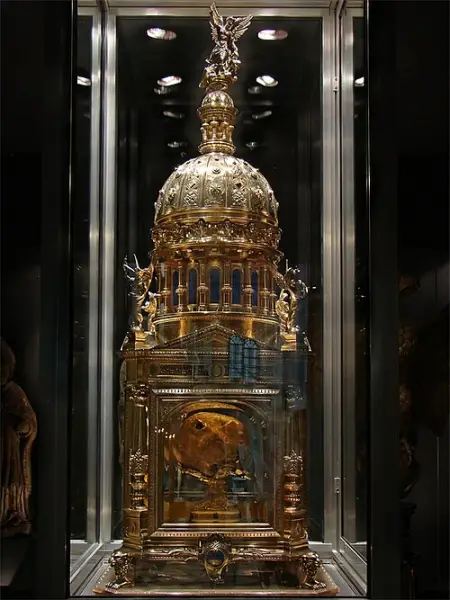
Aubert, also Autbert, bishop of Avranches in the early eighth century, is credited with founding Mont Saint-Michel, the great pilgrimage abbey on the tidal isle where the Couesnon meets the sea. He was born into a noble Genetas family and given a broad education; he lived under Childebert III (695-711) and died around 720. When the see of Avranches fell vacant, his wisdom and piety marked him out for election. In 708 a vision came to him: the archangel Michael told him to raise an oratory there, on the rocky island; doubting, Aubert disregarded it, and when the archangel appeared again he still hesitated, afraid the apparition might be demonic. At last, in exasperation, Michael pressed his finger into Aubert's skull, and the bishop obeyed: sending to Italy for relics of the archangel, he founded the sanctuary on the mount and installed a community of canons. Aubert's own skull, with the hole the angel's finger made, was long shown at the basilica of Saint-Gervais in Avranches. The oratory of 708 became the abbey of the archangel, the destination of pilgrims for twelve centuries.
The Complete Life
Early Life
Aubert's life in France spanned the reign of Childebert III, 695 to 711, and he died about 720; the Frankish Neustria of his day was the church of the generation after the great missionary bishops, organized in rural sees whose bishops were the royal government's local agents as well as pastors. The tradition holds that he came from a noble Genetas family and was given an extensive education — the phrase the old notices keep — in the letters and law that qualified a nobleman for high office, sacred or secular. When the see of Avranches became vacant, his wisdom and piety marked him out to the electors, clergy and people of the diocese that covered the Cotentin and the coast of the Couesnon. He governed a frontier church: the west still had its pagan survivals, the Breton immigration was planting Celtic Christianity across the border, and the sea that bounded his diocese carried pilgrims and raiders alike.
The Visions of the Archangel
The story that made Aubert's name is the founding vision of 708. While praying, he saw the archangel Michael, who told him to raise an oratory on the tidal isle of rock at the Couesnon's mouth — the mount then called the tomb on the sea. Aubert did not pay attention, doubting that the vision was true; the ordinary caution of an educated bishop. Michael appeared again, and still Aubert hesitated, fearing a demonic deception — the discernment of spirits was a pastoral duty, and Neustria had its share of false wonders. At last, in exasperation, the archangel pressed his finger into Aubert's skull, leaving the physical proof the bishop had demanded. Convinced, Aubert cut a channel through the rock for a spring, sent clerics to Italy for relics of Saint Michael from the older shrine on the Gargano, and built the oratory on the summit, installing a college of canons to serve it.
Mont Saint-Michel
The oratory of 708 became the abbey of Mont Saint-Michel. Within two centuries the Benedictines had replaced the canons, and the mount grew into one of the great pilgrimage centres of the medieval world — the archangel's own European trinity with the Gargano in Italy and Saint-Michel-de-Cuxa-linked routes, standing in the tide at the door of Normandy and Brittany. Aubert's foundation was the seed of the whole: the church he was commanded to build became the Romanesque marvel of the eleventh century, the fortress of the Hundred Years War that never fell, and the emblem of France itself. His skull, with the hole the angel's finger was said to have made, was preserved and long shown at the basilica of Saint-Gervais in Avranches, the bishop's own city keeping the physical relic of his obedience. History behind the legend is likely a real eighth-century episcopal foundation on the mount, attached to the spreading cult of Michael that followed the Gargano's fame.
Cult
Aubert's cult belongs to Avranches and to the mount he founded. His feast is kept on 10 September, and his memory is inseparable from the sanctuary's: every account of Mont Saint-Michel begins with the doubting bishop and the impatient archangel. He was never formally canonized — his is the pre-congregation sanctity of the early medieval episcopate — but the Church of the Middle Ages treated him as a founder-saint, and his name stands in the martyrologies. The pilgrimage he began has outlived every change of institution on the rock: monks, canons, revolutionaries' prisoners, and now the crowds of the causeway. For the modern pilgrim his lesson is the one the legend teaches with rough humour — that God's commands may be repeated, that discernment has limits, and that the hole in a bishop's head can be the beginning of a wonder of the world.
Timeline
- 708
Vision of the Archangel Michael commanding an oratory on the rocky islet at the Couesnon's mouth.
§ Legend
- 16 Oct 709
The oratory on the mount was dedicated, after Michael's third apparition left a hole in his skull.
§ Legend
- 720
Died about this year; reputedly buried at the oratory he founded.
§ Life
The Record
- Patron of
- Avranches·Mont Saint-Michel
- Symbols
- Skull with the angel's mark·Bishop's vestments·Archangel Michael
- Canonization
- Pre-congregation
Prayer
Profile text adapted from the Wikipedia article, licensed CC BY-SA 4.0.
Pray with this saint every day
Save St. Aubert of Avranches to your favorites, read the full profile, and get feast-day reminders in the Saints app.
Get the Saints AppFree on the App Store for iPhone and iPad