
c. 600-c. 668·Feast December 13
St. Aubert of Cambrai
Bishop of Cambrai and Arras
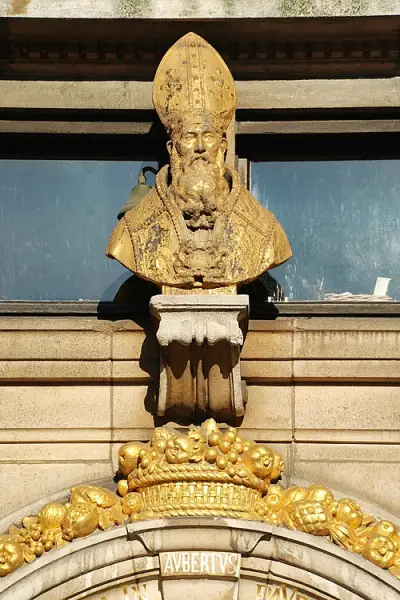
Overview
Aubert of Cambrai, French Aubert de Cambrai, was a Merovingian bishop of the united sees of Cambrai and Arras, born around 600 at Haucourt-en-Cambresis in Austrasia and dying around 668-669 at Cambrai after thirty-six years of rule. Consecrated on 24 March 633 as successor of Aldebert, he presided over the Christianization of Hainaut and Flanders in a generation that proved decisive for the faith: under his influence numerous nobles were brought to Christianity, and King Dagobert emerged as a chief patron of the church. Landelin was given into his keeping and schooled by him in learning and piety; he blessed the hermitage of St. Ghislain on the Haine; he bestowed the religious habit on Count Vincent Madelgarius of Hainaut, his wife St. Waltrude, and her sister St. Aldegund, admitting Aldegund to vows together with St. Amandus before she became first abbess of Maubeuge; and he veiled the widow St. Amalberga after the death of her husband Witger at Lobbes. He built many churches and several abbeys, including Hautmont in 652, and with St. Eligius of Noyon exhumed the body of the Irish monk St. Fursey around 655-658 for his canonization.
The Complete Life
Early Life
Aubert was born around 600 at Haucourt-en-Cambresis, in the Frankish kingdom of Austrasia — the border country between the Scheldt and the Sambre where his life's work would lie. He came to the episcopate through the regular channel of the Gallic church: on 24 March 633 he was consecrated to the two sees joined under one bishop, Arras together with Cambrai, taking over from Aldebert. That union of the two sees, which he governed for thirty-six years, gave him metropolitan weight over a region that was still religiously young.
§ Introduction
Christianizing the Nobility
His influence worked from the top down. Under his influence many nobles were brought to Christianity, and King Dagobert emerged as a major supporter of the Christian Church — the king whose goldsmith-bishop Eligius labored alongside Aubert. In Hainaut and Flanders he advanced religion and the reading of holy texts. His approach was personal as much as institutional: he took the boy Landelin for education in learning and piety, blessed the hermitage of Ghislain on the river Haine (the origin of the town of Saint-Ghislain), and gave the religious habit to the count Madelgarius, to his wife Waltrude, and to her sister Aldegund — the veiling of Aldegund he performed together with Amandus before she became first abbess of Maubeuge.
§ Biography
Builder and Guardian of Relics
Aubert raised many churches and several abbeys at his own hand, Hautmont among them in 652 — a house that would carry his name into the later Middle Ages. He also served as the church's ritual guarantor of holiness: after Witger, count of Condat, died as a monk at Lobbes, Aubert bestowed the veil of widowhood upon Amalberga; and around 655-658, thirty days after the death of the Irish missionary Fursey, Aubert together with Eligius of Noyon arrived to exhume the body for what the sources call his canonization — the translation that inaugurated Fursey's cult. In 666 he translated the relics of St. Vedast at Arras. Few bishops of his century so completely officiated at the making of the northern French sanctoral.
§ Biography
Final Years
Aubert died around 668-669 at Cambrai and was buried in St. Peter's church. He was succeeded by Vindicianus, another of the great Cambrai bishops. In 1066 a house of canons regular was founded at Cambrai, and his shrine was afterwards kept there.
§ Death
Legacy
Aubert's legacy is the Christian landscape of Hainaut: the abbeys of Hautmont, Maubeuge and Marchiennes in their first decades all passed through his hands, and the saints he clothed, taught, blessed and translated — Landelin, Ghislain, Waltrude, Aldegund, Amalberga, Fursey, Vedast — form the backbone of the region's calendar. He is the connective tissue of the seventh-century north, and his feast on 13 December keeps his memory at Cambrai and Arras.
§ Biography
Timeline
- 600
Born around this year in Austrasia, Francia, at Haucourt-en-Cambresis.
§ Biography
- 24 Mar 633
Consecrated on 24 March to head the joined dioceses of Arras and Cambrai, succeeding Aldebert.
§ Biography
- 652
Built churches and several abbeys, including Hautmont, in Hainaut and Flanders.
§ Biography
- 655
With St. Eligius of Noyon, exhumed the body of St. Fursey for veneration, arriving thirty days after his death.
§ Biography
- 666
Translated the relics of St. Vedast, enshrining them at Arras.
§ Biography
- 668
Died at Cambrai after thirty-six years as bishop and was buried in St. Peter's church; Vindicianus succeeded him.
§ Death
The Record
- Major works
- Founded Hautmont Abbey (652) and other churches and abbeys·Translated the relics of St. Vedast at Arras (666)
- Symbols
- Bishop's crozier·Church under construction
- Canonization
- Pre-congregation
Prayer
Bibliography
Show 12 sources
- ↑ Guérin, P. (1878). Les Petits Bollandistes: Vies des saints de l'Ancien et Nouveau Testament, des Martyrs, des Pères, des Auteurs sacrés et ecclésiastiques .... France: Bloud et Barral.
- ↑ Mackinlay, J. M. (1914). Ancient Church Dedications in Scotland: Non-scriptural Dedications. United Kingdom: D. Douglas.
- ↑ Rose, H. J., Rose, H. J., Wright, T. (1857). A New General Biographical Dictionary. United Kingdom: T. Fellowes.
- ↑ Bachrach, B. S., Bachrach, D. S., Leese, M. (2017). Deeds of the Bishops of Cambrai, Translation and Commentary. United Kingdom: Taylor & Francis.
- ↑ Dictionnaire universèle et classique d'histoire et de géographie..... (1853). Belgium: Parent.
- 1 2 The Biographical Dictionary of the Society for the Diffusion of Useful Knowledge--. (1844). United Kingdom: Longman, Brown, Green, and Longmans.
- ↑ Butler, A., Burns, P. (1995). Butler's Lives of the Saints: June. United Kingdom: Burns & Oates.
- 1 2 3 4 5 Butler, A., Butler, C. (1833). The Lives of the Fathers, Martyrs, and Other Principal Saints: Compiled from Original Monuments and Other Authentic Records, Illustrated with the Remarks of Judicious Modern Critics and Historians. I
- ↑ A Dictionary of Christian Biography, Literature, Sects and Doctrines: A-D. (1877). United Kingdom: J. Murray.
- ↑ Vinchant, F., Ruteau, A. (1648). Annales de la prouince et comte' d'Haynau. Ou l'on voit la suitte des comtes depuis leur commencement. Les antiquitez de la religion, et de l'estat depuis l'entrée de Iules Cesar dans le pays. ... Recueill
- ↑ “Les” vies des saints: composées sur ce qui nous est resté de plus authentique, & de plus assuré dans leur histoire, disposées selon l'ordre des calendriers & des martyrologes, avec l'histoire de leur culte, selon qu'il est établi dans l'
- ↑ Stokes, M. (1895). Three Months in the Forests of France: A Pilgrimage in Search of Vestiges of the Irish Saints in France. United Kingdom: G. Bell.
Profile text adapted from the Wikipedia article, licensed CC BY-SA 4.0.
Pray with this saint every day
Save St. Aubert of Cambrai to your favorites, read the full profile, and get feast-day reminders in the Saints app.
Get the Saints AppFree on the App Store for iPhone and iPad