
1st–2nd century (died c. 135)·Feast June 3
St. Ovidius (Auditus) of Braga
Third Bishop of Braga, Martyr
Overview
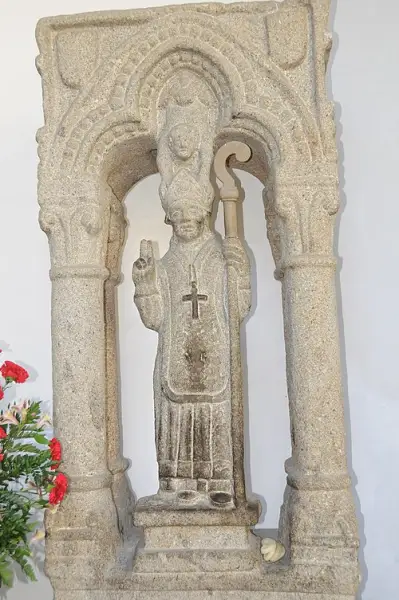
Ovidius, also called Saint Auditus, was the third Bishop of Braga and a Portuguese saint of the apostolic era. According to the hagiographies of the sixteenth century, he was a Roman citizen of Sicilian origin, sent to Braga by Pope Clement I, serving as the city's third bishop around the year 95. Saint Quiteria and her sisters, so the account runs, received baptism from him after their mother abandoned them, and in 135 he won martyrdom for the faith. The Portuguese call him Santo Ovídio, and by folk etymology São Ouvido — literally 'Saint that is heard', 'Saint Ear' — a popular translation of the Latin name Auditus. Because of the name, he was traditionally invoked against auditory diseases and conditions: beneath the base of his sepulcher in Braga cathedral two holes were cut, and the deaf would slide their fingers into them before putting them into their ears and asking for a cure through his intercession. His relics were elevated in 1527, giving official recognition to his cult, and seventeenth-century accounts report depictions of him in episcopal robes or hermit's garments in Lusitanian archaeological sites, witnessing to an ancient veneration. His feast is 3 June.
The Complete Life
A Sicilian in Bracara
The hagiographies of the sixteenth century, which are the source of nearly everything told about him, make Ovidius a Roman citizen of Sicilian origin, sent to Braga — Bracara Augusta, the Roman capital of Gallaecia, now a Portuguese archiepiscopal city — by Pope Clement I, and third bishop of the see from about the year 95. The chronology belongs to the apostolic legend-pattern that the early medieval Spanish and Portuguese churches elaborated to give their sees apostolic foundation: seven men sent out from Rome under Clement, dividing the Iberian peninsula between them. History cannot confirm it — the documented bishops of Braga begin centuries later — but the tradition is old in the peninsula, and it fixed Ovidius in the see's memory as the man who brought the faith in the apostolic generation. The same tradition credits him with baptizing Saint Quiteria and her sisters after they had been abandoned by their mother, attaching his name to the cycle of the legendary princess-martyrs of Iberia.
§ Hagiography
Martyrdom
Ovidius is said to have been martyred for his Christian faith in 135, under the emperor Hadrian — a date in the long quiet period between the known persecutions, but within the era of provincial harassment of Christian leaders that the great acts of the second century record. The manner of his death is not transmitted in the notice, only the fact; Braga keeps him as a martyr-bishop of the first age. His cult, whatever the history beneath it, is genuinely ancient: seventeenth-century accounts assert that Lusitanian archaeological sites — early Christian sarcophagi and architectural fragments — depicted him wearing episcopal robes or hermit's garb — iconographic witness to a veneration already old when it was recorded. He thus belongs to that earliest layer of Iberian sanctity in which the facts have dissolved into the calendar, and the city's memory of its first bishops is the only record.
§ Hagiography
São Ouvido, Saint Ear
The Portuguese call him Santo Ovídio, and sometimes, by a folk etymology, São Ouvido — literally 'Saint that is heard' or 'Saint Ear' — the Latin Auditus ('hearing') translated into the sound of the Portuguese word for ear. The pun became a patronage: because of his name he was invoked against auditory diseases and conditions. The devotion had a physical centre: in the cathedral of Braga, under the base of his sepulcher, two holes were bored; the deaf would slide their fingers into them and then press the fingers into their ears, praying to be cured through the saint's intercession — a rite of touch that lasted into the modern era, and one of the clearest examples of a saint's name generating a saint's office. His relics were elevated in 1527, giving his cult official recognition in the era when the local churches of Iberia were regularizing their traditions; his sepulcher remains in the cathedral of Braga, and his feast is kept on 3 June.
§ Veneration
Timeline
- 95
Sent to Braga by Pope Clement I, he serves as the city's third bishop
§ Hagiography
- 135
Martyred for his Christian faith
§ Hagiography
- 1527
His relics are elevated, giving official recognition to his cult
§ Veneration
The Record
- Patron of
- Invoked against auditory diseases and conditions·Braga
- Symbols
- Episcopal vestments; sometimes depicted as a hermit
- Canonization
- Pre-congregation; relics elevated in 1527
Prayer
Bibliography
Show 4 sources
- 1 2 3 Borrrelli, Antonio. "Sant' Audito (Ovidio) di Braga", Santi e Beati, September 16, 2002
- ↑ "San Ovidio", Parroquia San Martín de Porres, Hermosillo, Sonora, México
- 1 2 3 Young, John Riddington. "Patron saints of the ear", ENT & Audiology News , Vol. 31 Issue 1 March/April 2022
- ↑ Holweck, Frederick George. A Biographical Dictionary of the Saints: With a General Introduction on Hagiology United Kingdom, B. Herder Book Company, 1924. [. 762
Profile text adapted from the Wikipedia article, licensed CC BY-SA 4.0.
Pray with this saint every day
Save St. Ovidius (Auditus) of Braga to your favorites, read the full profile, and get feast-day reminders in the Saints app.
Get the Saints AppFree on the App Store for iPhone and iPad