
609-684·Feast August 24
St. Audoin
Bishop of Rouen, Courtier of Dagobert, Hagiographer of St. Eligius
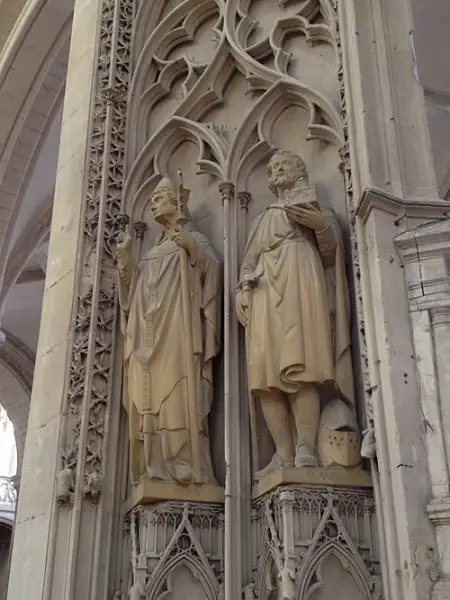
Overview
Audoin, Latin Audoenus, known in French as Saint Ouen, was a Frankish bishop, courtier, and hagiographer who lived from 609 to 684. His birth was into a wealthy aristocratic family — landholdings along the upper Seine and the Oise valleys, his father Authaire — and, schooled at the abbey of Saint-Médard de Soissons, he entered the court of Chlothar II and served Dagobert I as one of his referendaries. With his close friend Eligius, the goldsmith-bishop of Noyon, he belonged to the circle of court churchmen whose influence on the seventh-century Frankish church was decisive; Ian Wood has called Audoin and Eligius arguably the most influential churchmen in seventh-century Francia. Ordained priest in 634, he founded Rebais Abbey in 635 on land donated by Dagobert together with his brothers Ado and Rado, and he took part in founding Saint-Wandrille and the nunnery of Fécamp. After a year of missionary exile in Spain he succeeded Romanus as bishop of Rouen in 641. As bishop he influenced the founding of Fontenelle Abbey, promoted theological study, and worked to fuse the rules of Columbanus and Benedict. Under the regency of Queen Bathilde he became one of her chief counsellors, and his support of Ebroin's policies embroiled him in the mistreatment of St. Leodegar. Around 675 he made a pilgrimage to Rome, distributing alms and collecting relics. He died at Clichy on 24 August 684 and was buried in his church of St. Peter at Rouen; his successor Ansbert reburied him behind the high altar, an act equivalent to canonization. He is invoked for the deaf.
The Complete Life
Early Life
Audoin was born in 609 at Sancy into a wealthy aristocratic Frankish family whose lands lay in the valleys of the upper Seine and Oise. His father was Authaire, also called Audecharius; the family was of the Gallo-Roman nobility that had taken service with the Merovingian kings and was rapidly becoming the governing class of the Frankish church. His childhood was spent at Ussy-sur-Marne, and his education at the abbey of Saint-Médard de Soissons, one of the great royal monasteries of the early seventh century, gave him the formation in letters and piety that the age expected of a boy of his class. From Soissons he passed to the court of Chlothar II, whose household, historians have noted, was of particular importance in determining who would be politically important for the next two reigns. There he received with the other young noblemen a training both military and literary, and there he formed the friendships, above all with Eligius the goldsmith, that would define his life. He was a first cousin of Agilbert, who became bishop of the West Saxons, an indication of the reach of his family's ecclesiastical network.
Vocation
Audoin's vocation moved from court to cloister to cathedral. Serving Dagobert I as a referendary, one of the administrators who drafted and sealed the king's documents, he acquired a reputation, Fredegar reports, for being a religious man even amid the business of the palace. In 634 Dieudonné, bishop of Mâcon, ordained him priest, and the next year, with his brothers Ado and Rado, he founded the abbey of Rebais on land donated by the king, installing their relative Agilus, a monk of Luxeuil, as its first abbot. Rebais was one of the earliest of the Columbanian foundations near Paris and set the pattern for Audoin's later work. He took part likewise in the founding of Saint-Wandrille in the Rouen countryside and of a nunnery at Fécamp, the coastal estate of the kings. When the see of Rouen fell vacant, Audoin, so his biographers say, passed a year as an evangelical exile, doing mission work in Spain, before accepting election, succeeding Romanus as bishop in 641. The sequence suggests a man who moved deliberately toward the heavier burdens of office rather than seeking them, and who built institutions before he governed them.
Mission
As bishop of Rouen for over forty years, Audoin's mission was the consolidation of Christianity in Neustria through monasteries, learning, and influence at court. Through his influence Erchinoald, the mayor of the palace, donated to Wandregisel the land for Fontenelle Abbey, which under its later name of Saint-Wandrille became one of the great houses of Normandy and, centuries afterward, the chronicler of its founders' age. Audoin built up theological studies in his cathedral city and took part in fusing the rule of Saint Columbanus with that of Saint Benedict, the legislative settlement by which the strenuous Irish tradition was domesticated for the Frankish houses. Politically he remained what he had been at court, a counsellor of kings: under the regency of Queen Bathilde, after 657, he became one of her first counsellors, and he continued as advisor to Theuderic III. His politics were not above criticism, for he upheld the policy of Ebroin, the harsh mayor of the palace, so far as to share in the mistreatment of St. Leodegar of Autun, a stain on an otherwise luminous career that his biographers do not conceal. In 675 he made a pilgrimage to Rome, visiting the sanctuaries, distributing alms to the Roman poor, and collecting relics for his church, and his last years were spent in peace-making between the Frankish realms.
Final Years
Audoin died on 24 August 684 at the royal villa of Clichy, near Paris, having lived through the reigns of six Merovingian kings and the effective transfer of power to the Carolingian mayors. He was buried in the church of St. Peter at Rouen which he himself had built, outside the then boundaries of the city. His successor in the see was Ansbert, the former abbot of Fontenelle, whom Audoin had himself advanced, and it was Ansbert who had the body of his predecessor reburied behind the cathedral's high altar, an act that historians of canonization describe as the equivalent of a formal canonization: translation to the place of honour before the altar was the seventh-century church's way of declaring a bishop a saint. The cult that followed was immediate and durable, and around his tomb, in time, grew the abbey that bears his name, Saint-Ouen de Rouen, one of the masterpieces of Gothic architecture. He had lived his last years as a peace-maker, going to Cologne after Ebroin's death in 681 and succeeding in restoring peace between Neustria and Austrasia, a fitting final labour for a churchman whose whole career had joined the court and the cloister.
Legacy
Audoin's legacy is written into the religious geography of Normandy and the historiography of the seventh century. The abbey of Saint-Ouen, raised over his tomb, preserves his name and his relics; Saint-Wandrille and Fécamp, which he helped found, endured through every subsequent convulsion; Rebais began the monastic colonization of the Paris basin in which his family led. His Vita Sancti Eligii, the life of his friend written after Eligius's death in 660, counts among the seventh century's most authentic historical monuments, a rich store of information on the moral and religious education of the age and the chief witness to Eligius himself, and it preserves, incidentally, testimony to the life of Aurea of Paris. A poem on Audoin's own life came from Frithegod's pen in the tenth century, though it is now lost, a measure of the standing he retained. Even the hostile author of the Liber Historiae Francorum, who despised Ebroin whose cause Audoin had supported, invariably calls him blessed or sainted and reserves for his death a phrase of unusual reverence. He is invoked for the deaf, and his feast is kept on August 24.
Timeline
- 609
Born at Sancy into a wealthy aristocratic Frankish family of the Seine and Oise valleys
§ Introduction
- 634
Was ordained priest by Dieudonné, Bishop of Mâcon, while serving at court
§ Court official
- 635
Founded Rebais Abbey with his brothers Ado and Rado on land donated by King Dagobert
§ Court official
- 641
Succeeded Romanus as bishop of Rouen after a missionary year in Spain
§ Bishop
- 675
Made a pilgrimage to Rome, alms to the poor, and collected relics for Rouen
§ Bishop
- 681
Went to Cologne after Ebroin's death and restored peace between Neustria and Austrasia
§ Bishop
- 24 Aug 684
Died at the royal villa of Clichy and was buried in his own church of Saint-Peter at Rouen
§ Bishop
The Record
- Major works
- Vita Sancti Eligii (Life of St. Eligius), a principal monument of seventh-century hagiography·Foundations of Rebais Abbey and shares in Saint-Wandrille and Fécamp
- Patron of
- Deaf people; invoked against deafness·Rouen (see)
- Symbols
- Bishop's vestments·The pen of a hagiographer·Relics brought from Rome
- Canonization
- Pre-congregation; reburied behind the high altar at Rouen, equivalent to canonization
Prayer
Profile text adapted from the Wikipedia article, licensed CC BY-SA 4.0.
Pray with this saint every day
Save St. Audoin to your favorites, read the full profile, and get feast-day reminders in the Saints app.
Get the Saints AppFree on the App Store for iPhone and iPad