
died c. 670·Feast September 9
St. Audomar
Bishop of Thérouanne, Founder of Sithiu (Saint-Omer)
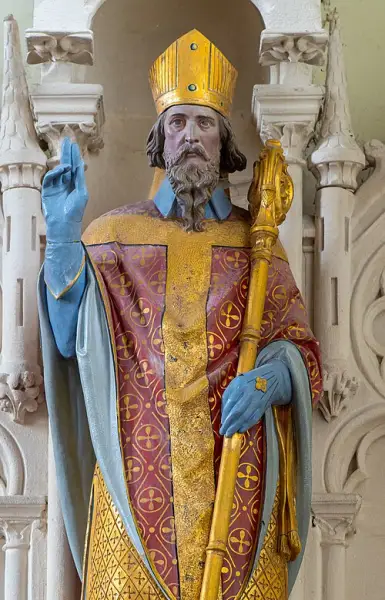
Overview
Audomar — Omer in the modern French — was bishop of Thérouanne in the seventh century and the founder of the monastery of Sithiu, around which the city of Saint-Omer grew and took his name. Born into a distinguished family of Coutances in western Neustria toward the close of the sixth century, he entered the abbey of Luxeuil with his father after his mother's death, around 615, and studied the Scriptures under Eustachius until he had, the old notice says, remarkable proficiency. When King Dagobert asked for a bishop for Thérouanne, the old capital of the Morini on the northern coast, Audomar was appointed and consecrated in 637. He found Christianity nearly extinguished in his diocese, and set about replanting it: on twelve estates given him around 649-651, including Sithiu, he settled missionaries from Austrasia and monks sent from Luxeuil — among them Bertin, Mommolin and Ebertran. He founded the abbey of St. Peter at Sithiu, which took Bertin's name, and the church of Our Lady beside it, later the cathedral where he was buried. He died around 670, and his feast is kept on 9 September.
The Complete Life
A Family of Luxeuil
Audomar was born toward the end of the sixth or the beginning of the seventh century into a distinguished family of Coutances, in the west of the Frankish realm of Neustria. The decisive event of his youth was domestic: his mother died, and his father — the sources give no name but give him this — entered the great monastery of Luxeuil with him, around 615. Luxeuil was then the mother house of Frankish monasticism, the Irish foundation of Columbanus, in the generation of Eustachius, and Audomar's formation there under Eustachius gave him both the learning — he acquired, the notice says, remarkable proficiency in the Scriptures — and the network of monks that would later people his diocese. It is hard to overstate how many of the seventh century's northern French bishops came out of exactly this formation.
Bishop of the Morini
Thérouanne, the Roman Tarvenna, had been the capital of the territory of the Morini, the coastal people of Caesar's Gallic Wars, and the seat of a bishopric since Roman times. By Dagobert's reign it was a backwater: though the faith had been preached there by Fuscian and Victoricus and later by Antmund and Adelbert, the old Lives state that nearly every vestige of Christianity had disappeared. The king requested a bishop for the important city, and Audomar was appointed and consecrated in 637. The pairing of a decaying Roman see with a Luxeuil monk was one of the standard moves of the Columbanan church: royal authority supplied the office, the monastery supplied the program.
The Founding of Sithiu
Audomar's mission was rebuilding from the ground. In 649 or 651 he received twelve estates in his diocese, among them the place called Sithiu, and on them he settled a three-part campaign: missionaries brought from Austrasia who spoke the local language; monks sent from Luxeuil to his assistance — the sources name Bertin, Mommolin and Ebertran among them; and churches. At Sithiu he founded the abbey of St. Peter, which the ages renamed Saint-Bertin after its first abbot, and which became a house of European standing, producing so many learned and zealous men that it rivaled even Luxeuil. In 649 he raised beside it the church of Our Lady with a small attached monastery, on the condition — recorded in his act — that he be buried there and that it serve as burial place for the monks. That church became the nucleus of the town, then the city, of Saint-Omer: the bishop's name, softened by eight centuries of speech, gave the place its identity.
Death and Burial
Audomar died around 670, an old man who had spent three decades converting a marsh. He was buried, as he had stipulated, in the church of Our Lady at Sithiu, which his cult made a place of pilgrimage and which the later cathedral of Saint-Omer succeeded; a thirteenth-century cenotaph marks the spot. The precise day of his death has not come down to us — the calendars keep 9 September — but the work of his old age is not: by his death the diocese of Thérouanne had a monastic center, a trained clergy, and a market town growing around a shrine, which is what a seventh-century mission considered a completed balance sheet.
Cult
Audomar's sanctity is of the pre-congregation kind, sealed by translation and popular use: his tomb at the church of Our Lady drew pilgrims through the Middle Ages, and his feast on 9 September spread with the calendars of the province of Reims. He is venerated in the Roman Catholic and Eastern Orthodox traditions, the latter receiving the Merovingian saints of the undivided Church into its menaia. The city that took his name has never ceased to honor him as founder and patron.
Legacy
Audomar's legacy is legible on any map of northern France. Saint-Omer, the city that grew from his church of Our Lady, became one of the great towns of medieval Flanders and Artois; Saint-Bertin, the abbey he founded, became one of the most learned houses of the Frankish world, whose school produced annalists whose work underpins the history of the entire region. The pattern he executed — estates, monks, churches, market — was the template of the Columbanan mission across the North, and it proved so durable that when Thérouanne itself was destroyed in 1553, the bishopric's successor was established not on the old Roman site but in his town. The marsh priest of the Morini had outbuilt the empire.
Timeline
- 615
After his mother's death, enters Luxeuil with his father; studies under Eustachius
§ Biography
- 637
Consecrated bishop of Thérouanne at King Dagobert's request
§ Biography
- 649
Receives twelve estates including Sithiu (in 649 or 651); settles missionaries and Luxeuil monks there
§ Biography
- 649
Erects the Church of Our Lady of Sithiu with a small monastery, reserved as a burial place
§ Biography
- 670
Dies around 670; buried in the church of Our Lady; feast on 9 September
§ Biography
The Record
- Patron of
- Saint-Omer·Thérouanne
- Symbols
- Bishop's vestments·Church model (the founder of Sithiu)
- Canonization
- Pre-congregation; cult at Saint-Omer and Thérouanne
Prayer
Profile text adapted from the Wikipedia article, licensed CC BY-SA 4.0.
Pray with this saint every day
Save St. Audomar to your favorites, read the full profile, and get feast-day reminders in the Saints app.
Get the Saints AppFree on the App Store for iPhone and iPad