
died 259·Feast January 21
St. Augurius of Tarragona
Deacon and Martyr
Overview
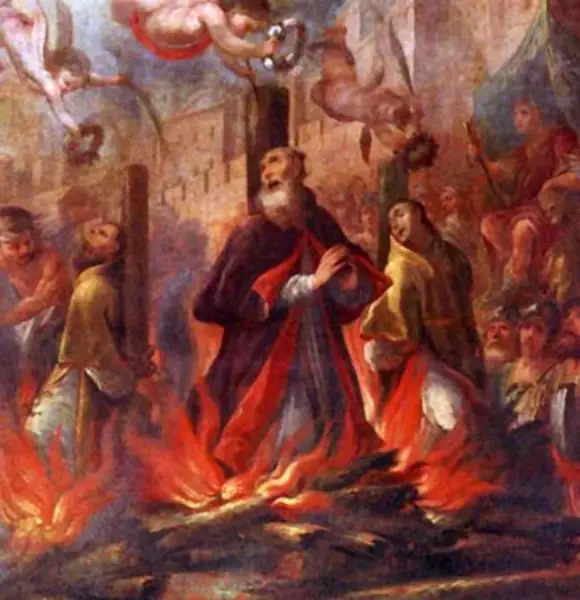
Augurius of Tarragona — also cited as Augurinus and Saint Auguri — was a Christian Hispano-Roman deacon martyred in 259 alongside his bishop Fructuosus and the deacon Eulogius, his colleague. His death came by fire in the amphitheater of Tarraco, capital of Roman Spain, during the persecution decreed by the emperor Valerian; the three are possibly the first martyrs of Christianity in Spain for whom some sort of documentation survives. The acts of the martyrdom — among the most reliable of the third-century acta, recorded near the events and used by the church from the earliest times — document the details: the three had just gone to bed when they were arrested at Tarraco; examined by the governor, they affirmed their belief in the one Christian God; they were sentenced to be burnt, and officers were posted at the amphitheater to prevent any disturbance. Near the gate some Christians got close enough to Fructuosus to ask his prayers, and the bishop gave an answer pitched to reach them all: 'I am bound to bear in mind,' he said, 'the whole Church universal, from the east even to the west.' When the flames climbed and wrapped the martyrs, they extended their arms and prayed to their God until death came. Augurius's feast is kept on 21 January. In 2008-2009 the Archdiocese of Tarragona celebrated the 1750th anniversary of his death with a Jubilee declared by Pope Benedict XVI.
The Complete Life
Tarraco
Augurius served as deacon of the church of Tarraco, the provincial capital of Hispania Citerior and the oldest organized see of Christian Spain. Nothing is recorded of his origin — the tradition marks him simply as one of the two deacons of Bishop Fructuosus, with Eulogius his colleague. The church they served was young and, in the crisis of 259, about to be given the first Spanish martyrdom of which documentation survives: the acts of Fructuosus and his companions are the earliest Spanish Christian text securely dated.
§ Introduction
The Martyrdom of 259
Under Valerian's persecution, which targeted the clergy above all, the three were arrested at night — they had just gone to bed, the acts note, the homely detail that signals eyewitness memory. Examined, they affirmed their belief in the Christian God and refused sacrifice; they were sentenced to be burnt alive. Officers were posted to prevent disturbances at the amphitheater, but near the gate some Christians reached Fructuosus, and one asked his prayers; the bishop's reply was spoken for everyone: 'I am bound to bear in mind,' he told them, 'the whole Church universal, from the east even to the west.' He added words of consolation to the assembly, and when the flames climbed the three extended their arms and prayed until death came — the posture of the acta's famous close. The date was 21 January 259.
§ Introduction
Veneration
Augurius is venerated in the Roman Catholic Church, the Eastern Orthodox Church, and the Anglican Church, with his feast on 21 January together with Fructuosus and Eulogius. Their acts circulated widely in the early church — Augustine preached sermons on the anniversary of Fructuosus in his own see — and the martyrdom became a foundational text of Spanish Christianity. The archaeological ensemble of Tarragona, which includes the amphitheater of their death, is now a UNESCO World Heritage site.
§ Introduction
Legacy
Augurius's legacy is bound to Fructuosus's: the bishop and his two deacons form a single icon of the third-century church — the shepherd and his servants dying together. For Spain they are the beginning of documented Christian history, and the church of Tarragona has kept their memory continuously for seventeen and a half centuries; the jubilee of 2008-2009, granted by Benedict XVI, marked the 1750th anniversary of their burning. That a deacon without a single recorded word of his own should be so remembered is itself the lesson: in the acts of the martyrs, to stand with the bishop in the fire is testimony enough.
§ Introduction
Timeline
- 259
Was arrested at night at Tarraco alongside Bishop Fructuosus and the deacon Eulogius
§ Context
- 259
Affirmed his belief in the Christian God under examination and was sentenced to be burnt
§ Context
- 259
Suffered death by burning in the amphitheater at Tarraco under the persecution of Valerian
§ Introduction
- 2008
A Jubilee marked the 1750th anniversary of his death, declared by the Archdiocese of Tarragona
§ Introduction
The Record
- Symbols
- Deacon's dalmatic·Flames of the amphitheater
- Canonization
- Pre-congregation; venerated in the Roman Catholic, Eastern Orthodox, and Anglican Churches
Prayer
Bibliography
Show 2 sources
Profile text adapted from the Wikipedia article, licensed CC BY-SA 4.0.
Pray with this saint every day
Save St. Augurius of Tarragona to your favorites, read the full profile, and get feast-day reminders in the Saints app.
Get the Saints AppFree on the App Store for iPhone and iPad