
traditional date c. 100 AD; some sources the 5th century·Feast March 27
St. Augusta of Treviso
Virgin and Martyr of Serravalle
Overview
Augusta of Treviso — also Augusta of Ceneda, of Tarvisium, or of Serravalle — is venerated as a virgin martyr whose sanctuary above Serravalle, now part of Vittorio Veneto in northern Italy, dominates the town. Her Acts were written in the sixteenth century by Minuccio Minucci di Serravalle, secretary to Pope Clement VIII and protonotary apostolic, and are frankly legendary. As they tell it, Augusta's father was Matrucus, a pagan chieftain of the Alemanni whose conquest had subdued the Christianized Friulians and left them under his rule. Augusta turned to Christianity in secret; her father posted spies over her, and on catching her at prayer he locked her up and had every one of her teeth knocked out, then put her to torture and cut off her head with his own sword at Serravalle around the year 100. Her iconography remembers the machinery of the legend: the sword, the funeral pyre, the wheel, and the father depicted in the act of killing her. Some sources shift her death to the fifth century. A few years after she died, so the tradition goes, her relics were recovered on the hill above Serravalle that carries her name today, and there a church in her honor rose during the fifth century; the translation of her relics was celebrated on 1 August and their invention on 22 August, but her main feast is 27 March. Minucci's Acts were printed in Surius's great hagiographic collection at Cologne, and her name appears in Ferrarius's Catalogue of Saints, though not in the Roman Martyrology.
The Complete Life
The Acts of 1590
The first thing to know about Augusta is that her story was written late. Her Acts were composed in the sixteenth century by Minuccio Minucci di Serravalle — a local man who became secretary to Pope Clement VIII and protonotary apostolic — and were included in the De probatis sanctorum historiis of Laurentius Surius, the great German hagiographic compilation, published at Cologne. A sixteenth-century act for a legendary martyr of the early empire is not evidence of the first century; it is evidence of a late medieval local cult that its learned sons wished to dignify with a text. Behind the text there almost certainly stood an older tradition of the holy virgin of the hill above Serravalle, but the narrative details — the Alemannic father, the teeth, the sword — belong to Minucci's pen. The compression of barbarian conquest and Christian persistence into a single household is the legend's working method, and its subjects were its first audience.
The Daughter of Matrucus
In the Acts, Augusta's father is Matrucus, a pagan chieftain of the Alemanni who subdued the Friulians, already Christianized, and held them under his rule — a scenario that compresses the whole history of barbarian-conquered Christian provinces into one household. Augusta converted to Christianity secretly, and her father sent spies to watch over her. The day of discovery came when he found her praying: he imprisoned her, and knocked out all her teeth. The enraged father then tortured her, and finally decapitated her with his sword at Serravalle, around the year 100 in the Acts' chronology, though some sources place the death in the fifth century, which fits the Alemannic setting far better. Her iconography carries the scene: the sword, the funeral pyre, the wheel of an earlier draft of the execution, and the father depicted in the very act of killing his daughter — one of the grimmer standard images of the virgin-martyr cycle.
The Hill of Santa Augusta
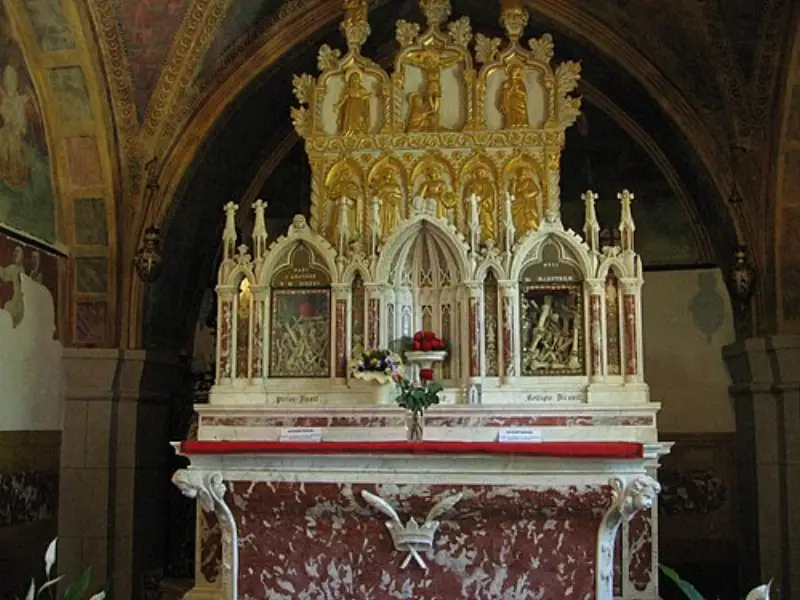
The cult has two fixed points older than the Acts. Tradition holds that her relics came to light only a few years after she died, on the hill that then took the name Santa Augusta from her, overlooking Serravalle, and a church in her honor was raised there during the fifth century — the sanctuary that still crowns the hill above Vittorio Veneto, holding her relics in a modern setting. Her calendar marks the stages of that cult: the main feast on 27 March, the translation of her relics on 1 August, and their invention — the discovery — on 22 August. Her name is listed in Ferrarius's Catalogue of Saints, though not in the Roman Martyrology, a distribution that places her among the strong local cults of the Veneto rather than the universal calendar. The sanctuary on the hill of Santa Augusta, with her relics, is the standing monument of the cult that the Acts of 1590 were written to dignify.
The Sanctuary Above Vittorio Veneto
Augusta's legacy is topographical and civic. The hill of Santa Augusta, with its ancient church and her relics, is the landmark of Serravalle — the most picturesque quarter of Vittorio Veneto, at the foot of the pre-Alps — and her feast belongs to the town's year. For the critical historian she is a case study in late hagiography: a sixteenth-century Acts in the service of a real and older cult, composed in the age when the church was both reforming its calendars and competing for relics. For the Church of the Veneto she is what the hill says: the virgin martyr who belongs to the place, invoked under her several names — of Treviso, the ancient diocese; of Ceneda, the see that became Vittorio Veneto; of Tarvisium; and of Serravalle, where the sword fell. Her several names — of Treviso, Ceneda, Tarvisium, Serravalle — map the jurisdictions that have claimed her, from the ancient diocese to the modern commune.
Timeline
- 100
Per her legendary Acts, beheaded at Serravalle by her father Matrucus around this year
§ Background
- 500
A church dedicated to her was built on the hill overlooking Serravalle
§ Veneration
- 1500
Her Acts were written by Minuccio Minucci and printed in Surius's compilation at Cologne
§ Background
The Record
- Patron of
- Ceneda and Serravalle (Vittorio Veneto), Italy
- Symbols
- Sword·Funeral pyre·Wheel·Depicted with her father in the act of killing her
- Canonization
- Pre-congregation (ancient local cult; listed in Ferrarius' Catalogue of Saints, not in the Roman Martyrology)
Prayer
Profile text adapted from the Wikipedia article, licensed CC BY-SA 4.0.
Pray with this saint every day
Save St. Augusta of Treviso to your favorites, read the full profile, and get feast-day reminders in the Saints app.
Get the Saints AppFree on the App Store for iPhone and iPad