
1814-1856·Feast February 28
St. Auguste Chapdelaine
Priest and Martyr (Paris Foreign Missions Society)
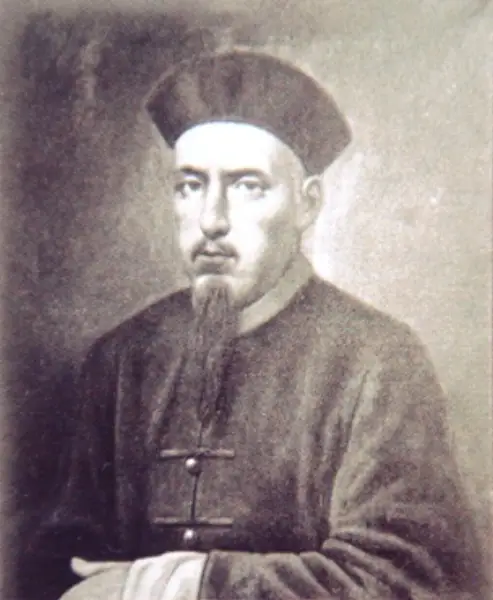
Overview
Born on a farm at La Rochelle-Normande in Normandy in February 1814, Auguste Chapdelaine entered the seminary at Coutances at twenty, was ordained for that diocese in 1843, and in 1851 offered himself to the Paris Foreign Missions Society. Sailing from Antwerp in April 1852, he worked his way toward Guangxi, a province closed to foreigners, by way of Guangzhou and then Guiyang in Guizhou. In December 1854 he reached Yaoshan village in Xilin County, where a Catholic community of roughly three hundred awaited him, and there said his first mass on 8 December; within days he was jailed, and after a fortnight or more of captivity and personal threats he withdrew into Guizhou, returning to Guangxi in December 1855. Denounced on 22 February 1856 by the relative of a convert, he was seized on the mandarin Zhang Mingfeng's orders, accused of stirring insurrection, and refused to buy his way out. Sentenced to the cage, he was flogged across the face and locked into an iron cage whose supporting planks were taken away one by one until he suffocated; already dead, he was decapitated, on 29 February 1856. France would seize on his execution as a cause for joining the Second Opium War.
The Complete Life
Early Life
Auguste Chapdelaine was born on 6 February 1814 on a farm at La Rochelle-Normande, in the Norman countryside of the Manche. The France of his childhood was rural, Catholic in its villages, and only just recovering from the Napoleonic wars; the seminary at Coutances, which he entered at about twenty, drew on exactly this stock of farm families. Coutances received his priestly ordination in 1843 and served as a diocesan priest for some years before a more demanding call took shape. In 1851 he offered himself to the Institute of Foreign Missions in Paris — the Paris Foreign Missions Society, or MEP — the society founded to supply priests for East and Southeast Asia.
§ Biography
Conversion and Vocation
Chapdelaine's vocation was not a conversion but a redirection: from the settled priesthood of a Norman parish to the mission territories of China. He sailed from Antwerp in April 1852, one of the society's middle-aged volunteers who gave up a European career for a country where their work was illegal. His assigned field was Guangxi, a province formally closed to foreigners, made more dangerous still by the Taiping Rebellion then raging across southern China — a pseudo-Christian upheaval that made every foreign missionary suspect as a potential agent of insurrection. Reaching the province at all required patience: he stopped first in Guangzhou, then moved to Guiyang in Guizhou in the spring of 1854, waiting for a way into Guangxi.
§ Biography
Mission and Ministry
In December 1854 Chapdelaine traveled with the Chinese catechist Lu Tingmei to Yaoshan village in Xilin County, Guangxi, where a Catholic community of some three hundred had grown up without a priest. His first Mass there fell on the feast of the Immaculate Conception, 8 December 1854. Ten days after his arrival he was arrested and imprisoned in the Xilin county jail, held for sixteen to eighteen days, then released under personal threats that made his position untenable. He withdrew into Guizhou for most of 1855 and returned to Guangxi in December of that year, resuming the quiet pastoral care of the Yaoshan community — the mass-going, instruction, and administration of sacraments that constituted the whole of an outlaw missionary's work.
§ Biography
Trial and Final Years
On 22 February 1856 Chapdelaine was denounced by Bai San, a relative of a recent convert, while the local tribunal sat in holiday recess. On 25 February, on the orders of Zhang Mingfeng, the newly arrived local mandarin, he was arrested at Yaoshan together with other Chinese Catholics. He was accused of stirring up revolt and turned down the bribe that could have won his release. Sentence was passed that he undergo the cage torture known as zhanlong: he first received a hundred blows of a leather thong across the face — a punishment that shattered his teeth and ripped his jaw — and was then shut into a small iron cage hung at the jail gate, from which the planks under his feet were progressively removed so that his body weight slowly strangled him. He was dead before the sentence of beheading was carried out on 29 February 1856; his head was hung by the hair from a tree, where witnesses said children threw stones until it fell and was consumed by animals.
§ Biography
Canonization
The Church's recognition of Chapdelaine moved slowly and then all at once. He was beatified in 1900, and on 1 October 2000 Pope John Paul II canonized him among the 120 Martyrs of China, the group of Catholics killed in China between the seventeenth and twentieth centuries. As with the rest of that group, the canonization drew official Chinese protest; the historian Anthony Clark has argued that the hostile versions of Chapdelaine circulated in some Chinese accounts — painting him as a spy or libertine — are unsupportable in the historical record, while freely conceding that his death was exploited by France for imperial purposes.
§ Recognition and controversy
Legacy
Chapdelaine's death had consequences far beyond his village. France, informed through its chargé d'affaires de Courcy in Macau, protested vigorously to Viceroy Ye Mingchen, demanded reparations, and ultimately joined Britain's war of 1856-1860 — the Second Opium War — with the priest's execution as its stated casus belli. Historians have generally judged the casus belli convenient rather than compelling: France had ignored missionary deaths before and after, and Lord Elgin dryly observed that his French colleague had been handed 'a much better case of quarrel' than Britain's own. Whatever the motives, Article Six of the Sino-French Convention of Peking that closed the war, in its Chinese text, gave Christians the right to propagate their faith in China's interior and French missionaries the right to hold property there — the legal foundation of the missions for the next half century. The mandarin Zhang Mingfeng was demoted under French pressure.
§ The Second Opium War
Timeline
- 6 Jan 1814
Born at La Rochelle-Normande, France
§ Introduction
- 1843
Ordained to the priesthood for the diocese of Coutances
§ Biography
- 1851
Joined the Institute of Foreign Missions in Paris
§ Biography
- Apr 1852
Left from Antwerp to join the Catholic mission in Guangxi, China
§ Biography
- 1854
Moved to Guiyang, capital of Guizhou, in the spring after a stay in Guangzhou
§ Biography
- 8 Dec 1854
Went with Lu Tingmei to Yaoshan village, Xilin County, and celebrated his first mass there
§ Biography
- Dec 1855
Returned to Guangxi after withdrawing to Guizhou earlier in the year under personal threats
§ Biography
- 22 Feb 1856
Betrayed to the authorities by Bai San, a kinsman of a recent convert, at a time when the local court was in recess
§ Biography
- 25 Feb 1856
Arrested at Yaoshan with other Chinese Catholics on the orders of the mandarin Zhang Mingfeng
§ Biography
- 29 Feb 1856
Died under cage torture at Xilin and was decapitated after his death
§ Biography
- 1900
Beatified
§ Recognition and controversy
- 1 Oct 2000
Canonized by Pope John Paul II together with 120 martyrs of China
§ Recognition and controversy
The Record
- Canonization
- Beatified in 1900; canonized by Pope John Paul II with the 120 Martyrs of China on 1 October 2000
Prayer
Bibliography
Show 12 sources
- 1 2 3 4 "China demonizes French saint in patriotic propaganda" , Philippine Daily Inquirer , Agence France-Presse, July 10, 2016
- ↑ "Museum praises murderers of a Catholic saint, 'enemy of the people ' " , AsianNews.it , 11 July 2016
- 1 2 "Auguste Chapdelaine" , Biographical Dictionary of Chinese Christianity
- ↑ Watkins, Basil (2015). The Book of Saints: A Comprehensive Biographical Dictionary . Bloomsbury. ISBN 978-0-567-66415-0 .
- ↑ Charbonnier, Jean (2007). Christians in China: A.D. 600 to 2000 . Ignatius Press. ISBN 978-0-89870-916-2 .
- ↑ Mungello, D. E. (2015). The Catholic Invasion of China: Remaking Chinese Christianity . United Kingdom: Rowman & Littlefield. pp. 102–03.
- ↑ Mungello, p. 104
- 1 2 3 4 5 Huang Yen-Yu (1941). "Viceroy Yeh Ming-Ch'en and The Canton Episode (1856–1861): 4. The Canton Episode". Harvard Journal of Asiatic Studies . Vol. 6, No. 1, March 1941
- ↑ Wang, Wenjuan (2015). 历史的回声与反思:定安镇天主教传播的调査研究 [ Echoes and Reflections of History: A Survey of the Spread of Catholicism in Ding'an Town ] (Master thesis) (in Chinese).
- ↑ Zhufeng Luo, Chu-feng Lo, Luo Zhufeng (1991). Religion Under Socialism in China . M.E. Sharpe. p. 42. "France started the second Opium War under the pretext of the 'Father Chapdelaine Incident ' " .
- ↑ Paul Kwang Tsien Sih, Taiwan in Modern Times , p. 105. [ full citation needed ] "The two incidents that eventually caused a war were the Arrow incident and the murder of the French Catholic priest, Abbe Auguste Chapdelaine"
- ↑ Kenneth Scott Latourette (1966), A History of Christian Missions in China , Ch'eng-wen, p. 273. "A casus belli was found in an unfortunate incident which had occurred before the Arrow affair, the judicial murder of a French priest, August
Profile text adapted from the Wikipedia article, licensed CC BY-SA 4.0.
Pray with this saint every day
Save St. Auguste Chapdelaine to your favorites, read the full profile, and get feast-day reminders in the Saints app.
Get the Saints AppFree on the App Store for iPhone and iPad