
early 6th century - c. 604·Feast May 27 (Roman Catholic Ordinary Form); May 26/28 in other calendars
St. Augustine of Canterbury
Benedictine Monk, First Archbishop of Canterbury, Apostle of the English
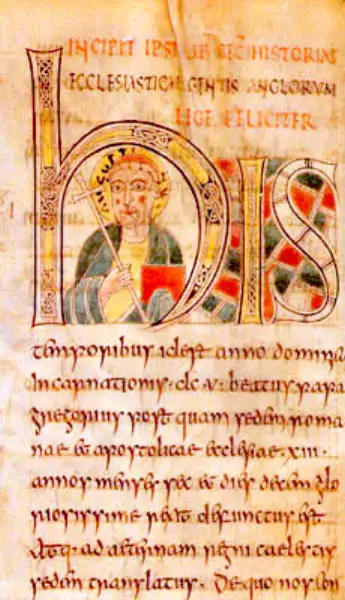
Overview
Augustine of Canterbury, a Christian monk of the early sixth century who died probably on 26 May 604, was prior at the Benedictine monastery of St. Andrew, on Rome's Caelian Hill, when Pope Gregory I picked him in 595 to head the enterprise usually called the Gregorian mission, sent to Britain to bring King Æthelberht and his kingdom of Kent out of Anglo-Saxon paganism. The choice of Kent probably owed to Æthelberht's influence over neighbouring kingdoms, and to his wife Bertha, a Frankish princess and Christian expected to exercise influence over her husband. The missionaries wavered before reaching Kent and thought of turning back, but Gregory spurred them on; in 597 Augustine came ashore on the Isle of Thanet and made his way to Æthelberht's principal town, Canterbury. The king converted and allowed free preaching, giving land for a monastery outside the walls; Augustine was consecrated bishop, and thousands of the king's subjects were baptized, including a mass baptism on Christmas Day 597. Gregory sent more missionaries in 601 with letters and gifts, though Augustine's attempts to bring the native British bishops under his authority failed. London and Rochester received sees in 604, a school for Anglo-Saxon clergy was founded, and Augustine arranged the consecration of his successor Laurence before his death, probably in 604. He is venerated as a saint in the Catholic, Anglican, and Eastern Orthodox churches as the Apostle of the English.
The Complete Life
Early Life
Almost nothing is known of Augustine's life before 595. He was probably born in Italy in the first half of the sixth century, and by the time he enters history he was prior of the monastery of St. Andrew on the Caelian Hill in Rome, which Pope Gregory I had founded in his own family house. The monastery was the centre of Gregory's monastic project, and its community, trained in the severe Lombard years of his papacy, supplied the men for his missions; that Augustine was its prior marks him as one of Gregory's most trusted religious. Prior and pope knew each other well, and Gregory's choice of this cautious, capable monk for the hardest of assignments was confirmed when, at the missionaries' moment of panic in Gaul, it was to Augustine that Gregory addressed the letters that turned them back toward Britain. His formation was Benedictine in everything but perhaps the letter of the rule, in an Italy where Benedict's monasticism was still new, and his instincts, revealed in the correspondence, were Roman: for order, for papal authority, and for the systematic conversion of a people rather than a scattering of individual souls.
Vocation
Augustine's vocation arrived as an assignment, and his first recorded act in it was an attempt to resign. In 595 Gregory chose him to lead a group of perhaps forty monks to the island of the Angles, an idea that had been Gregory's own since, the famous story says, he had seen English slaves in the Roman market. The party set out, but in Gaul the reports of the journey's dangers frightened them, and they sent Augustine back to Rome to beg release from the enterprise. Gregory refused, wrote letters of commendation to the Frankish kings and bishops, appointed interpreters including Frankish priests, and named Augustine abbot of the mission with authority over its members. The choice of Kent was careful strategy rather than chance: Æthelberht of Kent was the most powerful of the Anglo-Saxon kings, holding the overlordship his father had won, and his queen Bertha was a Christian Frankish princess with her own bishop, Liudhard, and a church at Canterbury. If the king could be converted, the whole southern English world might follow. Augustine landed on the Isle of Thanet in 597 with the king's permission already secured by Frankish diplomacy.
Mission
The mission succeeded faster than any in the early medieval church. Æthelberht, meeting the missionaries in the open air, where he judged the foreign magic could not trap him, gave them leave to preach, a house in Canterbury, and land for the monastery that became St Augustine's Abbey. Augustine was consecrated bishop, probably at Arles on the way, and by Christmas Day 597 thousands of the king's subjects were baptized in the Swale or the Stour. In 601 Gregory sent a second wave of missionaries under Mellitus, with letters answering the questions Augustine had posed about the organization of the new church, the famous replies that instructed the missionaries to purify rather than destroy pagan temples, to convert feasts into Christian festivals, and to proceed gradually. Augustine received the pallium, making him metropolitan of all Britain as the pope conceived it, and Gregory's plan contemplated twelve bishoprics with London as the primatial see. Rochester was set up with Justus, London with Mellitus, and a school was founded for Anglo-Saxon clergy. The one large failure was the native church: at a conference, traditionally placed at Augustine's Oak near the Severn, the British bishops refused his demands for conformity in the dating of Easter and in baptismal practice, and the ancient church of the Britons remained apart.
Final Years
Augustine's last years were occupied with consolidation. The consecration of Mellitus and Justus in 604, with papal authorization, gave the young church three bishops, and the appointment of Laurence as Augustine's coadjutor and guaranteed successor provided for continuity, a precaution whose wisdom appeared when the whole mission nearly collapsed after Æthelberht's death. Augustine also founded, beside the monastery outside the walls, the abbey church of Sts Peter and Paul where the kings of Kent and the archbishops would be buried, himself among the first. The date of his death is given as 26 May 604, or possibly 605, and Bede preserves the tradition that he died soon after securing the succession. He was buried in the cemetery of the abbey he had founded, translated later into the church itself, and his tomb became the first shrine of English Christianity. The monastery, sacked and rebuilt across the centuries, kept his name and his relics until the dissolution of the monasteries, and the site of St Augustine's Abbey in Canterbury is still called after him.
Cult and Canonization
Augustine is a saint of the pre-congregation age. Bede, writing within a century of the mission, records that he was 'received into the bosom of the apostles' and his cult was assured from the time of his burial in the abbey that carried his name. His canonization was the work of the church he founded: the English church honoured its own apostle in its calendars, and his feast, kept on 26 May, was later moved in various reckonings, the Roman Catholic church in England and Wales now keeping it on 27 May in the Ordinary Form calendar, while the Extraordinary Form and the Anglican and Orthodox churches keep their own dates. His shrine at St Augustine's Abbey was a place of pilgrimage until the abbey's destruction in 1538. He is honoured by the Catholic Church, the Anglican Communion, and the Eastern Orthodox Church alike, a rare shared patrimony, as the apostle of the English. The title of his mission, and of his office, has continued without interruption: the archbishop of Canterbury still sits in the succession Augustine began.
Legacy
The legacy of Augustine of Canterbury is the church of England in the widest sense, and through it much of the character of English Christianity. From his mission came the see of Canterbury, whose primacy over the English church has never lapsed; the cathedral and abbey of Canterbury; and the Roman orientation of the southern English church, whose calendar, liturgy, and episcopal structure were set in his years. His recorded counsels from Gregory, on converting rather than destroying what was pagan, have been quoted in every age of the church's missionary history, rightly or not, as a charter for adaptation. The reconciliation of Celtic and Roman traditions, which he failed to achieve with the British bishops, was accomplished two generations later at the Synod of Whitby on the ground he had prepared. Historians judge him not a great man in himself but a perfectly faithful executor of a great man's design, and Gregory's Dialogues and letters preserve his voice, uncertain, dutiful, and obedient. He stands at the head of the long line of English Christians, and his feast is kept by Catholics, Anglicans, and Orthodox as the apostle of the English.
Timeline
- 595
Chosen by Pope Gregory I, while prior of St Andrew's Abbey in Rome, to head the Gregorian mission to Kent.
§ Background to the mission
- 597
Landed in Kent on the Isle of Thanet with about forty companions and began preaching in Æthelberht's Canterbury.
§ Arrival and first efforts
- 597
Consecrated a bishop, probably before reaching England, on Gregory's command; a September letter already styles him bishop.
§ Arrival and first efforts
- 597
Founded the monastery of Saints Peter and Paul, later St Augustine's Abbey, on land donated by the king.
§ Arrival and first efforts
- 2 Jun 597
King Æthelberht's conversion, dated by late medieval tradition to Whit Sunday, 2 June 597.
§ Arrival and first efforts
- 25 Dec 597
Baptized thousands of the king's subjects in a mass baptism on Christmas Day.
§ Introduction
- 601
Received the pallium brought by new missionaries from Rome, marking his metropolitan status as archbishop.
§ Arrival and first efforts
- 603
Met the British bishops at a gathering south of the Severn; failing to rise for them, he lost their submission.
§ Additional work
- 604
Founded two further bishoprics, consecrating Mellitus for London and Justus for Rochester.
§ Additional work
- 26 May 604
Died at Canterbury, probably on this date, having consecrated Laurence as his successor.
§ Death and legacy
The Record
- Major works
- Foundation of the see of Canterbury and the English church·Foundations of Christ Church, Canterbury and Sts Peter and Paul (later St Augustine's Abbey)·A school at Canterbury for Anglo-Saxon clergy
- Patron of
- England (Apostle of the English)·Canterbury
- Symbols
- Benedictine habit and bishop's vestments·The pallium sent by Gregory·A church model (as founder)
- Canonization
- Pre-congregation; revered as a saint soon after his death c. 604
Prayer
Profile text adapted from the Wikipedia article, licensed CC BY-SA 4.0.
Pray with this saint every day
Save St. Augustine of Canterbury to your favorites, read the full profile, and get feast-day reminders in the Saints app.
Get the Saints AppFree on the App Store for iPhone and iPad