
354-430·Feast August 28
St. Augustine of Hippo
Bishop, Doctor of the Church
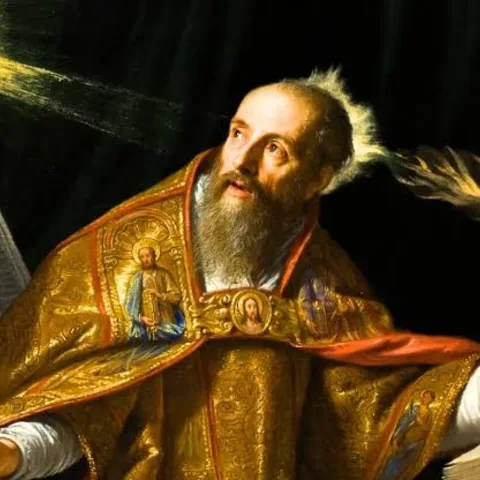
Overview
Aurelius Augustinus was born at Thagaste in Roman Numidia in 354 to a Christian mother, Monica, and a pagan father. Gifted and restless, he taught rhetoric across North Africa and Italy while searching the philosophies of his age for truth, living for years as a Manichaean auditor. In Milan, the preaching of Bishop Ambrose and the prayers of his mother broke through; in a garden in 386, hearing a child's voice bid him take up and read, he opened Paul's letter to the Romans and his long resistance ended. Baptized by Ambrose at the Easter Vigil of 387, he returned to Africa intending a quiet life of study, but the people of Hippo pressed him to the priesthood in 391 and to the episcopate around 395. For thirty-five years he preached, shepherded the poor, contested the Donatist and Pelagian divisions, and wrote at a pace the ancient world rarely saw. When the Vandals besieged Hippo in 430, the old bishop fell ill and died on 28 August, leaving the Church a library that has never gone out of print.
The Complete Life
Early Life
Aurelius Augustinus was born in 354 at Thagaste, a modest town of Roman Numidia in what is now eastern Algeria. His father Patricius was a pagan town councillor of limited means and considerable ambition for his brilliant son; his mother Monica was a Christian whose patient, sometimes unbearable prayers for that son would become one of the Church's standing images of maternal intercession. Augustine was raised a catechumen but not baptized — the custom of the age, which deferred the sacrament — and his education, bought at family sacrifice, made him a rhetorician: first at Madauros, then at Carthage, the great metropolis where he arrived at seventeen and where, by his own account, he loved and lusted and topped his classes. He took a concubine whose name the Confessions never records, and by her had a son, Adeodatus, in 372. He was, in his own telling, a man of enormous gifts and no peace, and the book that made him immortal is the audit of that condition.
§ Childhood and education
Conversion and Vocation
Augustine's path to faith ran through every alternative his age offered. For nearly a decade he was an auditor of the Manichaeans, drawn by their claim to offer reason rather than authority; when their promised explanations failed, he drifted disillusioned through skepticism, then to the Academics and Cicero, then to a neo-Platonic reading of evil as privation that broke his last intellectual objection. In 384 he obtained the chair of rhetoric at Milan, the empire's second city, and there encountered Ambrose, the bishop whose preaching showed him that Catholic scripture could be read figuratively rather than as the crude literalism the Manichaeans mocked. Monica arrived to manage his marriage prospects; his concubine was sent away; the betrothed bride was years too young; and in the crisis that followed — his friend Alypius beside him, a child's voice chanting what he heard as tolle, lege, take up and read — he opened Paul's letter to the Romans at random and the long resistance ended. He resigned his chair, was baptized by Ambrose at the Easter Vigil of 387 with Alypius and Adeodatus, and started home to Africa. Monica died at Ostia on the way, and the vision the two shared there — the pair of them carried up to the eternal — closes the ninth book of the Confessions.
§ Conversion to Christianity and priesthood
Mission and Ministry
Augustine had intended a life of Christian study in retirement; Africa had other plans. Visiting Hippo Regius in 391, he was seized by the congregation and ordained priest to their astonishment and his own, and around 395 he was consecrated bishop — Valerius, the aged bishop, having secured his succession while Augustine still lived. For nearly forty years he was Hippo's bishop, and the ministry he exercised was total: preaching constantly (some four hundred sermons survive, many taken down by stenographers as he spoke), arbitrating the lawsuits of the poor who had no other court, ransoming captives, feeding the destitute, and governing a church in a province that was itself the prize in the empire's religious wars. The monastery he founded at his house gave the Latin West the template of clerical common life. He died as he had served — at his post, with the Vandals at the walls.
§ Conversion to Christianity and priesthood
Spirituality and Teaching
Augustine's teaching was forged in controversy, and each of the three great fights of his episcopate produced a permanent piece of Christian thought. Against the Donatists, who held that the validity of the sacraments depended on the purity of the ministers, he developed the theology of the Church as a mixed body of saints and sinners, and the sacraments as Christ's, not men's. Against the Pelagians, who taught that man can will his own moral beginning, he worked out the doctrine of grace — that the initiative is always God's, and that even the will to believe is gift — pressed to an edge that later centuries would both reverence and dispute. And in the Confessions and On the Trinity he wrote the interior turn of Western thought: the self examined before God, time and memory probed as no one had probed them, and the restless heart that finds rest only in the One who made it. The City of God, begun after Alaric's sack of Rome in 410, framed the whole of history as the interplay of two loves, and became the founding book of Western political theology.
§ Ethics
Trial and Final Years
The last decade of Augustine's life was the collapse of the world he had served. The Vandals crossed into Africa in 429 and burned their way through the province; refugees flooded Hippo, among them bishops whose sees were gone. Augustine, old and ailing, organized relief, argued with the Pelagians still, and asked the psalms of penitence to be written on the walls of his room so that he might read them from his bed. He is said to have asked that no one's trouble be hidden from him, since he was the bishop of all. The Vandals besieged Hippo through the summer of 430; the city held, but the old bishop fell ill and died on 28 August 430, aged seventy-five. The city fell and burned a year later, but his library, by the account of the age, was saved.
§ Death and sainthood
Canonization
Augustine belongs to the ancient cult, canonized by no process but by the consensus of the undivided Church. His authority was invoked at councils within a generation of his death, his rule or its derivatives organized hundreds of communities, and his books carried his influence wherever Latin was read. In 1298 Pope Boniface VIII declared him a Doctor of the Church, one of the original four with Ambrose, Jerome, and Gregory the Great. The Reformation and the Counter-Reformation both claimed him — Luther was an Augustinian — and the argument between them over grace and the Church has run through his works ever since. His feast is kept on 28 August.
§ Biography and criticism
Legacy
No Christian writer after the apostles has been read more. The Confessions created autobiography as a genre; On Christian Doctrine founded hermeneutics; the City of God set the terms of Christian political thought until modernity. The Augustinian orders — several of them, by various routes — carry his name, as does the theology of grace that the Council of Orange and the Reformation both drew from him. His thought marked Dante and Calvin, Descartes and Newman; modern philosophy's discovery of time and interiority keeps finding him there first. And in the popular devotion of the whole Church he remains the convert — the man who wasted nothing, not even his sins, because he made them the material of the most honest book in Christian literature.
§ Biography and criticism
Timeline
- 13 Nov 354
Born Aurelius Augustinus at Thagaste, Numidia, on 13 November.
§ Introduction
- 373
Taught grammar at Thagaste from 373 to 374, then moved to Carthage to run a school of rhetoric.
§ Move to Carthage, Rome, and Milan
- 383
Moved to Rome to establish a school, discouraged by unruly students in Carthage.
§ Move to Carthage, Rome, and Milan
- 384
Won the imperial chair of rhetoric at Milan and took up the position late that year.
§ Move to Carthage, Rome, and Milan
- Aug 386
Converted to Christianity in late August at Milan, aged thirty-one, after hearing of Anthony of the Desert.
§ Conversion to Christianity and priesthood
- 24 Apr 387
Baptized by Ambrose at the Milan Easter Vigil, 24-25 April, together with his son Adeodatus.
§ Conversion to Christianity and priesthood
- 388
Completed his apology On the Holiness of the Catholic Church a year after his baptism.
§ Conversion to Christianity and priesthood
- 391
Ordained a priest at Hippo Regius.
§ Conversion to Christianity and priesthood
- 395
Made coadjutor Bishop of Hippo, becoming full bishop shortly thereafter and giving his property to the church of Thagaste.
§ Conversion to Christianity and priesthood
- 397
Wrote his autobiographical Confessions across 397-398.
§ Conversion to Christianity and priesthood
- 410
After the Visigoths sacked Rome, wrote The City of God to console shaken fellow Christians.
§ Conversion to Christianity and priesthood
- 430
The Vandals besieged Hippo in the spring as he entered his final illness.
§ Death and sainthood
- 28 Aug 430
Died at Hippo Regius on 28 August, aged seventy-five.
§ Death and sainthood
In Their Own Words
Thou hast made us for Thyself and restless is our heart until it comes to rest in Thee.
Late have I loved you, O Beauty ever ancient and ever new! Late have I loved you!
Love, and do what thou wilt.
As the soul is the life of the body, so God is the life of the soul.
The Record
- Major works
- Confessions·The City of God·On Christian Doctrine·On the Trinity·Enarrations on the Psalms·On the Catechizing of the Uninstructed
- Patron of
- Theologians·Printers·Brewers·Sore eyes·The Augustinian Order
- Symbols
- Bishop's vestments·Flaming heart (the restlessness that finds rest)·Child with a shell (the mystery he could not empty)
- Canonization
- Pre-congregation (ancient cult); declared Doctor of the Church by Pope Boniface VIII in 1298
Prayer
Bibliography
Show 12 sources
- ↑ "[T]he names Monnica and Nonnica are found on tombstones in the Libyan language – as such Monnica is the only Berber name commonly used in English." Brett & Fentress 1996 , p. 293
- ↑ Augustine later wrote in Confessions : "I thought it should be too miserable unless folded in female arms." [ 71 ]
- ↑ Brown 2000 , p. 64 places Augustine's garden conversion at the end of August, 386.
- ↑ He explained to Julian of Eclanum that it was a most subtle job to discern what came first: Sed si disputatione subtilissima et elimatissima opus est, ut sciamus utrum primos homines insipientia superbos, an insipientes superbia fecerit .
- ↑ Augustine explained it in this way: "Why therefore is it enjoined upon mind, that it should know itself? I suppose, in order that, it may consider itself, and live according to its own nature; that is, seek to be regulated according to it
- ↑ In one of Augustine's late works, Retractationes , he made a significant remark indicating the way he understood the difference between spiritual, moral libido and the sexual desire: "Libido is not good and righteous use of the libido" ("
- ↑ Although Augustine praises him in the Confessions , 8.2., it is widely acknowledged that Augustine's attitude towards that pagan philosophy was very much of a Christian apostle, as Clarke 1958 , p. 151 writes: Towards Neoplatonism there w
- ↑ "It is, of course, always easier to oppose and denounce than to understand." [ 162 ]
- ↑ In 393 or 394 he commented: Moreover, if unbelief is fornication, and idolatry unbelief, and covetousness idolatry, it is not to be doubted that covetousness also is fornication. Who, then, in that case can rightly separate any unlawful l
- ↑ French archaeology has shown the north African landscape of this time period became "covered with a white robe of churches" with Catholics and Donatists building multiple churches with granaries to feed the poor as they competed for the l
- ↑ See: C. Kirwan, Augustine (London, 1989), pp. 209–218; and J. M. Rist. Augustine: Ancient Thought Baptized (Cambridge, 1994), pp. 239–245.
- ↑ For example, Martin Heidegger 's articulations of how " Being-in-the-world " is described through thinking about seeing : "The remarkable priority of 'seeing' was noticed particularly by Augustine, in connection with his Interpretation of
Profile text adapted from the Wikipedia article, licensed CC BY-SA 4.0.
Pray with this saint every day
Save St. Augustine of Hippo to your favorites, read the full profile, and get feast-day reminders in the Saints app.
Get the Saints AppFree on the App Store for iPhone and iPad