
died 1535·Feast May 4 (individual); October 25 (with the Forty Martyrs)
St. Augustine Webster
Carthusian Prior and Martyr
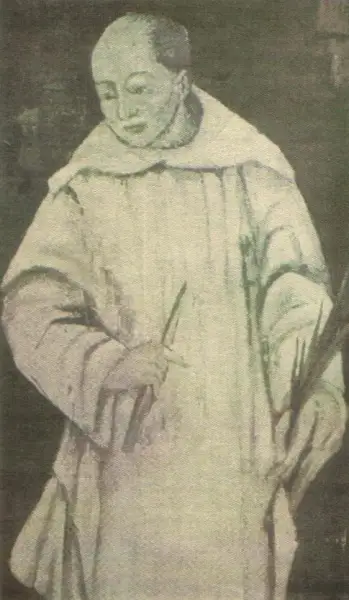
Overview
Augustine Webster, a Carthusian monk and prior of the Charterhouse of Our Lady of Melwood at Epworth on the Isle of Axholme in north Lincolnshire, was one of the Carthusian martyrs executed under Henry VIII. Educated at Cambridge, he became a monk at the Charterhouse of Sheen, and in 1531 was named prior of the small Lincolnshire house. When the question of the king's supremacy over the Church in England was forced upon the religious orders, the government was anxious above all to secure the public acquiescence of the London Carthusians, whose austere and sincere life gave them immense prestige; Webster, with John Houghton, prior of the London Charterhouse, and Robert Lawrence, prior of Beauvale, went to Thomas Cromwell to seek exemption for their order from the oath acknowledging the king's marriage and supremacy. Refused a hearing, they were imprisoned, tried and condemned. On 4 May 1535 Webster suffered at Tyburn, hanged, drawn and quartered alongside Houghton, Lawrence and the Brigittine Richard Reynolds. He was beatified in 1886 and canonized among the Forty Martyrs of England and Wales in 1970.
The Complete Life
Early Life
Nothing is recorded of Augustine Webster's family or birthplace; his life, like most Carthusian lives, was deliberately erased into the order's silence. He was educated at Cambridge University, at a time when the university was supplying the English Church with its reforming clergy and its Carthusian recruits alike, and he became a monk at the Charterhouse of Sheen, the royal foundation beside Richmond that ranked among the strictest houses of the order. Sheen gave him his formation in the Carthusian life — the solitary cell, the manual work, the night offices, the silence that the order counts its principal asceticism — and the name Augustine under which he is known, his baptismal name being unrecorded. In 1531 he was named prior of the Charterhouse of Our Lady of Melwood at Epworth, on the Isle of Axholme in north Lincolnshire, one of the smaller and poorer houses of the English province, where the prior's office meant the care of a handful of monks in a marsh-bound solitude — and, as it proved, the leadership of that little community in the greatest crisis of English religious life.
The Supremacy Crisis
When the English Reformation broke out, ten Carthusian charterhouses — hermitage-monasteries — stood in England, held in the highest esteem for the austerity and sincerity of their life. The authorities were eager to obtain from the monks of the London Charterhouse a public acceptance of the royal supremacy in ecclesiastical matters, because their prestige would carry weight no other religious house could match: if the Carthusians, whose holiness England took for granted, could be seen to accept the king's claims, opposition would be disarmed. In 1535 the three priors — John Houghton of London, Robert Lawrence of Beauvale and Augustine Webster of Axholme — went together to Thomas Cromwell, the vicegerent, to seek a form of exemption for their order from the oath that acknowledged the king's supremacy and the justice of his new marriage. The request was refused; the priors were detained, and the regime decided to make examples of the order's leaders rather than negotiate with them.
Trial and Martyrdom
Houghton, Lawrence and Webster, with the Brigittine monk Richard Reynolds — considered the best Latinist in England — were brought to trial on charges of treason, for denying the king's supremacy. The jury at first hesitated to condemn the Carthusians until coerced by the judges; the sentence was the full terror of the age: hanging, drawing and quartering at Tyburn. The execution came on 4 May 1535, and the three priors and the Brigittine died together, the Carthusians going to their deaths in their habits with a quiet that impressed even the hostile crowd. Within weeks, of the London house, Sebastian Newdigate, Humphrey Middlemore and William Exmew followed, and over the next years the whole community of the Charterhouse was destroyed, some hanged in chains in their habits, some starved. Webster, as prior of Axholme, had gone to London to protect his own distant house by securing the order's corporate stance, and paid with his life for the attempt.
Canonization
The Carthusian martyrs were beatified by Pope Leo XIII on 29 December 1886, among the first large groups of the English martyrs to receive formal recognition, and Augustine Webster was canonized by Pope Paul VI on 25 October 1970 as one of the Forty Martyrs of England and Wales, the collective canonization that fixed the Reformation's dead in the Church's calendar. His individual feast is 4 May, and the collective feast 25 October. The Forty include him as the type of the religious superior martyred for the papal primacy he had lived under — the prior whose obedience to his order's constitution and to the Church's head could not be reconciled with the new supremacy. For the Carthusians he remains one of their greatest, and the order's modern martyrology reads his name beside Houghton's at every commemoration.
Legacy
Augustine Webster's legacy is shared with the Carthusian martyrs as a body: the proof that the most hidden and least political of religious orders could not escape the supremacy's demand for total assent, and would not give it. The government's own anxiety to secure the Charterhouses' acquiescence is the best evidence of what their refusal cost the crown's legitimacy. Historians of the Reformation treat the Carthusian executions as the moral hinge of the persecution — the moment when what had begun as a constitutional revolution became, visibly, the killing of manifestly holy men. For the English Catholic tradition the three priors stand together, and Webster represents the provinces: the northern prior who came to London for his order and died with the London prior who sent him. Tyburn's tree and the Charterhouse's silence hold his memory.
Timeline
- 1531
Made prior of the Carthusian house of Our Lady of Melwood at Epworth, in Lincolnshire's Isle of Axholme.
§ Life
- Feb 1535
Visited the London Charterhouse with Prior Robert Lawrence to consult John Houghton on responding to Henry VIII's religious policies.
§ Life
- Apr 1535
Imprisoned in the Tower on Cromwell's orders around mid-April for refusing the Oath of Supremacy.
§ Trial
- 28 Apr 1535
Tried with Houghton, Lawrence and Reynolds for denying the royal supremacy; the jury hesitated before Cromwell's threats.
§ Trial
- 4 May 1535
Hanged, beheaded and quartered at Tyburn with his fellow Carthusian priors.
§ Trial
- 29 Dec 1886
Beatified by Pope Leo XIII.
§ Introduction
- 25 Oct 1970
Canonized by Pope Paul VI among the Forty Martyrs of England and Wales.
§ Veneration
The Record
- Patron of
- Carthusians·Priors
- Symbols
- Carthusian habit·Martyr's palm·Knife (instrument of his execution)
- Canonization
- Beatified 29 December 1886 by Pope Leo XIII; canonized 25 October 1970 by Pope Paul VI
Prayer
Profile text adapted from the Wikipedia article, licensed CC BY-SA 4.0.
Pray with this saint every day
Save St. Augustine Webster to your favorites, read the full profile, and get feast-day reminders in the Saints app.
Get the Saints AppFree on the App Store for iPhone and iPad