
1746-1815·Feast July 9
St. Augustine Zhao Rong
Priest and Martyr
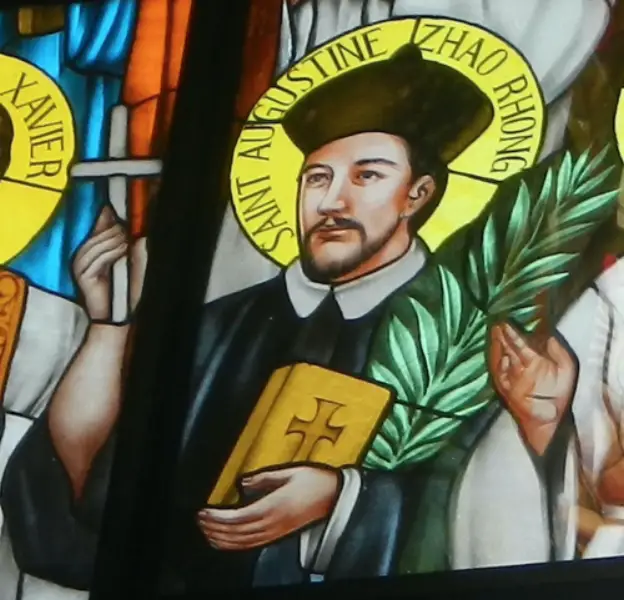
Overview
Born in Guizhou in 1746, Zhao Rong spent his youth as a soldier, joining the Qing imperial army at twenty. During the anti-Christian crackdowns of the eighteenth century his superiors assigned him to guard captured Catholics, and among his prisoners was Father Gabriel-Taurin Dufresse, later a bishop, whom he escorted toward Beijing in 1785. The quiet dignity of that imprisoned missionary worked on the young soldier until conviction followed admiration: when Dufresse was freed, he baptized his former guard with the name Augustine. Ordained a priest only five years later by François Pottier, the Apostolic Vicar of Sichuan, Augustine became the first priest of diocesan rank born in China. He served in Yunnan and across western Sichuan, noted for the numbers he drew into the Church, and in his final year carried responsibility for all Catholics in Guan Xian, Jin Tang, and Wen Jiang. When the Jiaqing Emperor's reign brought a fresh persecution, Augustine was seized, beaten, and ordered to renounce Christianity. He refused, and died in prison from the beatings in the winter of 1815.
The Complete Life
Early Life
Zhao Rong was born at Wuchuan in Guizhou province in 1746, in the remote south-west of the Qing empire, at a time when Catholicism in China survived in scattered rural communities served by a handful of foreign missionaries and a smaller handful of native catechists. At the age of twenty he entered the service of the Qing dynasty's army, and like many soldiers of his province he found himself used, sooner or later, against the Christians his government had outlawed. Nothing in his origins pointed toward the priesthood, and he gave no early sign of interest in the foreign creed. Even so: he was a soldier of an empire whose edicts treated the faith he would die for as a subversive sect, and his path to the Church ran, by a strange providence, through the very persecutions he was sent to enforce. Guizhou was among the provinces where the small Catholic communities were most exposed, and where the state's edicts against them were enforced most literally.
Conversion and Vocation
During the anti-Christian persecutions of the eighteenth century, he was at one stage assigned to guard Christian prisoners. In 1785 he was among those escorting Father Gabriel-Taurin Dufresse, later a bishop, while the missionary, under arrest, was being taken to Beijing. The contact between guard and prisoner worked its effect: Zhao Rong was converted through his dealings with Dufresse, and when the priest was later released from prison, he baptised his former guard, who took the name Augustine. The new convert then sought the priesthood himself, received the necessary training, and was ordained by François Pottier, the Apostolic Vicar of Szechwan, only five years after his baptism — the first Chinese-born diocesan priest in history. The speed — five years from the font to the altar — was extraordinary, and so was the precedent: an entirely native clergy, which the Church in China would need if it was to outlive its European missionaries.
Mission and Ministry
Augustine worked as a priest in western China with a reputation for bringing many people into the Church. He was sent to labour in Yunnan, where he spent years among the villages, he spent himself in the villages of the south-west, and his last year of life was given to charge of all the Catholics across Guan Xian, Jin Tang and Wen Jiang counties in western Sichuan. The Christians of those counties looked to him for the sacraments that a foreign missionary could not safely administer, and the work was that of the Chinese mission at its hardest: long journeys, clandestine instruction, Mass in private houses, and the constant risk that a single informer could end everything. That he was a native priest mattered doubly — he could go where no foreign missionary could pass unnoticed, and his existence was itself an argument that the faith was not a foreign intrusion but a Chinese possibility.
Trial and Final Years
Under the Jiaqing Emperor there came a new wave of persecution against the Chinese church, and it reached Augustine in his Sichuan charge. He was arrested and tortured, and the demand was put to him that he deny his faith. The order to renounce his faith was put to him plainly, and he refused it. Held in prison through the winter of 1815, he died there from the beatings received at the hands of his jailers — the first Chinese priest ever to die a martyr. He was sixty-nine years old, and had been a priest for the last quarter-century of a life that had spanned soldiering, the guarding of prisoners, and the altar. The manner of his death — not execution but fatal beating in custody — was typical of the quiet violence with which the Qing state suppressed the church. His death passed almost unnoticed outside his province, but within the Chinese Catholic community it confirmed what his ordination had begun: that the native clergy would pay the same price the missionaries had always paid.
Canonization
Augustine Zhao Rong was beatified by Pope Leo XIII on 27 May 1893, one of a series of nineteenth-century beatifications of Chinese martyrs. On 1 October 2000 Pope John Paul II canonised him together with the other martyrs of China — the group of one hundred and twenty who now appear in the liturgy under the name 'Augustine Zhao Rong and companions'. The company spans nearly three centuries of Chinese church history, from bishops and missionaries of the seventeenth century to catechists and parents killed at the turn of the twentieth. The placing of his name first, ahead of bishops and foreign missionaries of far greater fame, was a deliberate honour to the native Chinese church, and the ceremony drew both celebration and protest: the Chinese government objected to the canonisation of martyrs of an era it reads through the history of foreign intervention. The feast of the group is kept on 9 July.
Legacy
Augustine's legacy is chiefly symbolic, and the symbol is a strong one: a soldier of the Qing who became the first Chinese diocesan priest and the first Chinese priest-martyr. For Chinese Catholics he stands for the native roots of their church; for the wider church he stands for the turn, slow and contested, from mission territory to local clergy. The 2000 canonisation, with the group bearing his name, fixed that symbolism in the universal liturgy. The 9 July feast invites Catholics to remember the whole company of one hundred and twenty with him, but his own story is told on its own terms: a conversion worked through a guarded missionary, a priesthood won against every discouragement, and a death endured without renunciation. His life also preserves, in miniature, the drama of the Chinese missions in his century: persecution as the setting of conversion, the prison as the pulpit, and the guard who took the faith from the man he was guarding.
Timeline
- 1746
Born in Wuchuan county, Guizhou
§ Introduction
- 1766
Joins the Qing imperial army at age twenty
§ Life
- 1785
While guarding imprisoned Fr. Gabriel-Taurin Dufresse en route to Beijing, is converted
§ Life
- 1815
Arrested under the Jiaqing persecution, tortured, and dies from beatings in prison during winter
§ Life
- 27 May 1893
Beatified by Pope Leo XIII
§ Canonization
- 1 Oct 2000
Canonized by Pope John Paul II with the 120 Martyrs of China
§ Canonization
The Record
- Symbols
- Soldier's garb of his early life·Priestly dress of the Chinese mission
- Canonization
- Beatified by Pope Leo XIII on 27 May 1893; canonized by Pope John Paul II on 1 October 2000; the 120 Martyrs of China are collectively named for him
Prayer
Bibliography
Show 7 sources
- 1 2 "Sts. Augustine Zhao Rong and Companions" . EWTN . Retrieved 22 April 2026 .
- ↑ "},"date":{"wt":""},"website":{"wt":"Catholic Bishops' Conference of England and Wales"},"publisher":{"wt":""},"access-date":{"wt":"22 April 2026"},"quote":{"wt":""}},"i":0}}]}' id="mwXg"/> "Sts. Augustine Zhao Rong" . Catholic Bishops' C
- 1 2 "},"date":{"wt":""},"website":{"wt":"Vatican News"},"publisher":{"wt":""},"access-date":{"wt":"2 April 2026"},"quote":{"wt":""}},"i":0}}]}' id="mwag"/> "Sts. Augustine Zhao Rong, priest and Companions, Chinese Martyrs" . Vatican News .
- ↑ "},"date":{"wt":""},"website":{"wt":"Catholic Ireland"},"publisher":{"wt":""},"access-date":{"wt":"22 April 2026"},"quote":{"wt":""}},"i":0}}]}' id="mwdA"/> "Jul 9 - St Augustine Zhao Rong (d. 1815) & many other Chinese martyrs" . Catholi
- ↑ Famille Chretienne: Saint Augustin Zhao Rong et ses compagnons, premiers d’une multitude de témoins archived through Wikiwix , retrieved May 23, 2024
- ↑ John Paul II: "Świadkowie wiary" in L'Osservatore Romano . 1 (229)/2001, pp. 30–32. M. Agnes, C. Drążek SJ. ISSN 1122-7249
- ↑ Cappella papale for the canonization of 123 new saints: homily of John Paul II , Libreria Editrice Vaticana, 1 October 2000 , retrieved May 23, 2024
Profile text adapted from the Wikipedia article, licensed CC BY-SA 4.0.
Pray with this saint every day
Save St. Augustine Zhao Rong to your favorites, read the full profile, and get feast-day reminders in the Saints app.
Get the Saints AppFree on the App Store for iPhone and iPad