
mid-3rd century·Feast August 24; also May 20
St. Aurea of Ostia
Virgin and Martyr, Patron of Ostia
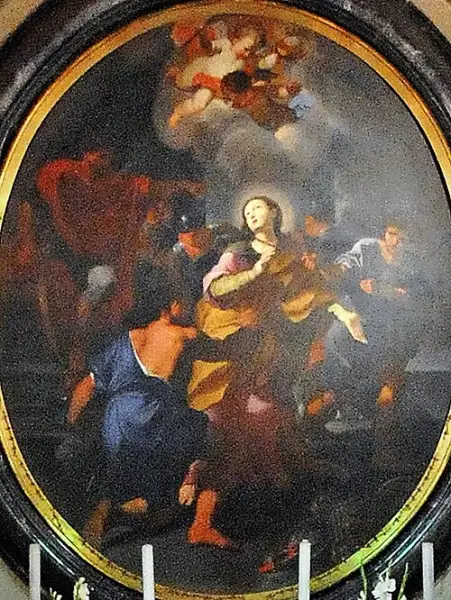
Overview
Aurea of Ostia — Aura in Latin, Chryse in Greek, both names meaning 'golden girl' — is the patron saint of Ostia, the ancient port of Rome, where she was martyred in the mid-third century, under either Claudius Gothicus or Trebonianus Gallus. Tradition describes her as of royal or noble blood; for her Christianity she was banished from Rome to Ostia, living there on an estate outside the walls, in contact with the local Christian community and its bishop, Cyriacus. The acts attach miracles to her: a Christian prisoner named Censorinus, comforted by her, had his chains fall loose, and seventeen soldiers converted by the miracle were beheaded near the arch of Caracalla; she and her companions were also credited with bringing a shoemaker's dead son back to life. Her judge, Ulpius Romulus, put her friends to death and had her tortured; her refusal to sacrifice to the Roman gods brought the sentence of drowning: she was cast into the sea with a stone fastened about her neck, the image in which art remembers her. She was buried on her estate, and the church of Santa Aurea grew around the tomb. A Christian inscription reading CHRYSE HIC DORMIT, 'Chryse sleeps here,' found near the church in 1981, may be her original funerary stone. The Orthodox venerate her as Chryse with her companions.
The Complete Life
An Exile at the Port of Rome
Aurea's story begins with the penalty that preceded the ultimate one: exile. A Christian of the mid-third century, said in the acts to be of royal or noble blood, she was banished from Rome to Ostia, the harbor city at the Tiber's mouth — a punishment that placed her in a community with a long Christian history and a bishop of its own, Cyriacus (or Quiriacus), with whom she kept contact from an estate outside the walls. The dating of her passion is uncertain between the reigns of Trebonianus Gallus and Claudius Gothicus, that is, between the early 250s and the early 270s; the calendars keep 24 August and 20 May, the latter as a local feast of Ostia.
Miracles at Ostia
The acts attach to Aurea the two classes of miracle the early church loved best: the freeing of prisoners and the raising of the dead. A Christian prisoner, Censorinus, whom she had comforted, was loosed of his chains — the oldest of Christian signs, Peter's deliverance retold — and the wonder converted seventeen soldiers, who were promptly beheaded near the arch of Caracalla; their names, seventeen of them from Felix to Theodorus, the acta preserves in full. Aurea and her friends, at another time, brought a shoemaker's dead son back to life. The historian reads such stories as literary inheritance — the prison-miracles of the apostolic age reapplied to every new persecution; the ancient reader read them as the credentials of the martyr: the woman who freed others would be asked to free herself by one word of sacrifice, and would refuse.
The Millstone
The judge in the case, Ulpius Romulus, executed Aurea's companions and had her tortured; she declined to pour libation to the Roman gods, whereupon the sentence came: she was cast into the sea with a stone fastened about her neck. The manner of death fixed her iconography — the martyr carried to the water with the millstone — and gave the acta its most quoted image. The body was recovered and buried on her own estate outside the walls of Ostia, and around the grave the church of Santa Aurea arose, rebuilt in the fifteenth century and still standing in the borgo of Ostia Antica, the center of her cult to this day.
Cult and Inscription
Aurea's cult is ancient and local in the best sense: centered on her tomb-church at Ostia, patron of the city, kept in the Roman Martyrology on 24 August with a second feast locally on 20 May. Modern archaeology has given her cult a rare physical anchor: in 1981 a fragment of Christian inscription was found near Santa Aurea reading CHRYSE HIC DORMIT — 'Chryse sleeps here' — which, as scholars cautiously allow, may be her original funerary inscription, though it may also be a later addition to the tomb. A marble column of perhaps the fifth century found near the same church in 1950 carries the letters S.AVR. The Orthodox Church venerates her under her Greek name, Chryse, together with her seventeen companions.
Legacy
Aurea's legacy is Ostia's Christianity made visible. The church over her tomb has carried her name for the better part of two thousand years, through the decline of the port, the silting of the river, and the abandonment and rebirth of the town; the possibly-original inscription of the third century rests today in the castle of Ostia, a few hundred meters from the church. She belongs to the small class of early martyrs for whom the chain of cult, place, and stone is unbroken from the acta to the museum — the golden girl of the golden legend, sleeping where the inscriptions say she sleeps.
Timeline
- 1950
A marble column of perhaps the fifth century, inscribed S.AVR., was found near the church of Santa Aurea
§ Veneration
- 1981
A Christian inscription fragment reading CHRYSE HIC DORMIT was rediscovered near Santa Aurea and later moved to the castle of Ostia
§ Veneration
The Record
- Patron of
- Ostia
- Symbols
- Millstone around the neck·Palm of martyrdom
- Canonization
- Pre-congregation; patron of Ostia
Prayer
Profile text adapted from the Wikipedia article, licensed CC BY-SA 4.0.
Pray with this saint every day
Save St. Aurea of Ostia to your favorites, read the full profile, and get feast-day reminders in the Saints app.
Get the Saints AppFree on the App Store for iPhone and iPad