
died 666·Feast October 4 (Orthodox); October 5 (Catholic)
St. Aurea of Paris
Abbess of Saint-Martial, Paris
Overview
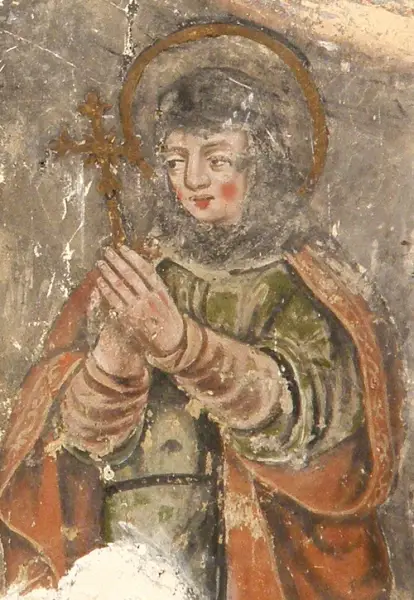
Aurea — Sainte Aure in French — was a Syrian immigrant who became abbess of a great nunnery in seventh-century Paris and died in 666 in an epidemic that carried off many of her community. Both Saint Ouen and Jonas of Bobbio mention her in their lives of Saints Eligius and Eustace, making her one of the few women of the Merovingian church known from contemporary narrative rather than from legend alone. Around 632, Eligius — with the generosity of King Dagobert behind him — founded at Paris a convent of three hundred virgins in honor of Saint Martial, and he named Aurea its first abbess; she was therefore a trusted disciple of the most influential churchman of the reign. The older accounts tell us that one hundred and sixty of her sisters perished alongside her in the plague of 666, in the reign of King Clovis II. Because her convent stood within the city, burial was not permitted there, and she was interred at Saint-Paul's; her bones were later raised to a rich shrine and translated to her monastery. Her relics are now held at the church of Saint-Eloi in Paris, where a mural shows her receiving the veil from Eligius. Legend credits her with raising a dead woman, multiplying loaves from an empty oven, and healing a blind woman with her severed arm.
The Complete Life
A Syrian in Paris
Aurea was an immigrant to Paris from Syria — a detail preserved, remarkably, by two independent near-contemporary writers: Saint Ouen (Audoin) of Rouen in his life of Eligius, and Jonas of Bobbio in his life of Eustace of Luxeuil. Syria in the seventh century was a country of ancient Christianity and, from the 630s onward, of war; whatever carried Aurea west — pilgrimage, flight, trade, or the network of Syrian merchants who served the Frankish courts — she arrived in the Paris of Dagobert I, the busiest and most cosmopolitan reign of the Merovingian era. The sources do not record her age or her family. What they record is the trust she earned: when a nunnery of three hundred virgins was founded in the city, the man chosen to organize it gave her its government. For a foreign-born woman to be set over three hundred Frankish religious, in the most politic church of the kingdom, is the strongest evidence of her character that survives.
Abbess of Saint-Martial
Around 632 Eligius — Eloi, the goldsmith-bishop whose career ran from Dagobert's mint to the see of Noyon — founded at Paris a convent of three hundred virgins in honor of Saint Martial — King Dagobert's own liberality paid for it — and named Aurea its abbess. A community of three hundred women was a major institution by any measure of the age, a factory of prayer in the capital. Governing it meant managing estates, educating daughters of the Frankish aristocracy, maintaining a liturgy, and holding a community together through the violent politics of the reign of Clovis II and the regency of Queen Balthild — the last of which, a former slave risen to queen, was itself a sign of how fluid Merovingian society had become. Aurea held the office for over thirty years, from the foundation until her death, an incumbency long enough to have made and unmade several generations of nuns.
The Plague of 666
Aurea's death came in the plague year 666, and the older accounts are blunt about the scale: one hundred and sixty of her sisters died alongside her. More than half the great community perished with its abbess, one of the demographic catastrophes that monastic necrologies preserve and chronicles pass over. Because her nunnery stood within the city, burial there was not permitted; she was interred at Saint-Paul's. Not long afterward her bones were raised up and placed in a costly shrine in that church, before being moved to her monastery; the final resting place of what remains is the church of Saint-Eloi in Paris, where a mural depicts her receiving the veil from Eligius, the founding scene of her Parisian life. The translation of her bones from Saint-Paul's to a rich shrine, and then to her own monastery, is recorded in the older notices as a public event of the city.
Legend, Calendar, and Relics
Around Aurea's historical core the devotional tradition gathered a set of marvels: that she restored a dead woman to life so that a key could be taken from her lifeless hands; that she swept red-hot ashes from an empty oven and well-baked loaves appeared; and that long after her death her cut-off arm, freshly bleeding, cured a blind woman at its touch. These are the standard currency of Merovingian hagiography, and they testify to a living cult rather than to biography. Her feast was 4 October everywhere before the Great Schism and remains so in the Orthodox Church; the Catholic celebration was transferred to 5 October when the calendar was rearranged around the feast of Francis of Assisi. She remains one of the few Merovingian abbesses of Paris whose name, dates, community, and relics can all still be named. Her survival in two near-contemporary lives, and in the physical shrine at Saint-Eloi, makes her one of the few Merovingian abbesses of Paris still securely placed.
Timeline
- 632
Around this year Eligius founds a nunnery of three hundred virgins at Paris with King Dagobert's generosity and appoints Aurea abbess
§ Narrative
- 666
A plague kills her along with one hundred and sixty of her nuns
§ Narrative
- 666
Buried at St Paul's because her nunnery stood within the city; her bones are later translated to her monastery
§ Veneration
- 1054
Kept on 4 October throughout the undivided church, her feast remains on that date among Eastern Christians
§ Introduction
The Record
- Patron of
- Paris, France·Religious sisters
- Symbols
- Abbess's crozier·Syrian pilgrim's staff
- Canonization
- Pre-congregation (ancient cult; relics kept at the church of Saint-Eloi, Paris)
Prayer
Profile text adapted from the Wikipedia article, licensed CC BY-SA 4.0.
Pray with this saint every day
Save St. Aurea of Paris to your favorites, read the full profile, and get feast-day reminders in the Saints app.
Get the Saints AppFree on the App Store for iPhone and iPad